
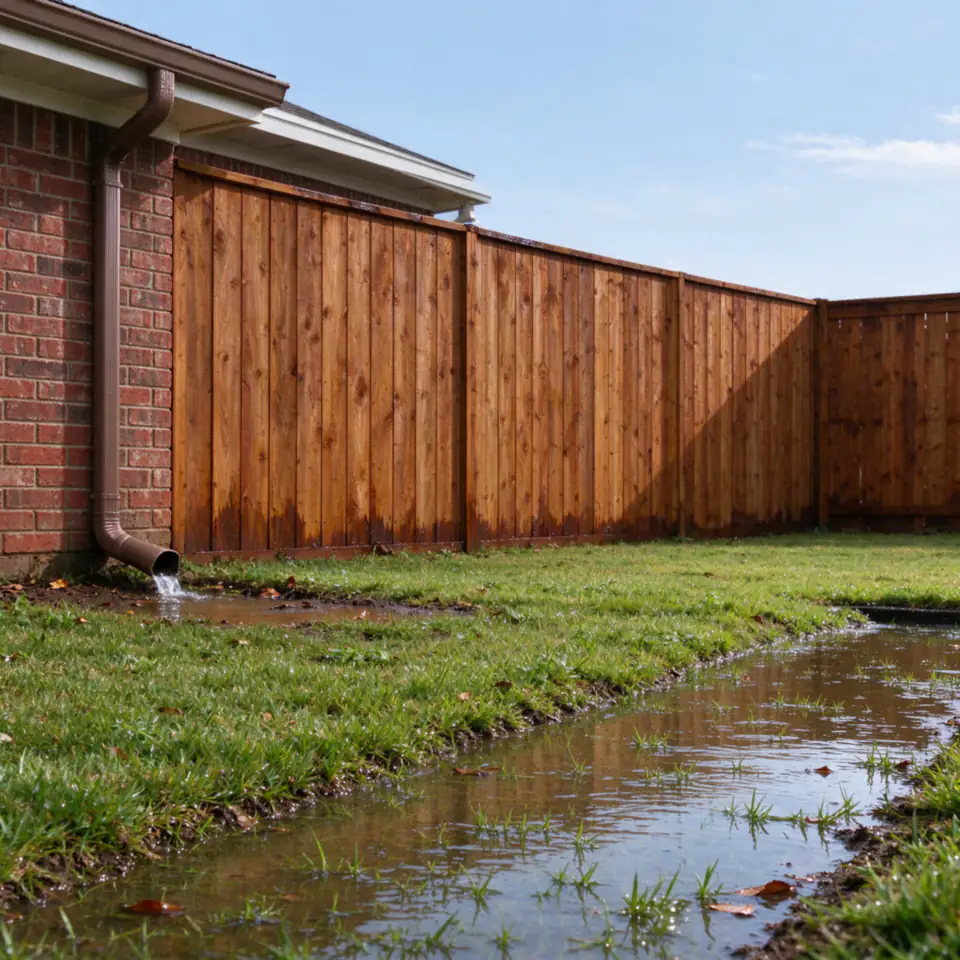
Start with the water, not the drain
Most yard drainage problems are water from one place ending up in another: roof water at the slab, a neighbor’s runoff in your side yard, sprinkler water in a low corner. A drain fixes the problem only when it matches where that water starts.
This guide follows the order Clay Plano Drainage Company uses on every site visit in Plano: find the source, give the water a route, confirm where it is allowed to leave, then pick the collector. Each step rules out fixes that look right and won’t work.
Step 1: Find where the water comes from
The quickest way to find the source is to watch it happen. Put on a rain jacket during a steady storm and follow the water: where it arrives, which way it travels, and the spot where it finally pools.
| What you see | What it usually points to |
|---|---|
| Water gushing at one corner of the house | A downspout dumping at the slab |
| A sheet of water crossing the lawn during the storm | Runoff from the roof, the paving or a higher lot |
| A puddle that returns to one spot after each rain | A dip in the grade with no way out |
| Soil that stays soft for days after the surface dries | Water held in the clay, or seeping downhill through it |
| A soggy patch in a dry week | A sprinkler zone running long, or a leak |
| Water arriving from next door | The neighbor’s slope, downspouts or sprinklers |
Many yards have two or three sources at once. A phone video taken while it rains shows the pattern better than any description. The drainage assessment asks the same questions and sorts your answers into a planning class.
When it’s wet and hasn’t rained
Ground that is wet in a dry spell usually points to irrigation, not drainage. Look at the controller’s run times first, then turn on one zone at a time and look for a broken head or a patch that turns to mud. The guide on a soggy yard without rain walks through it.
Why Plano yards hold water
Plano’s soil is the reason a short storm can leave water for days. Houston Black, the soil mapped across most of the city, is about 54% clay and lets water in very slowly.
Two soil measures explain most of what you see in a wet yard:
- Permeability is how easily water moves through the soil. In Houston Black it is about 0.21 micrometers a second, which works out to roughly three hundredths of an inch per hour.
- Infiltration rate is how fast rain can soak in from the surface. Once the top layer is wet, it falls to about that same slow pace.
Rain arrives far faster than clay can take it
NOAA’s rainfall atlas puts a storm with a 50% chance in any year at 1.80 inches in one hour in central Plano. The clay can take in about 0.03 inches in that hour, which leaves roughly sixty times more water than the soil can absorb. The rest runs off or sits.
| Storm in central Plano | Rain in one hour | Rain in 24 hours |
|---|---|---|
| 50% chance in any year | 1.80 in | 4.07 in |
| 10% chance in any year | 2.52 in | 6.04 in |
| 1% chance in any year | 3.61 in | 9.47 in |
Soil scientists put Houston Black in hydrologic group D, the slowest-draining class. Plano’s normal rainfall is about 41 inches a year, and May and October are the two wettest months, so spring and fall storms are when problems show.
Swelling clay and wet slabs
Houston Black also swells when it soaks up water and contracts as it dries out. A slab sitting on wet clay along one edge and dry clay along another can move unevenly, which is why roof water at the foundation matters more here. The guide to foundation moisture in clay soil covers that link.
Water that sits just below the surface
After a big storm, water can sit in the top of the clay for days without any high water table beneath it. The ground feels spongy and stays dark. That held water is what a French drain is built to collect, and the guide to French drains in clay soil explains how it is designed for slow ground.
Far west Plano is different
Around the Dallas Parkway and Arbor Hills, Eddy gravelly clay loam takes in water at about 1 inch an hour, more than thirty times faster than Houston Black. It is thin, though, and chalk sits shallow beneath it, so water still stops at the rock.
Compacted soil, such as ground packed down by construction traffic, slows infiltration anywhere in town.
Step 2: Give the water a route
Once you know the source, the next question is how the water gets from there to an outlet. It can travel over the surface in a shaped channel, or underground in pipe.
Surface routes: grade and swales
Positive drainage means the ground falls away from the house and toward a place the water can leave. Most Plano soils are mapped on 0 to 3 percent slopes, so small differences in height steer the water.
- Grade at the house. McKinney’s design manual asks for the finished grade to drop 6 inches within 10 feet of a building, a useful target around any slab.
- Side swales. Plano’s lot drainage figure shows a swale at least 0.25 feet deep across 3 feet on each side of the side property line.
- Fall along the yard. The same figure calls for at least a 1% slope along side and back yards.
Raised beds, fence footings, equipment pads and patio extensions can all dam a swale, and water backs up behind whatever is in the way. Yard regrading and side-yard drainage restore those routes.
Underground routes: solid and perforated pipe
Pipe carries water where a surface route can’t, such as under a walk or along a narrow side yard. Solid pipe moves water from downspouts and basins without letting it seep out along the way. Perforated pipe belongs only where you want to collect water from the ground, inside a French drain.
Every underground line needs steady fall from start to finish. A line with a sag holds water and silt, and a bigger pipe doesn’t fix a missing outlet or a reversed grade.
Step 3: Confirm where the water can leave
The outlet decides the design, and it comes before the trench. A drain that collects water perfectly but has nowhere to send it just fills up.
In Plano, the rules point one way. The city’s Stormwater Design Manual sends residential lots to the street, does not permit lot-to-lot drainage, and bars diverting or holding back natural flow so that it harms a neighboring or downstream property. Texas Water Code section 11.086 sets the same limit statewide.
- No fall to the street? A pump basin lifts the water when gravity can’t; see yard sump drainage.
- Thinking of a dry well? In group D clay, a pit meant to soak water into the ground fills and stays full; the guide on dry wells in clay explains why.
- Water from next door? The guide to neighbor runoff in Texas covers what each owner can and can’t do.
The full set of outlet options is in the guide to where yard drain water can go, and Plano’s drainage rules are summarized for homeowners in their own guide.
Is it the creek, not your yard?
A creek over its banks is not the same problem as storm water trapped on your lot. Homes near Rowlett Creek and the Oak Point corridor can border a floodplain, and no yard drain can hold back a flooding creek. The guide to floodplain or drainage problems helps you tell them apart.
Step 4: Match the fix to the problem
With the source, the route and the outlet known, the fix usually picks itself. This table pairs the common problems with the work that solves them.
| The problem | The usual cause | The usual fix |
|---|---|---|
| Water at the slab after every storm | Downspouts dumping at the house, or grade tilting back toward it | Downspout lines in solid pipe, then regrading |
| A puddle in the same low spot | A dip with no fall to an outlet | A catch basin, or regrading if the dip is wide and shallow |
| Lawn soggy for days after rain | Water held in the clay, or seeping downhill | A French drain, or a curtain drain across the slope |
| Water standing between houses | A blocked or flattened side swale | Side-yard drainage: swale restored, or a line past the obstruction |
| Water across the driveway or patio | Paving shedding toward the garage or a door | A channel drain set into the paving |
| An old drain that quit | A clogged outlet, a crushed or sagging section, or clay in the stone | Drain repair and cleaning |
| Water arriving from several directions | Several sources meeting in one low corner | A whole-yard system on one solid line |
| Standing water with no clear cause | Any of the above, or a sprinkler leak | A diagnosis first; see standing water in the yard |
| Wet soil along the foundation | Roof water, grade and wet beds at the slab | Foundation drainage, separate from structural repair |
HOA common areas, retail lots and offices follow the same logic at a larger scale, with plans and permits up front; see commercial drainage.
When a French drain is the wrong answer
French drains gather groundwater held in the soil. Sheet flow over the lawn arrives too fast for a stone trench to swallow, so a low spot that fills mid-storm calls for a basin or regrading, and roof water poured into the stone fills it before soil water can get in.
The guide to French drains or catch basins compares the two, and channel drains or French drains covers paving.
What you can check yourself
Some of the first steps need no tools beyond a rain jacket. They also make a site visit more useful.
- Clear leaves and grit from grates, downspout outlets and pop-up emitters.
- Add splash extensions so roof water lands well away from the slab while you plan a buried line.
- Shorten sprinkler run times on zones that stay soggy, and watch for heads that bubble.
- Rake mulch and soil in beds so they slope away from the house, not toward it.
- Pull up your lot’s recorded plat (the Collin Central Appraisal District links to it) and look for drainage or floodplain easements.
- Before digging any trench, call Texas811 so buried lines get marked.
Is it the sprinklers? Plano’s watering schedule
Too much sprinkler water on clay leaves puddles that look like a drainage problem. Before you plan a drain, set the controller to Plano’s schedule and see whether the wet spot dries up.
| Season | How often | Days, by the last digit of your address |
|---|---|---|
| April 1 to October 31 | Up to twice a week | Even: Monday and Thursday. Odd: Tuesday and Friday |
| November 1 to March 31 | Up to once a week | Even: Thursday. Odd: Tuesday |
- Hours. From April through October, sprinklers can’t run between 10 am and 6 pm. In winter the city asks for those warmer hours instead, so spray doesn’t ice the street.
- Runoff. Plano prohibits watering during rain and excessive runoff from the lawn.
- Hand watering. In the spring and summer rules, a hand-held or soaker hose may water foundations and beds for up to 2 hours on any day, and low-flow drip may run as needed.
Sprinkler zones near the slab
Spray heads that wet the foundation put water right where drainage work tries to keep it off. Plano’s water conservation page suggests soaker hose or drip 6 to 18 inches from the slab, watering 8 to 10 inches deep, and a cycle-and-soak setting so the clay takes in what lands.
NTMWD sponsors WaterMyYard, run with Texas A&M AgriLife Extension, which sends free weekly run times for your area. If a patch stays wet with the schedule set right, see a soggy yard without rain or standing water in the yard.
Urgent, or can it wait for a plan?
Not every wet yard is an emergency. Sort what you see into one of two lists.
Get it looked at soon:
- Water reaching the slab edge, a door or the garage after every storm
- Runoff cutting a gully, or washing out soil under a walk or fence
- An outlet that backs water up into the yard
- A hole or sunken line opening over a buried drain
Fine to plan around:
- A lawn that is soggy for a day or two and then dries
- A puddle in open lawn well away from the house
- A wet patch that dries when the sprinklers are off
Wall cracks, sticking doors and floors that slope may mean a structural issue. That calls for a foundation engineer or repair firm to look at the structure; drainage work deals with the water around it.
Before a patio, turf or new fence
New paving sheds water fast and in new directions, so plan drainage before the patio, turf or fence goes in, not after. Pipe laid before a new surface goes down is far simpler than pipe dug in under it later.
- Patios and flatwork. Decide where the water from the new surface will go, and give it a route to the street side of the lot.
- Artificial turf. Water moves through the turf into the base and then into slow clay; plan the low edge and an outlet before the base goes down.
- Fences. Leave clearance under any fence that crosses a side swale, so water can flow beneath the pickets.
- Easements. Plano tells owners to check the plat before adding landscaping, fences, walls or decks, since the city can cite and remove improvements built inside a drainage or floodplain easement.
Plano’s stormwater staff answer easement questions at Stormwater@Plano.gov, and the guide to drainage easements shows how to read them.
Buying a house? What to look for
A dry day hides most drainage problems, so look for the marks water leaves behind. A showing in the rain, or the morning after, tells you more than any listing.
- Fence pickets stained or rotting at the base, and mulch carried out of beds
- Downspouts that end at the slab, or buried lines with no visible outlet
- Pop-up emitters or grates in the lawn, and where they let out
- Soil or beds that slope toward the house
- A side yard where the swale has been filled by beds, slabs or an AC pad
- Easements on the plat that limit what you can build
Ask the sellers what drains are buried on the lot, where each one empties and when it was last flushed. If a drain is in the ground, run a hose into it and see whether water reaches the outlet.
Keeping a fix working
Drains last when what flows into them stays clean. Clear grates after storms and in the fall, keep outlets free of clippings and mulch, and flush lines through their cleanouts when water slows.
Upkeep includes the far end. The City of Plano asks residents to keep the ditches on their lots free of debris and vegetation, and it is illegal to dump anything into a ditch or channel. The guide on how long a French drain lasts covers what wears drains out in clay.
Hiring someone? What to ask before you sign
Ask questions that show how the water will be handled, not only what it costs. A sound plan names the source, the route, the outlet and who handles permits, locates and the yard repairs afterward.
- Where does the water leave? Expect a specific outlet, such as the curb or a front-yard emitter.
- Who pulls the permit? Plano’s Building Inspections tips say to see the permit before work starts and to be wary when asked to pull it yourself, since the permit holder answers for the work.
- Who calls Texas811? Buried lines get marked before the first trench is cut.
- Who fixes the sprinklers and sod? Ask who moves or repairs heads in the trench path, and which state license they hold.
- How is payment split? The same tips advise against paying for the whole job up front; a small deposit for materials can be fair.
What a written estimate lists
| Item | What it should say |
|---|---|
| Route | Where each line runs, its length, and solid or perforated pipe |
| Collectors | Each basin, emitter, channel drain and downspout connection |
| Outlet | Where the water leaves the lot and how it reaches the street |
| Permits and locates | Who applies, and Texas811 marks before digging |
| Yard repairs | Sod, beds and sprinkler lines put back, and by whom |
| Testing | Cleanouts, and water run through the line before backfill |
Plano’s tips also suggest at least three bids; side by side, they show which plans skip the outlet or the yard repairs. Our written estimate lists each item, and we arrange the permit as part of the job; what happens during installation follows the work.
Who needs a license for drainage work in Texas?
The Texas Department of Licensing and Regulation, which licenses trades from electricians to water well drillers, doesn’t list a drainage license. The trades a drain job can touch do need state licenses, so ask who does each part and check the numbers.
| Part of the job | Who licenses or registers it | Where to check |
|---|---|---|
| Moving or repairing sprinkler heads and lines | TCEQ: landscape irrigators, and irrigation technicians working under one | TCEQ’s license search |
| Any tie-in to the house’s water supply or sewer pipes | Texas State Board of Plumbing Examiners | The board’s public license search |
| Wiring for a yard pump basin | TDLR: electricians | TDLR’s license search |
| A curb tie-in or other work in the street right-of-way | City of Plano Engineering: yearly registration with insurance, plus an engineering permit | Plano Engineering |
TCEQ’s rule under 30 TAC Chapter 344 is broad: no one may sell, design, install, maintain, alter, repair or service an irrigation system without its license, apart from the exemptions in 30 TAC 30.129. A trench across sprinkler lines brings that rule into a drain job.
Plano also lists irrigation systems, plumbing and electrical work among the projects that need a city permit. Plano’s drainage rules cover what the city asks of the drain itself.
Will insurance or a rebate help pay?
Rarely for the drain itself. The Texas Department of Insurance says home insurance doesn’t cover flood damage; that takes a separate flood policy, and most flood policies wait 30 days before coverage starts.
- What counts as a flood. FEMA’s flood insurance definition covers a general, temporary flooding of 2 or more acres or 2 or more properties, including rapid runoff of surface water. A puddle on one lot usually isn’t that.
- Where floods hit. TDI places Flash Flood Alley through Central and North Texas, and says floods can happen outside mapped flood zones. If a creek is the issue, see floodplain or drainage problem.
- Before a storm. Ask your agent how your own policy treats water damage, and whether a flood policy makes sense for your address.
Rebates in Plano
The City of Plano’s water conservation rebates include a rain and freeze sensor on a sprinkler system: $50, and $25 more when an irrigation professional with a state license installs it. You need a Plano water account, a Plano retailer and an application within 120 days of purchase.
The city’s rebate list doesn’t include drainage work, and NTMWD’s conservation page lists no rebate, only its free WaterMyYard advice. Plano Water Resources can confirm what’s current. Our drainage cost guide covers what the work itself runs.
What it costs and what happens next
Our typical ranges: $25 to $60 per foot for a French drain, $500 to $1,500 for a catch basin, $300 to $800 per downspout line and $3,000 to $8,000 and up for a whole-yard system. The site visit and written estimate set yours.
- The drainage cost guide lists every range and what moves it.
- The cost estimator applies them to your own run lengths.
- The guide to what happens during drainage installation follows the work from Texas811 locates to the final walk-through.
When you’re ready to have someone look at the yard, call (469) 551-8518 or send photos through the form below. We walk it with you, measure the fall, find the outlet and put the plan in a written estimate.