
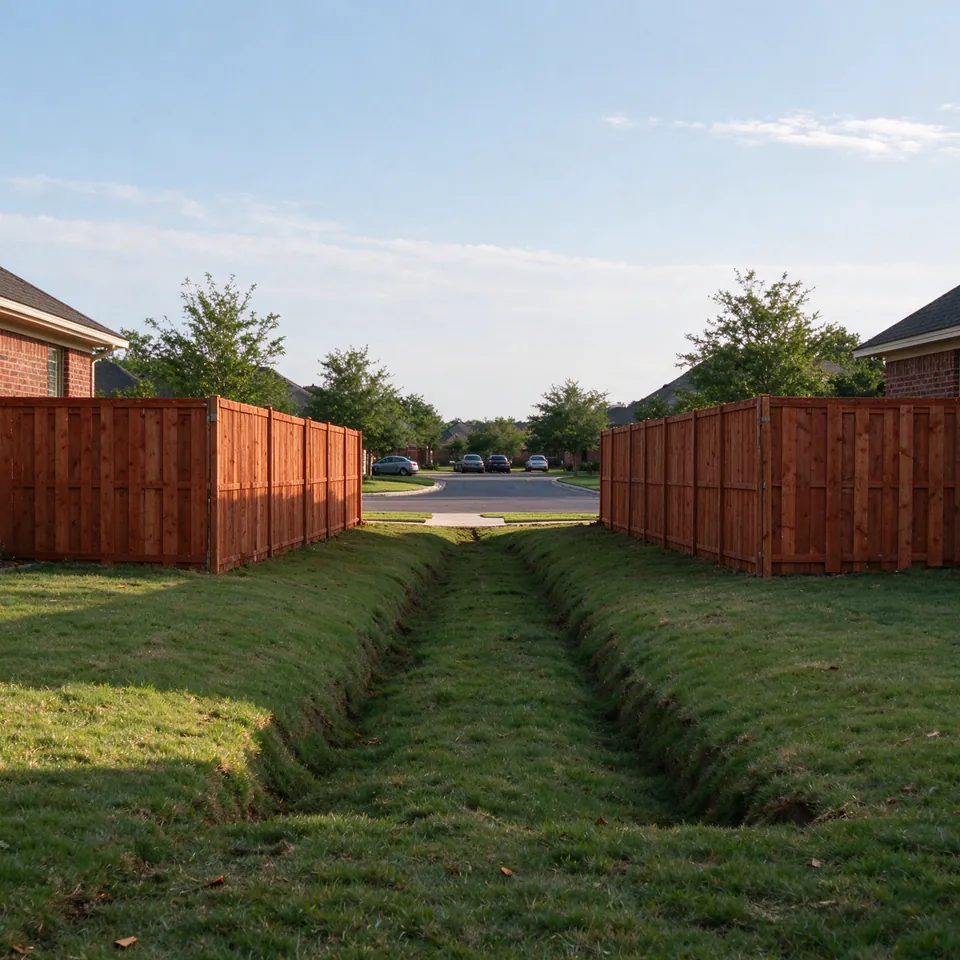
Planning a fence, patio or shed near the property line?
Check the easement first: drainage easement rules in Plano limit what can sit on it. That strip along a side or back line is often where water from several lots leaves, and building there can trap it in your yard or next door.
Clay Plano Drainage Company reshapes and pipes side yards across Plano, and the easement is the first thing we look at on the plat. This guide shows how to read it, what tends to block one, and what you can still do with the space.
What a drainage easement is
An easement is a right that someone else holds over part of your land. A drainage easement reserves a strip for storm water, so it can keep flowing across or along your lot.
You still own the ground and look after it. What changes is what you can put on it:
- Water has to get through. The swale, ditch or pipe in the easement must stay open.
- Your neighbors depend on it. Water from the lots above yours may use the same strip on its way to the street.
- Maintenance stays with you. Plano’s residential lot drainage figure treats house drainage easements as privately maintained.
A floodplain easement is a separate thing: it marks land that a creek can cover in a big flood. The guide to floodplain or drainage problems explains that difference.
How to find it on your plat
The recorded plat for your subdivision shows every easement on your lot. You can reach it through the Collin Central Appraisal District’s property record for your address.
When you have it open, look for these details:
- Dashed lines inside your lot lines, usually along a side or rear line.
- A label naming the easement: drainage, utility, floodplain, or a combined one.
- A width, written in feet, which tells you how far into the yard it reaches.
- Notes on the plat sheet about what the easement allows or forbids.
A survey from your closing papers often shows the same lines drawn against your house and fence. If the plat and the yard don’t seem to match, Plano’s stormwater staff answer easement questions at Stormwater@Plano.gov.
What tends to block an easement
The trouble is rarely one big structure. It’s usually a series of small additions that each take a little room from the water.
| Addition | What it does to the flow |
|---|---|
| Fence with pickets to the ground | Acts as a dam once leaves and grass clippings collect along it |
| Patio slab or walk | Raises the low line or fills part of the swale |
| AC pad, pool pump or generator | Sits in the low line and pushes water around it, toward the house |
| Raised bed or border | Turns a shallow swale into a pond behind it |
| Shed, playset base or deck | Covers the route and makes later repair hard to reach |
| Fill or new topsoil | Lifts the swale bottom until it no longer falls toward the street |
| Artificial turf base | Changes the grade and how fast water leaves the surface |
Plano tells owners to check the plat before adding landscaping, fences, walls or decks, because the city can cite and remove improvements inside a drainage or floodplain easement. A removal costs far more than planning the route first.
What the side swale is meant to look like
Plano’s lot drainage figure shows a side swale at least 0.25 feet deep, about 3 inches, spread across 3 feet on each side of the property line, with at least a 1% fall. Anything that fills those 6 feet of width or flattens that fall works against the design.
How nearby cities set the limits
Each city writes its own easement rules, and some spell them out in detail. These are the ones on record for cities near Plano.
| City | What its rules say |
|---|---|
| Allen | A concrete slab may extend no more than 1 foot into the side swale; a screening fence can be cantilevered over the drainage easement but not past the slab footprint |
| Garland | Fences in a floodplain or drainage easement need Engineering approval |
| Frisco | Any work in city right-of-way or easements needs a permit from a registered firm; some subdivisions also require HOA approval |
| Murphy | A separate right-of-way and easement permit covers digging in drainage and utility easements, issued only after line locates |
| Rowlett | Pool equipment cannot be installed in drainage swales or designated drainage flows |
| Heath | Owners must keep drainage easements clear; they are private land reserved for storm water |
In McKinney, the engineering manual adds that a drainage or floodplain easement does not change who owns or maintains the land. If your house is elsewhere, we confirm the rule for the address before the plan is drawn.
Fixing a swale that no longer drains
A blocked easement shows itself after rain: water standing between houses, mud along the fence, a damp strip at the slab on the low side. The fix starts by finding what took the space.
- Reshape the swale when fill, sod buildup or settling has flattened it. Yard regrading restores the low line and its fall.
- Pipe past an obstruction when a slab or pad can’t move. A drain line with an inlet on each side carries water under or around it; see side-yard drainage.
- Open the fence line by trimming pickets, adding a gap at grade or clearing debris that has built up against it.
Our typical range for one side yard is $1,500 to $4,000 per side yard; the site visit and written estimate set yours. Any work that reaches the public right-of-way at the street goes through the city’s permit, which we arrange as part of the job.
Ask first, or fine to plan?
Some plans call for a question to the city before you start; others just need a little care.
Ask the city first:
- A fence, wall, deck or shed inside the easement lines on the plat
- A slab, pad or patio extension reaching into the side swale
- Any fill that raises the strip, even a few inches
- Work in a floodplain easement of any kind
Fine to plan with care:
- Lawn, low groundcover or sod that keeps the existing grade
- A fence set outside the easement line, with open space at the bottom
- Clearing leaves, mulch and debris out of the swale
When the water comes from the lot next door
An easement often carries a neighbor’s water as well as yours. That’s the design working, not a neighbor redirecting water onto your lot.
- Neighbor runoff in Texas covers what each owner can and can’t do about water crossing the line.
- Plano’s drainage rules explain the lot grading the easement belongs to.
If you’re planning a project near the line, or a swale has stopped working, call (469) 551-8518 or send the plat and a few photos through the form below. We’ll walk the strip with you and show you where the water needs to pass.