
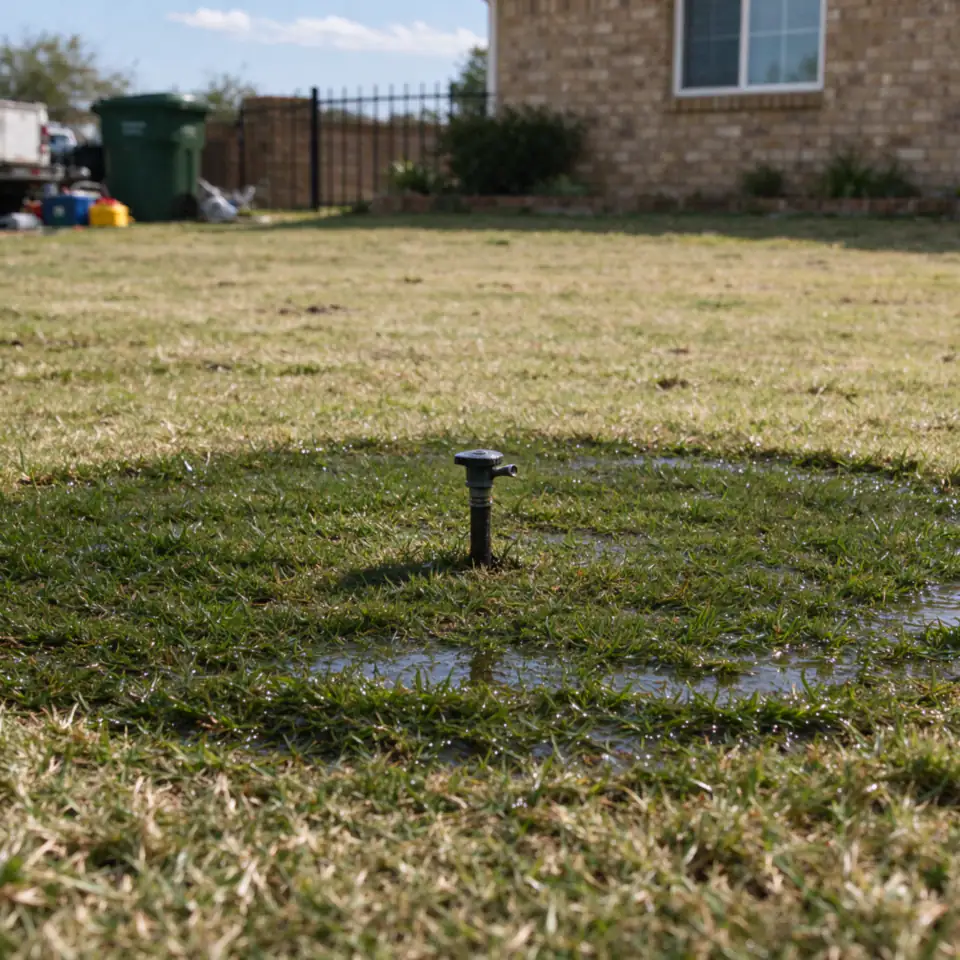
Soggy grass in a dry week?
When the rest of the lawn is dry and one patch squelches underfoot, something is feeding it water. The good news is that the source can often be found in an afternoon, with nothing more than a controller, a meter and your eyes.
Clay Plano Drainage Company diagnoses standing water in yards across Plano. This guide is the checklist to run before anyone digs, and it tells you when the answer really is drainage.
First, how long since it rained?
Clay holds water longer than you’d think. Houston Black, the soil under most of Plano, gives up water at roughly three quarters of an inch a day once soaked, so a low spot can stay soft for several days after a big storm.
If it rained hard in the last few days, the patch may just be slow to dry. If it’s been a dry week or more, keep going down this list.
Check the sprinklers today
Irrigation is the first suspect, and you can test it without tools.
- Read the controller. Check each zone’s run time and how many days it runs. Look for a second program or extra start times left over from a past season.
- Compare it with the city’s watering schedule. Plano publishes one; set the controller to it.
- Run each zone alone for a few minutes and walk it.
- Watch for trouble: a head that bubbles instead of sprays, one that won’t pop up, water pooling around a head, or a spray hitting the same spot as the next zone.
- Check the valve box after the zones stop. Water still running or standing there points to a valve that doesn’t close.
If the patch sits downhill of a zone, the leak may be uphill of the wet spot. Water travels along the clay surface before it shows.
The meter test for hidden leaks
A leak you can’t see shows on the water meter. This test takes about fifteen minutes.
- Turn everything off in the house: taps, the washer, the dishwasher, the ice maker and the sprinklers.
- Find the meter, usually in a box near the street, and lift the lid.
- Watch the leak indicator, a small dial or triangle on the meter face. If it turns, water is going somewhere.
- Close the irrigation supply valve and watch again. If it stops, the leak is on the sprinkler side; if it keeps turning, it’s on the house side or the service line.
A water bill that jumps with no change in how you use water is the same signal, a month later.
Other sources to rule out
When the sprinklers check out, a few other sources can wet a patch of lawn in dry weather.
| Source | Clues | Who fixes it |
|---|---|---|
| Water service line leak | Wet ground along the route from the meter to the house; the meter test fails with irrigation off | A plumber for the house side; your water provider if it’s at or before the meter |
| Pool or spa | Wet ground near the pool or its equipment; the water level drops faster than usual | A pool service |
| AC condensate | A wet spot under the drip line, worst in summer | A short solid line to an emitter; see dry wells in clay |
| A neighbor’s sprinklers | Water arrives on their schedule, from their side | A word with the neighbor; see neighbor runoff in Texas |
| A downspout line that holds water | A soggy line across the lawn days after rain | Flushing or a repair; see drain repair |
Get help now, or watch it?
Some wet patches need a call the same day. Others can wait while you run the checks.
Call now:
- Water bubbling up from the ground near the meter, the street or a sidewalk: call your water provider
- A hole, sinkhole or sunken spot opening in the wet area
- Water reaching the slab, a door or the garage in dry weather
- A wet area spreading by the day
Fine to check first:
- A soft patch around one sprinkler head
- Wet ground that dries when the irrigation is off for a few days
- A low spot still drying a few days after a big storm
Wet ground after regrading or new work
A strip that turns soggy right after regrading, or after a patio or fence went in, points to the work itself. A sprinkler line can be nicked during grading, and new paving can send water to a spot that never got it before.
Start with the same checks: zones, meter, then the new surface’s slope. If none explains it, the grade may be holding water at that spot, and yard regrading puts the fall back.
When it really is drainage
If the patch stays wet with every source off for several dry days, the water is coming through the ground. On a sloped lot, that can be water seeping from higher ground; on a flat one, water held in the clay with no way out.
That’s where we come in. On the first visit we probe the soil and look at the grade and any buried lines.
- French drains in clay soil explains how soil water is collected.
- Fixing yard drainage problems sorts the other sources of water in a yard.
If the ground near a creek or channel is the one getting wet, the guide to floodplain or drainage problems helps tell them apart. To have someone look at the patch, call (469) 551-8518 or send photos through the form below.