
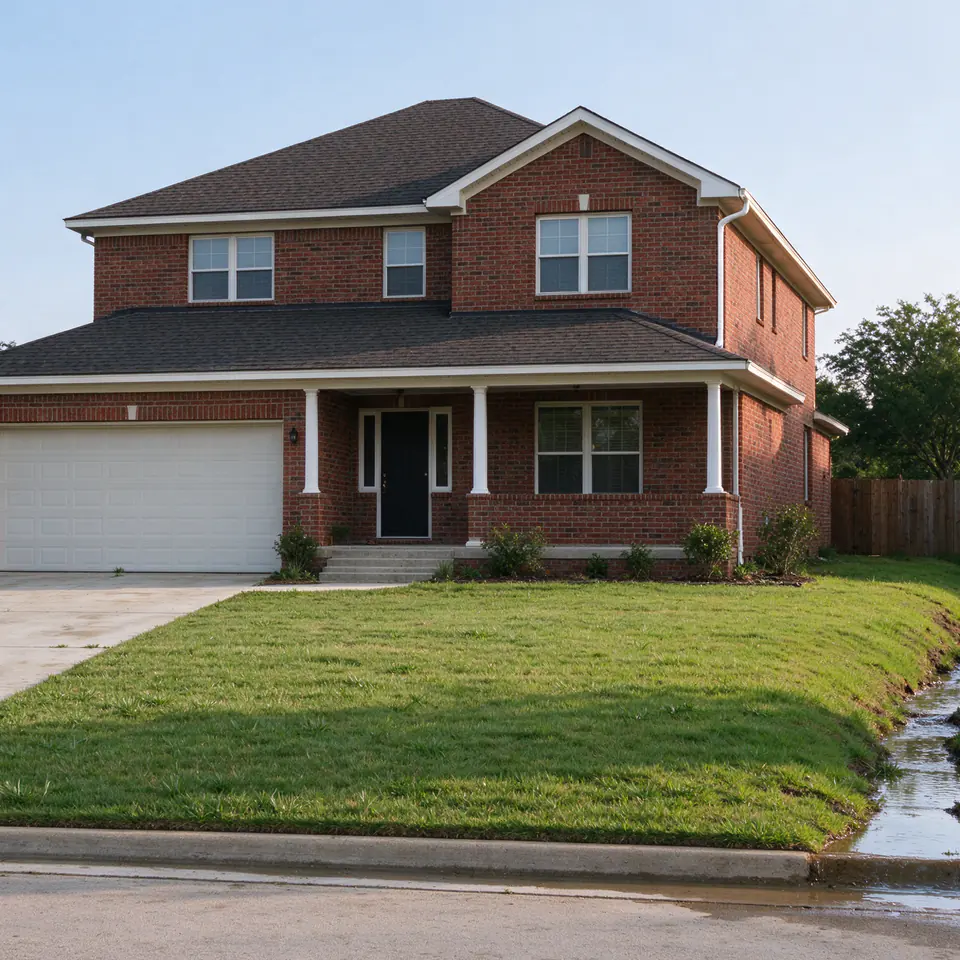
Planning drainage work and wondering what the city allows?
Plano’s Stormwater Design Manual, the current edition dating from 2024, sets the rules for how land in the city drains. Most of it covers streets, channels and new subdivisions, but a few rules decide what you can do in your own yard.
Clay Plano Drainage Company plans yard and side-yard drainage around those rules on every Plano job. This guide pulls out the parts that matter to a homeowner and explains each with its numbers.
Rule 1: House lots drain to the street
The manual’s site grading section says residential lots generally drain to the street. It sorts house lots into grading types, labeled A, B and C, by how water crosses them on the way out.
In practice, that sets the outlet for almost every yard drain in Plano:
- The front lawn, through a pop-up emitter that lets water out onto open grass toward the curb.
- An existing line that already reaches the street, once we prove it still flows.
- The curb itself, with the city permit described below.
The guide to where yard drain water can go compares those outlets side by side.
Rule 2: No lot-to-lot drainage
Lot-to-lot drainage is not permitted. Water from your lot shouldn’t be sent across a neighbor’s lot to get to the street, and theirs shouldn’t cross yours.
The manual’s lot drainage figure allows an exception only where an engineer has approved it. The same section says natural flow must not be diverted or impounded in a way that damages adjacent or downstream property, the city version of a rule Texas law applies statewide.
What it means for your project
The rule shapes ordinary projects, not just new subdivisions:
- A downspout line can’t end at the shared fence.
- A new patio’s runoff needs its own route to the street.
- A berm or raised bed that dams water on the line works against the rule.
Rule 3: Side swales need depth and fall
Figure 1 of the manual draws the side swale between houses. It shows a swale at least 0.25 feet deep, about 3 inches, spread across 3 feet on each side of the property line, so about 6 feet wide in all.
The same figure asks for at least a 1% slope along side and back yards. Here is what that fall means on real lots:
| Length of the run | Least fall at 1% |
|---|---|
| 40-foot side yard | About 5 inches |
| 60-foot side yard | About 7 inches |
| 100-foot back yard run | 12 inches |
Most Plano soils are mapped on 0 to 3% slopes, so there isn’t much natural fall to spare. A few inches of fill, a slab edge or a bed can flatten a side swale below that 1%. Yard regrading restores it.
Rule 4: Owners maintain their lot drainage
The lot drainage figure marks house drainage easements as privately maintained. The city’s drainage maintenance guidance adds two more points:
- Keep it clear. Residents should keep drainage ditches on their property free of debris and vegetation.
- Don’t dump in it. Dumping debris into ditches or channels is illegal, and Plano Public Works takes reports.
Easements on your plat also limit what you can build, from fences to sheds. That’s a topic of its own in the guide to drainage easements in Plano.
Rule 5: Right-of-way work needs a permit
The parkway between the sidewalk and the street, and the curb itself, are public right-of-way. Any drainage work there goes through Plano’s Engineering Permit for public infrastructure.
- Permit types include excavation and grading, storm drain, and paving or drive approaches.
- Registration. Firms working in the right-of-way register with the city each year and show proof of insurance under the right-of-way ordinance, Section 19-68.
- On site. The approved permit stays at the worksite while the work happens.
- Where it goes. Applications go to the city’s engineering permits office at EngPermits@plano.gov.
We arrange that permit as part of the job when a route reaches the curb. The details of a curb connection are confirmed for each address with the city before the route is final.
Before and during the dig
Two more city requirements touch every drainage job, even one that never leaves the lot.
- Locates first. Plano’s outdoor improvements guidance tells residents to call before they dig, through Texas811.
- Keep soil out of the storm system. Plano runs its storm sewers under a state permit with controls for construction runoff, so silt controls protect street inlets while trenches are open.
The guide to what happens during drainage installation shows how both fit into the work.
HOA approval is a separate step
A city permit and HOA approval answer different questions. The city cares about the right-of-way and how water leaves; an HOA may care about what the work looks like and where it sits.
Some subdivisions require HOA approval for exterior work, and their guidelines say so. Check yours before work starts. Our written estimate gives you the route, the outlet and the restoration to describe in the request.
Plano compared with nearby cities
The rules around Plano point the same way, with different numbers. If you’re just over the line, these are worth knowing.
| City | A detail its rules add |
|---|---|
| McKinney | Grade falls at least 6 inches in the first 10 feet from a building; earthen swales 2% minimum |
| Garland | House pad at least 12 inches above the lowest primary drainage point; unpaved swales 1% minimum |
| Allen | A slab may reach no more than 1 foot into the side swale |
| Prosper | One curb core per lot, no more than 3 inches across, with a right-of-way permit |
If you’re planning work and want the rules applied to your lot, call (469) 551-8518 or send photos through the form below. We’ll measure the fall, find the outlet and show you how the plan fits the manual.