
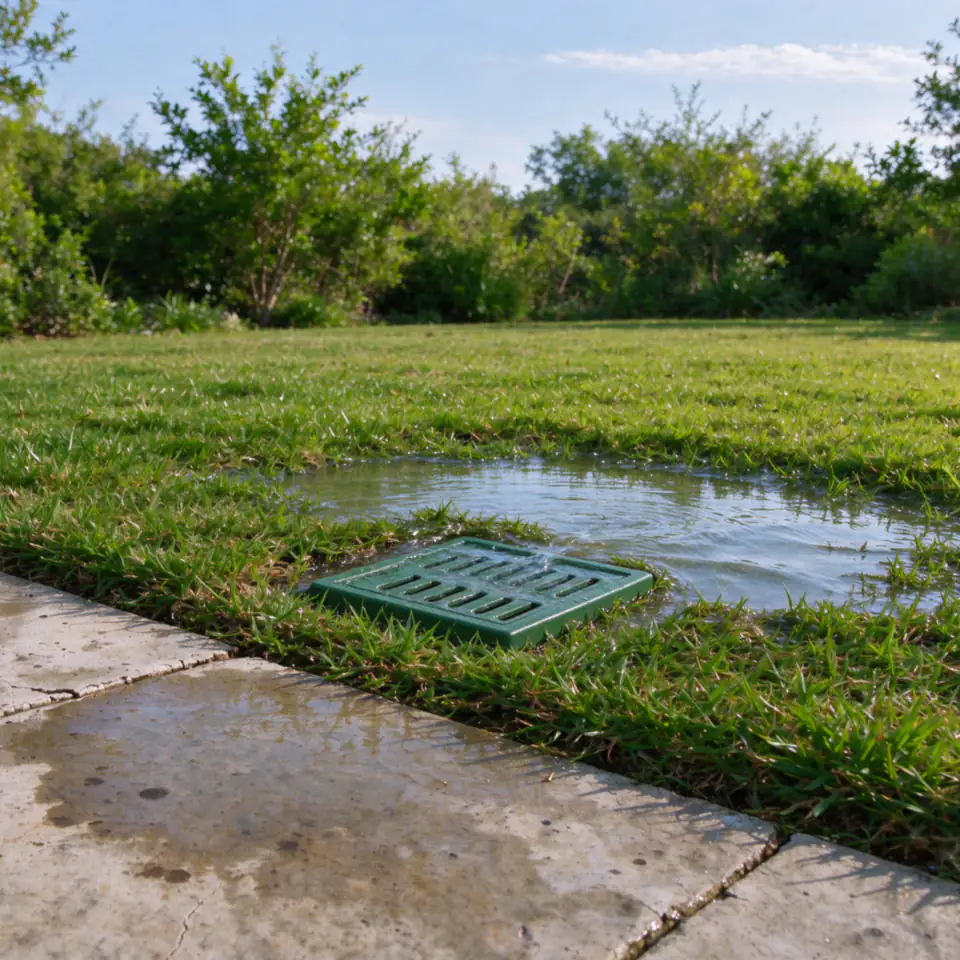
Puddle or soggy ground?
The answer to this choice is in your yard during the next good rain. Water you can see sitting on top and water hiding in the soil call for different collectors.
Clay Plano Drainage Company installs both catch basins and French drains across Plano, sometimes both on one line. This guide compares the two so you can tell which your yard needs before anyone digs.
The timing test
Go out twice: once while it’s raining hard, and again about two days after the rain stops. What you see each time sorts the problem.
| During the storm | Two days later | Points to |
|---|---|---|
| A puddle fills one low spot | The puddle’s gone, the ground is firm | A catch basin |
| Water sheets across the lawn | Dry on top | A catch basin, a swale or regrading |
| Little water on the surface | The ground is still spongy over a strip | A French drain |
| A puddle fills one low spot | The ground around it is still soft | Both, on one line |
| Nothing much | Soggy in one spot in a dry week | Neither; check the sprinklers first |
If the ground is wet when it hasn’t rained at all, the likelier cause is irrigation rather than drainage. The guide to a soggy yard without rain walks through it.
Why speed decides it
Surface water arrives fast, and Plano clay takes in very little of it. A storm with a 50% chance in any year drops 1.80 inches in an hour over central Plano, by NOAA’s rainfall atlas.
On 2,000 square feet of lawn and paving, that’s about 2,200 gallons in the hour. The Houston Black clay under most of the city soaks up roughly 0.03 inches of it, so nearly all of that water runs to the low spot.
- A catch basin takes that water in through an open grate as fast as it arrives, then sends it down solid pipe.
- A French drain takes water in only as fast as it can seep through fabric and stone, which suits slow soil water, not a mid-storm flood.
Side by side
The two collectors differ in more than where they sit. Here is how they compare on the points that matter to a homeowner.
| Catch basin | French drain | |
|---|---|---|
| Water it handles | Surface water pooling at a low point | Water held in the soil, or seeping through it |
| How water gets in | Through a grate at grade | Through fabric, washed stone and perforated pipe |
| Shape on the ground | One grate, with solid pipe leading away | A line, often tens of feet long |
| How fast it works | During the storm | Over hours and days after it |
| What you see afterward | A grate in the lawn or bed | A sod line, cleanouts and an outlet |
| Upkeep | Clear the grate, scoop the sump | Keep the outlet clear, flush through cleanouts |
| What ends it early | Leaves and grit left in the grate and sump | Clay fines in the stone, a blocked outlet |
| Our typical range | $500 to $1,500 per basin | $25 to $60 per foot |
The site visit and written estimate set your price within those ranges. The catch basin cost guide covers what moves a basin’s price.
When the answer is both
A low spot that floods mid-storm and a strip of ground that stays soft for days can sit in the same back yard. Two collectors on one outlet line handle both.
- The basin sits at the lowest surface point and catches the flash of storm water.
- The French drain runs along the wet strip and gathers soil water slowly.
- Solid pipe joins them below the perforated section, so surface water from the basin never flows back out into the stone.
- One outlet at the street side of the lot takes it all.
Surface water poured into a French drain’s stone fills it before soil water can get in. Keeping each collector on its own job is what makes the pair work. A whole-yard drainage system is the name for that combined route.
Catch basin or plain inlet?
A drainage inlet is just a grate over a pipe. A catch basin adds a box with a sump below the outlet pipe, where grit and heavier debris settle out before the water moves on.
In a yard with trees, beds or bare soil upstream, the sump protects the solid line behind it. Where the water comes off clean paving, a plain inlet can be enough. We choose by what the water carries.
Other collectors worth knowing
Two more options come up when neither fits cleanly:
- A channel drain catches water at the edge of concrete, such as a garage apron or patio. The guide to channel drains or French drains compares them.
- Regrading gives sheet flow a route without any grate at all; see yard regrading.
A soak-away pit isn’t on the list for Plano clay, for reasons the guide to where yard drain water can go explains. To have someone run the timing test with you and price the right collector, call (469) 551-8518 or send photos through the form below.