
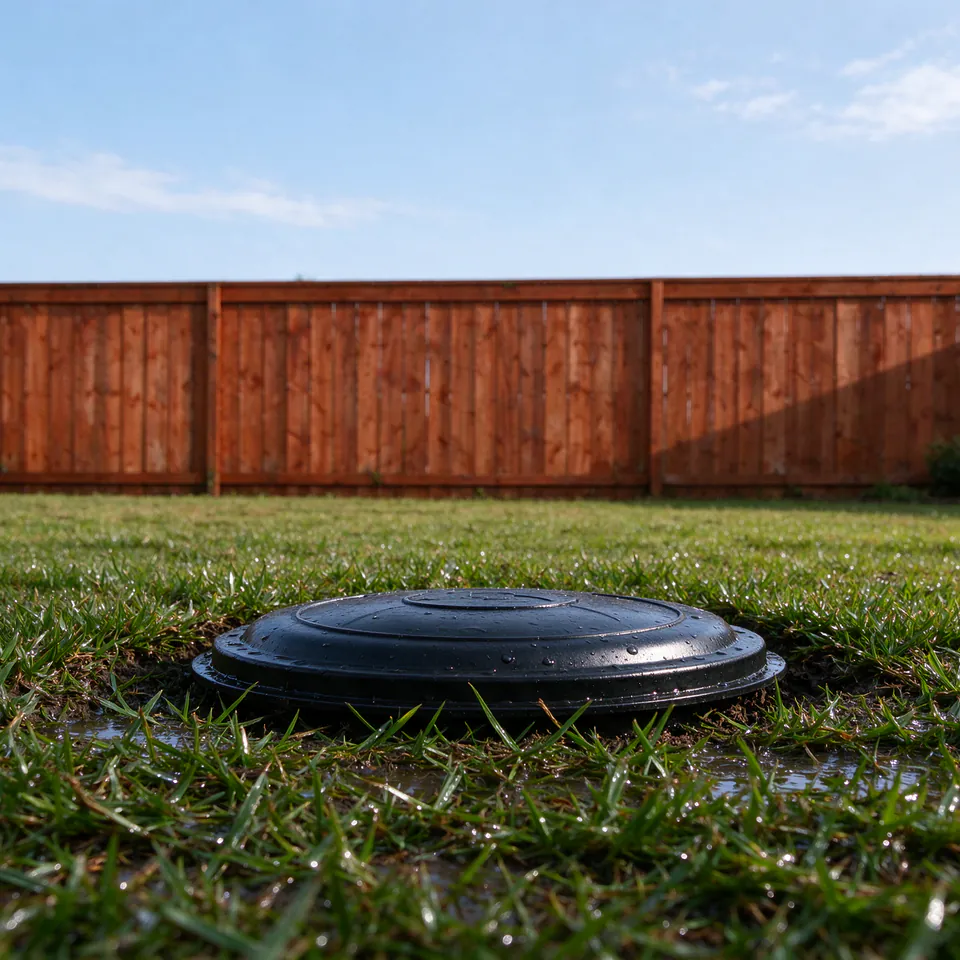
Thinking about a dry well for your yard?
A dry well sounds like the neat answer: bury a pit, pipe water into it, and let the ground take it away. It works where the ground can take water away. Plano’s clay can’t, at least not at any useful speed.
Clay Plano Drainage Company plans drainage outlets across Plano and nearby cities. This guide shows why a soak-away pit struggles in this clay, with numbers you can check, and what to use instead.
What a dry well does
A dry well is a buried pit or perforated tank, often filled with stone, that receives water from a downspout or drain line. It stores the water for a while and lets it soak out into the surrounding soil.
An infiltration trench works the same way, only stretched into a line. Both depend on one thing: how fast the soil around them takes in water.
How slow Plano clay is
Houston Black, the clay under most of central, east and north Plano, passes water at about 0.21 micrometers a second when soaked. That’s about 0.03 inches an hour.
The USDA soil survey puts it in hydrologic group D, the class for soils with the slowest infiltration. Murphy, Parker, Wylie, central Allen and much of McKinney sit on the same soil.
What a percolation test would show
A percolation test, or perc test, times how fast water drops in a soaked test hole. In fast soils the level falls in minutes. In clay rated at 0.03 inches an hour, the water level in a test hole barely moves through an afternoon.
On the first visit we probe the soil to see what the water is doing, which tells us early whether any soak-away design is worth considering.
The dry well math
Numbers make the problem plain. Take a modest pit 3 feet across and 4 feet deep, and a storm with a 50% chance in any year, which drops 1.80 inches in an hour over central Plano by NOAA’s rainfall atlas.
| Quantity | Figure | How it’s worked out |
|---|---|---|
| Water from one heavy hour on a 1,000 sq ft roof | About 1,100 gallons | 1,000 sq ft x 0.15 ft of rain = 150 cubic feet |
| What the empty pit can hold | About 210 gallons | A 3-foot circle, 4 feet deep = about 28 cubic feet |
| Soil the pit touches | About 45 square feet | Floor plus walls |
| What that soil takes in | About 20 gallons a day | 45 sq ft at 0.03 inches an hour |
| Time to empty a full pit | More than a week | 210 gallons at about 20 a day |
That’s a simplified figure at the soil’s mapped rate, and a real pit varies. The point holds either way: the pit overflows in the first minutes of the storm and is still holding water when the next one comes.
Richardson’s weather station, just south of Plano, records about 27 days a year with half an inch of rain or more in NOAA’s climate normals. In this clay, a dry well rarely gets the chance to empty between them.
Far west Plano is the exception, partly
Around the Dallas Parkway and Arbor Hills, the soil is Eddy gravelly clay loam. It passes water at about 7.2 micrometers a second, roughly 34 times faster than Houston Black, so in its top layer a pit would empty in hours rather than days.
The catch is depth. Eddy and the nearby Stephen soils sit shallow over chalk, so a 4-foot pit can reach rock, and water stops at the rock instead of soaking down. A soak-away there still needs a backup outlet.
Dry well or piped discharge?
The real choice in Plano is between storing water in the ground and moving it to the street. The city’s design manual has house lots drain to the street, which favors the second.
| Dry well | Piped discharge to the street | |
|---|---|---|
| Where the water goes | Into the soil around the pit | Out through an emitter, an existing line or a permitted curb outlet |
| In Houston Black clay | Fills and stays full for days | Empties as fast as the pipe allows |
| In a big storm | Overflows into the yard | Carries what it can; an overflow path handles the rest |
| Upkeep | Silt builds up in the pit over time | Clear the outlet and flush through cleanouts |
| Fits Plano’s lot rules | Only with an outlet of its own | Yes, it’s the outlet the rules expect |
The guide to where yard drain water can go compares every outlet a Plano lot can use, and standing water in the yard covers how we find the cause when water already sits after storms.
When the lot has no fall
Dry wells come up most on lots that can’t drain to the street by gravity: a flat back yard, a lot below the street, or a low corner with nowhere downhill to go.
For those yards, a pump basin does what a dry well promises. It collects water in a sealed basin, and a pump lifts it through a buried discharge line to the curb or an approved outlet; see yard sump drainage.
- Our typical range for an outdoor pump basin with its discharge line is $1,500 to $4,000 per pump basin; the site visit and written estimate set yours.
- Where the low spot fills mid-storm, a catch basin can feed the pump basin; the guide to French drains or catch basins explains when a basin fits.
AC condensate and other small flows
An AC condensate line drips a slow, steady flow through the cooling season. A pit for it stays soggy for the same reason a storm pit does.
Better options for condensate:
- A short solid line to a pop-up emitter in open lawn
- A tie-in to an existing downspout line that reaches the street side
- A planted bed well away from the slab, where the plants use the water
If a dry well is already in your yard and the ground around it stays soft, the fix is a solid line to a real outlet. Drain repair and cleaning covers reworking old systems, and the guide to French drains in clay soil explains how collection drains are built for this ground.
To find the outlet that works for your lot, call (469) 551-8518 or send photos through the form below.