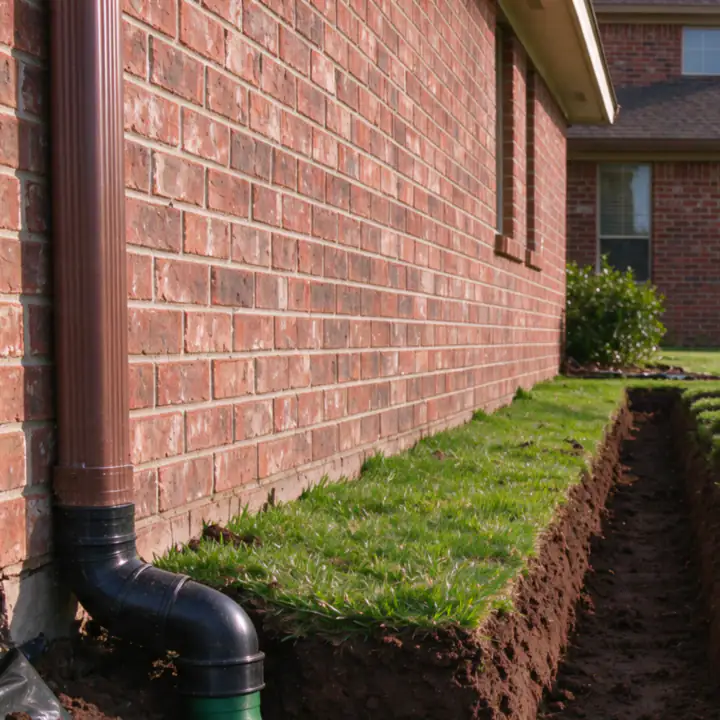
Water pooling where the downspouts let out?
A downspout gathers rain from a big slice of roof and drops all of it in one place, usually right beside the foundation. A buried line carries it away before it can soak the soil along the slab or pool in the beds.
Clay Plano Drainage Company installs underground downspout drainage in Plano and nearby cities. We route each line in solid pipe to a place your lot can legally release water, which in Plano means toward the street.
What happens on the first visit
We follow each downspout from the gutter to wherever its water ends up today. A short video during a heavy rain shows which ones overflow and where the water runs.
- Roof area. How much roof feeds each downspout. A corner that drains two roof planes carries far more than a single run of gutter.
- Where it goes now. Splash blocks, flexible extensions, an old buried line, or a pipe that simply ends in the lawn.
- Old lines. If a line is already buried, we run a hose into it to see whether it still flows.
- Route and crossings. Walks, the driveway, beds and the AC pad between the downspout and the outlet.
- The outlet. Room and fall for a pop-up emitter, or a curb outlet the city permits.
The written estimate lists every line with its length, outlet and restoration.
How much water one downspout carries
More than most people expect. Every inch of rain on 1,000 square feet of roof sheds about 620 gallons, and the downspout delivers it in the time the storm lasts.
The Richardson weather station, next to south Plano, records about 14 days a year with an inch of rain or more. On each of those days, a splash block puts that whole load within a few feet of the beam.
- At the slab. Clay beside the foundation swells as it wets and shrinks as it dries, and one corner soaked over and over wets unevenly.
- In the beds. Water poured on one spot cuts a channel and washes mulch onto the lawn.
- On paving. A patio or walk beside the house adds its own runoff to the same corner.
Keeping water off the slab is the whole point of foundation drainage, and downspout lines are usually its first step.
Solid pipe, not perforated
Roof water belongs in solid pipe from the downspout to the outlet. Perforated pipe leaks it into the soil along the way, and that soil is usually the strip beside the house you’re trying to keep dry.
Where a line ends matters too. A downspout emptied into a French drain’s stone fills the trench with roof water before it can collect the soil water it was built for. We run downspout lines on their own and join them to a French drain outlet only through solid fittings.
That black pipe that ends in the lawn
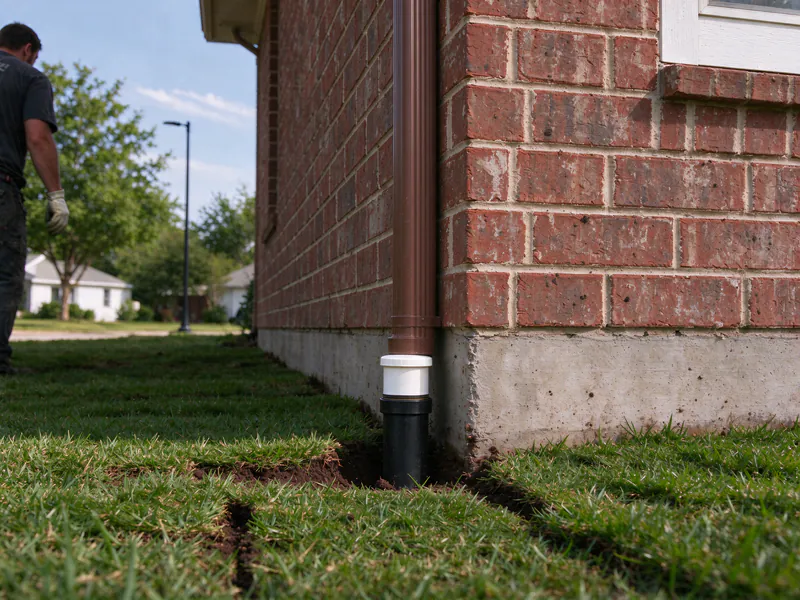
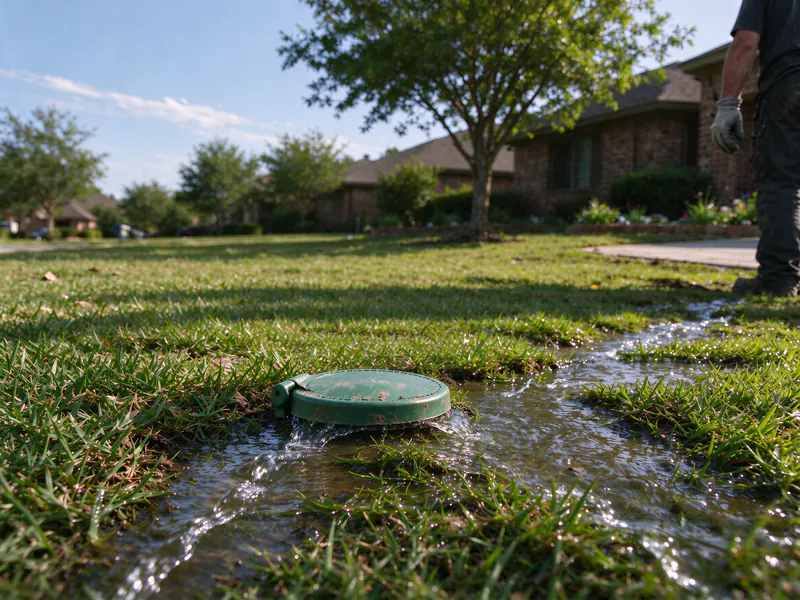
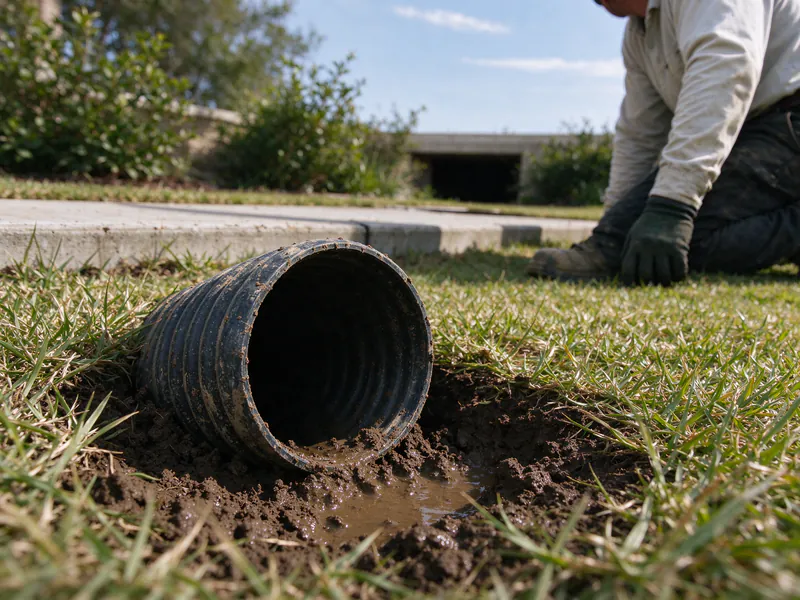
An older downspout line is sometimes corrugated pipe run a few yards out and left open or capped in the grass. The soggy spot at its end is where the line lets go of everything it carries.
We replace it with solid pipe, or extend it to a real outlet if the old pipe is sound.
Where the water leaves
Each line needs an exit that lets water go without sending it to the neighbor. We choose one of three, depending on the lawn and the street.
- Pop-up emitter. A lid at the end of the line lifts when water pushes up and drops closed afterward. It needs open lawn toward the street and a little fall.
- Existing line. An older drain that already reaches the street, after we run water through it to prove it works.
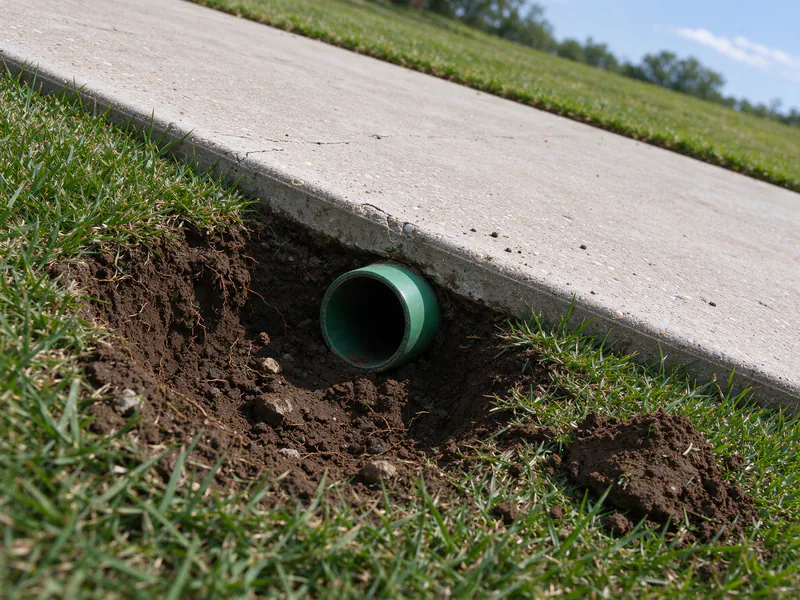
- Curb outlet. A pipe through the curb into the street gutter. In Plano, work in the right-of-way needs the city’s Engineering Permit. In Prosper, the town allows one curb core per lot, no more than 3 inches across.
Richardson’s own guidance asks residents to let roof water cross grass or gravel before it leaves the lot, and an emitter in open lawn does exactly that. The guide to where yard drain water can go covers the outlet rules.
How we install a downspout line
The work is short, but the order still matters, because a line that loses fall in one spot holds water there.
- Locates. Texas811 marks buried lines, and we mark each route in white.
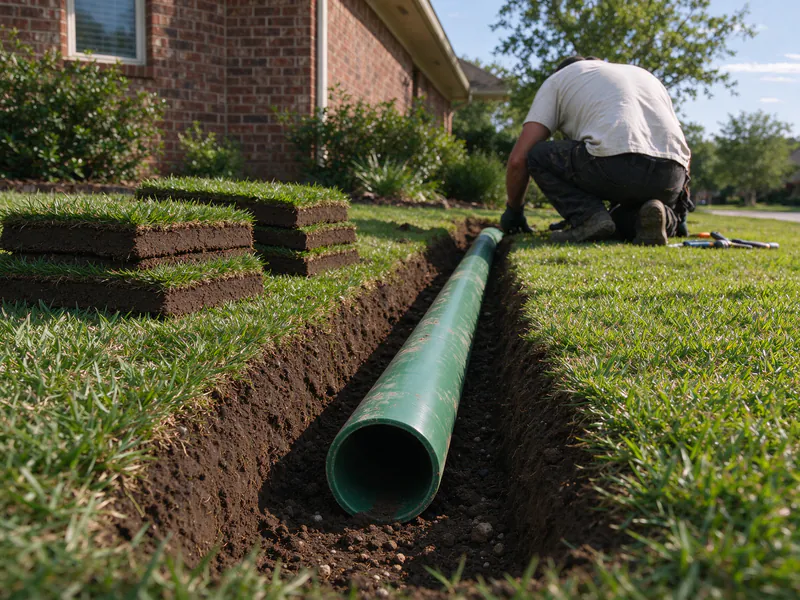
- Trench. A narrow trench, sod cut in strips and set aside, soil on tarps.
- Adapter. At the base of the downspout, with a cleanout or removable section so gutter grit can be cleared at the top of the line, not dug out later.
- Pipe. Solid pipe at a steady fall, with sweep fittings at the turns.
- Crossings. A bore under the walk or driveway where the soil allows, or a narrow saw-cut and concrete patch where it doesn’t.
- Test. We run a hose into the gutter and watch the outlet open.
- Restore. Sod goes back, sprinkler lines get repaired and we walk you through the route.
What a downspout line costs
Our typical range for an underground downspout line is $300 to $800 per downspout. That’s one downspout with its adapter and roughly 10 to 30 feet of buried solid pipe to an emitter, a curb outlet or a working line; the estimate sets your figure.
Longer runs, crossings under walks or the driveway, rock in the trench and a curb outlet push a line toward the top. Doing several downspouts on one visit spreads the setup across them. The downspout drainage cost guide has the detail.
- Where downspouts drop into a narrow side yard, we price the lines with the side-yard fix.
- Where they feed a catch basin or a whole-yard system, they become branches of one route.
Keeping downspout lines clear
Most downspout lines clog from the top. Roof grit, seed pods and leaves wash straight down out of the gutters.
Keep the gutters clean, check that the emitter lid lifts freely, and flush from the cleanout if water backs up at the downspout. A line that still won’t drain after flushing is a job for drain repair and cleaning. If the pooling continues somewhere else in the yard, the standing water page explains how we trace it.