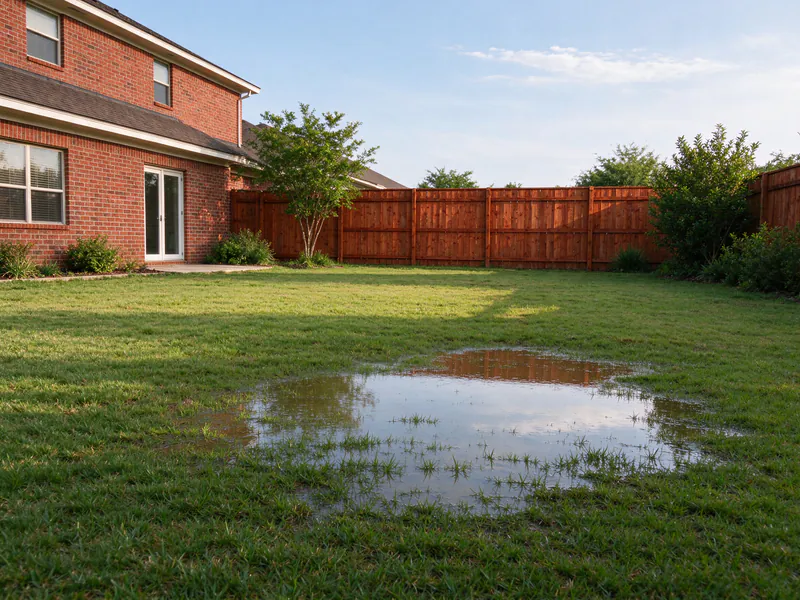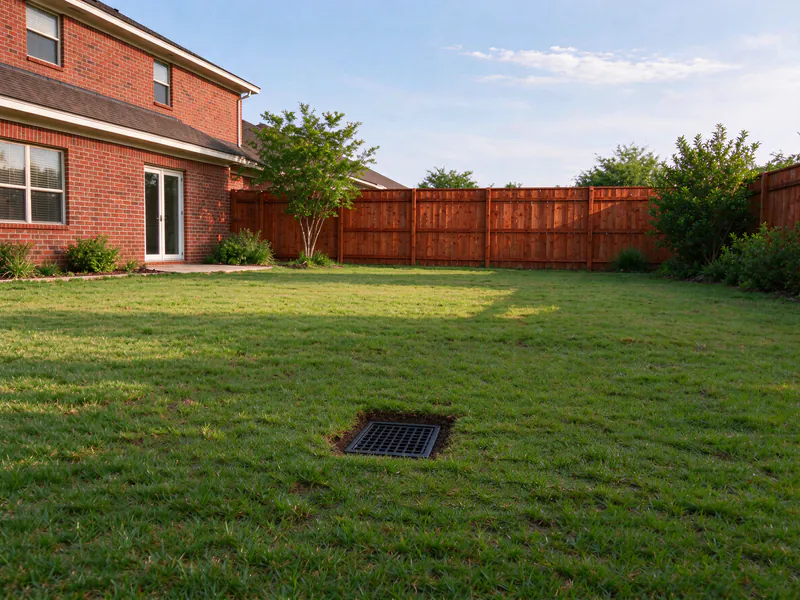
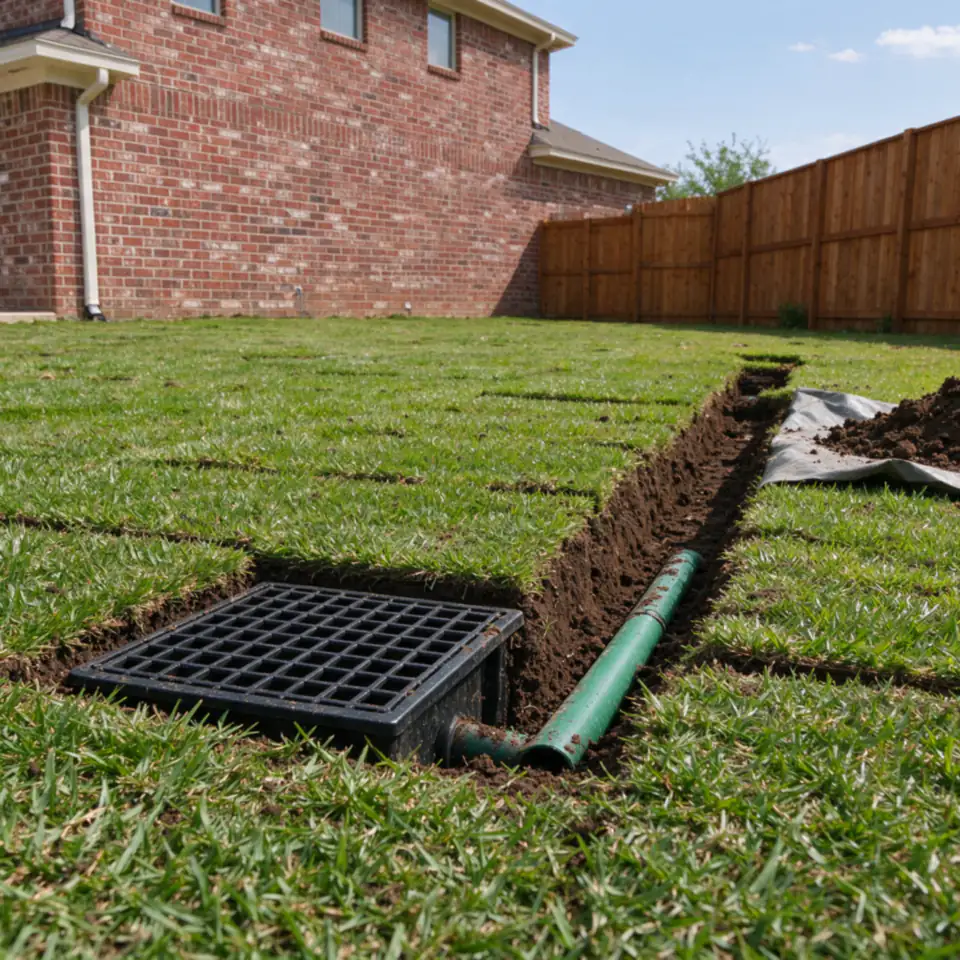
Puddle in the same spot after every storm?
Rain that runs off the lawn, the roof and the patio ends up in the lowest spot it can find, and in a flat Plano yard that spot can hold it for a day. A catch basin gives that water a way in.
Clay Plano Drainage Company installs catch basins and the solid pipe behind them in Plano and nearby cities. A basin only works when it sits at the true low point and has a working outlet, so we find both before we set a single grate.
What happens on the first visit
We start by watching how water moves over the surface, since a catch basin collects surface water only. A photo taken during the storm tells us more than one taken the next day.
- Where the water comes from. Roof corners, the patio, the driveway and a higher neighbor’s lawn.
- The true low point. We take spot elevations, because the lowest point is often a few feet from where the puddle looks deepest.
- What washes in. Trees, mulch beds and clippings upstream decide the basin size and the grate.
- Fall to the outlet. How far the pipe has to run, and whether it can fall the whole way.
- Surface or soil. If the ground stays soft long after the puddle drains, soil water is part of the problem and a basin alone won’t solve it.
You get a written estimate with each basin’s spot, its grate, the pipe route and the outlet.
Catch basin or drainage inlet?
People use both names for the same grate in the lawn, and in DFW “yard drain” can mean either. They’re built differently, and the difference is what happens to the leaves.
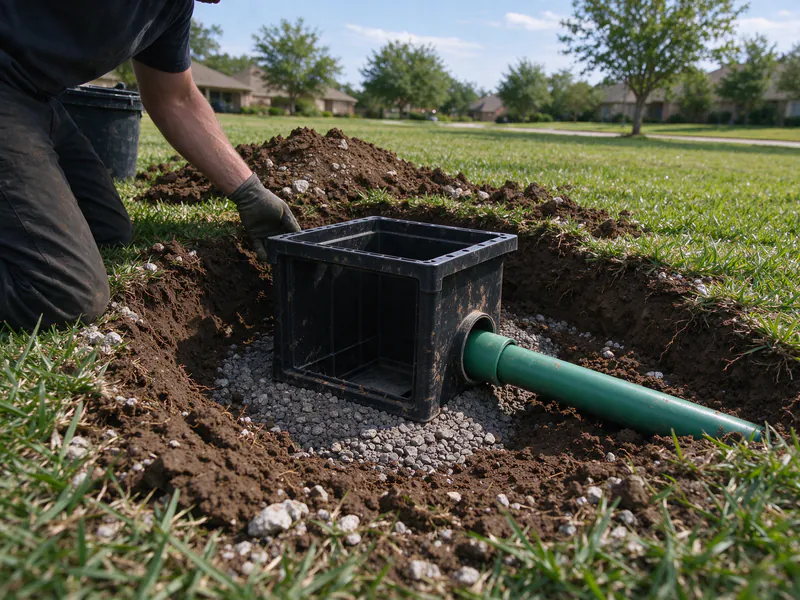
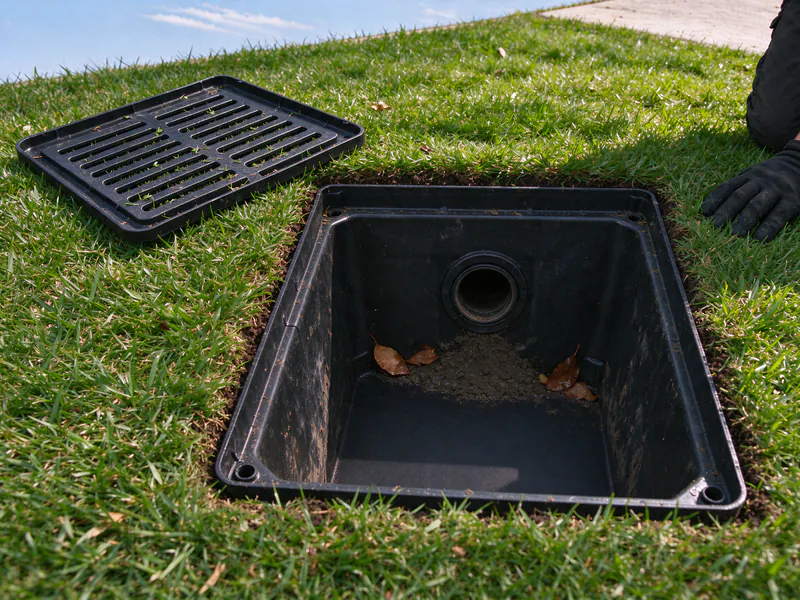
- A catch basin is a box, often 12-inch-class plastic, with its outlet pipe set above the floor. The space below the pipe is a sump where leaves, silt and grit settle out.
- A drainage inlet is a grate on a fitting at the end of the pipe. Water and whatever it carries go straight into the line.
Under trees or downhill from a mulch bed, we use a basin. For clean water off a patio or a short roof edge, an inlet does the job. Where the soil itself stays wet, the French drain vs catch basin guide explains when a trench fits better.
Picking the grate
The grate decides what gets in and what sits on top. We match it to the surface around it.
| Where it sits | Grate | Why |
|---|---|---|
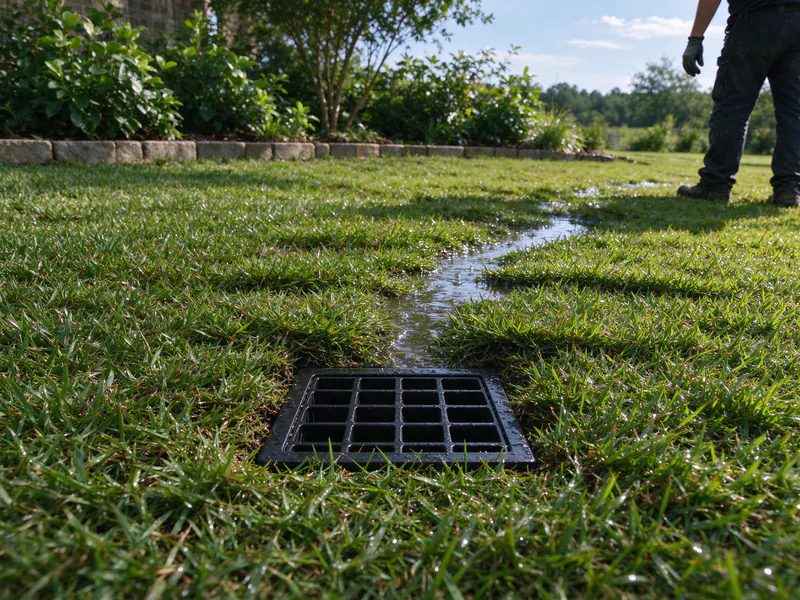
| Open lawn | Flat grate, just below the sod | Mows over, and water reaches it from every side |
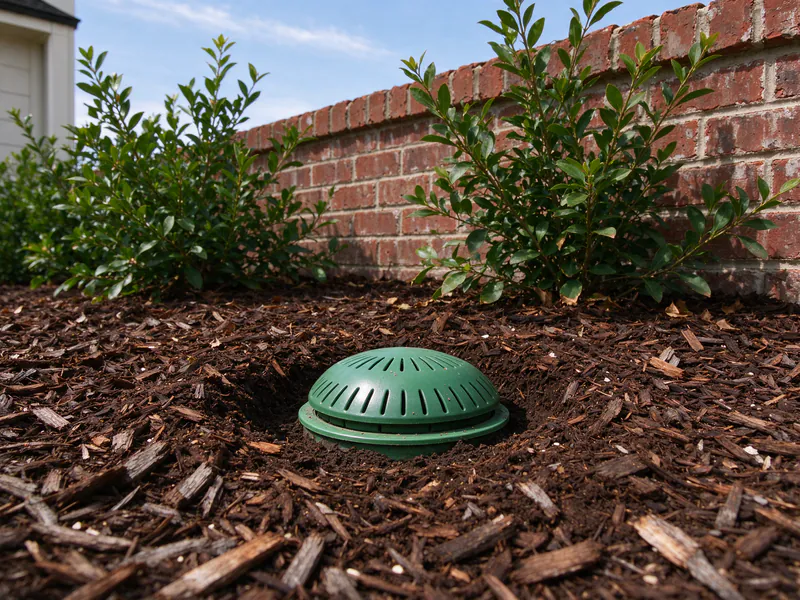
| Planting bed | Domed grate | Stands above mulch and leaves, so water still gets in |
| Walk or patio edge | Flat grate, flush with the paving | No edge to trip on |
| Driveway | Traffic-rated basin and grate | Carries tire loads without cracking |
A grate that rocks, sinks or shifts usually sits on loose fill. We set every basin on a compacted, level base and tamp the soil around it, so the grate holds its height after the first few storms. For a long sheet of water across paving, a channel drain collects better than one square grate.
Setting the height right
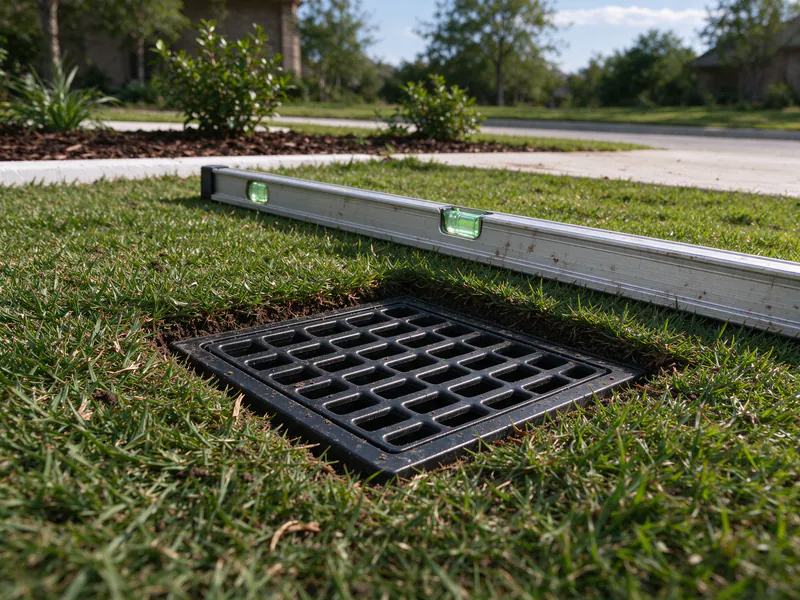
A basin set too high never fills. Water can’t run uphill into a grate, so the rim has to sit a little below the soil around it.
We set the grate a short distance below finished grade and shape the lawn to fall gently into it from every side. From there the pipe takes over, leaving the basin at a steady fall to the outlet.
Plastic or concrete basin?
Plastic basins suit most lawns and beds. They’re light, they cut cleanly for pipe connections, and they come in sizes for one or two inlet pipes.
A concrete basin earns its weight where a driveway or carport sheds a lot of water onto one spot, or where vehicles cross the grate. If an old 2-inch line behind a carport keeps clogging, the fix is usually a larger basin with a sump and 4-inch outlet pipe, not a second small line.
Bedding the pipe
Solid pipe needs a firm, even bed so it can’t sag into a belly, a low section that holds water and collects silt. We lay it on compacted soil, or on a thin layer of stone where the trench bottom is soft.
What happens in a cloudburst
Every basin and pipe has a limit, and in the biggest storms the street sets it. Richardson, next door to south Plano, sizes its storm drains for storms with a 10 to 20 percent chance in a year.
In larger storms, Richardson’s streets are designed to carry water up to the top of the curb. When the gutter runs that full, a curb outlet can’t drain, and the basin fills and overflows.
- We set basin heights so the overflow spills toward the street across open lawn, not back toward the slab.
- The guide to where yard drain water can go covers outlet choices and their limits.
Cleaning a catch basin
A catch basin is built to catch, so it needs emptying. Lift the grate after the fall leaves drop and again before the spring storms, and scoop out what has settled.
- A little water in the sump is normal. It sits below the outlet pipe. Water above the pipe a day after rain means the line is blocked.
- Flush the outlet line from the basin with a hose. If it won’t clear, drain repair and cleaning finds the blockage.
- Keep the far end clear. Clippings and mulch on an emitter lid hold it shut.
If a basin keeps flooding even when it’s clean, the low spot may be part of a bigger pattern. The standing water page explains how we sort that out, and sometimes a small regrade removes the low spot entirely.
What a catch basin costs
Our typical range for a catch basin with a short pipe run is $500 to $1,500 per basin. That covers one basin, its grate and roughly 20 feet of solid pipe to an existing line or outlet; the written estimate sets yours.
A basin added to a drain we’re already building costs less than one on its own. Deep or concrete basins, paving to cut and patch, and long runs to a new outlet cost more. The catch basin cost guide breaks it down.
- Basins often take water from downspout lines at the same low corner.
- Several basins on one trunk make up a whole-yard drainage system.