
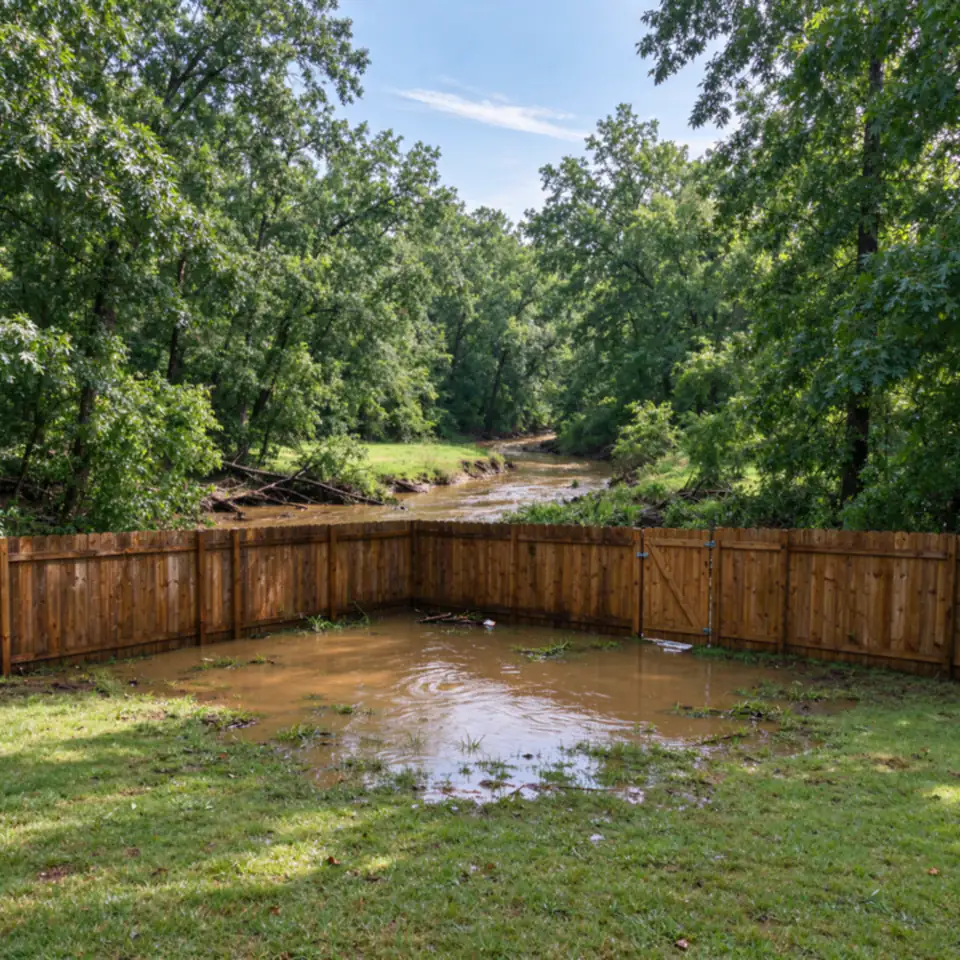
Back yard under water after a big storm?
Two very different problems can leave the same picture. On some lots, a creek has climbed out of its channel. On others, the rain had nowhere to go. Telling them apart is the first step, because only one of them is a yard problem.
Clay Plano Drainage Company fixes the second kind: storm water trapped on a lot in Plano and nearby cities. This guide helps you sort which you have, and who handles the first kind.
Signs it’s the creek
Creek flooding comes from outside the lot, usually from the lowest edge, and it follows the creek’s rise and fall rather than the rain over your roof.
- Direction. Water spreads up the yard from the creek side, not down from the house or a neighbor.
- Timing. It can arrive after the heaviest rain has passed, as water from upstream reaches you.
- Look. It’s often brown and carries leaves, sticks and silt that end up on the lawn and fence.
- Location. The lot backs onto a creek, channel or greenbelt, such as the Rowlett Creek and Oak Point corridors.
- Paperwork. The plat shows a floodplain easement across part of the lot.
Soils along those corridors are mapped as eroded Lewisville silty clay on 3 to 5% slopes in the USDA soil survey. Creek-side slopes there can wash out where outlet water lands hard.
Signs it’s trapped rain
A drainage problem starts with rain on your lot, or runoff from the one next door, that can’t reach the street.
- Direction. Water collects in a low corner, a side yard or against the slab.
- Timing. It appears during the storm and stays after the rain stops.
- Look. It’s mostly clear, with mulch or grass clippings rather than creek debris.
- Pattern. It comes back to the same spot after every good rain, not just the rare big one.
- Clues. Downspouts empty nearby, a swale is blocked, or the grade tilts toward the low spot.
Some lots have both. A yard near a creek can still hold rain in a dip by the house, and that part a drain can fix. The guide to a soggy yard without rain covers a third case: wet ground in dry weather.
| Question | Creek flooding | Yard drainage |
|---|---|---|
| Where does the water enter? | From the creek or channel side | From the roof, paving, lawn or a higher lot |
| When does it show? | Rare big storms, sometimes after the rain eases | Most good rains, during the storm |
| What does it leave behind? | Silt, sticks and debris | Mulch, clippings, puddles |
| Can a yard drain fix it? | No | Usually, with the right route and outlet |
| Who to ask first | Plano’s stormwater staff and your insurance agent | A drainage visit |
What a 1% annual chance flood means
Floodplains are drawn around the 1% annual chance flood, often called the 100-year flood. The name misleads: it’s a 1% chance each year, every year.
Over 30 years, that adds up to about a 26% chance of at least one such flood. For rain alone, NOAA’s rainfall atlas puts the 1% annual chance storm in central Plano at 3.61 inches in an hour or 9.47 inches in a day. Storms like that overwhelm both creeks and yard drains.
When the street fills up
A street full of water to the curb can look like a failure. It can be the storm system doing what it was built to do.
Next door in Richardson, the city spells out how its system is meant to behave:
- Pipes for ordinary storms. Storm drains are sized for storms with a 10 to 20% chance each year.
- Streets for the big ones. In larger storms, streets and alleys are designed to carry and hold water up to the top of the curb.
- Backups while creeks peak. The system can back up while a creek’s flood surge passes downstream.
What that means for your lot:
- Curb outlets can’t empty while the street is full; water waits in the line until the street drains.
- Driveways below curb height can take street water in those storms. A channel drain handles water off your own drive, but the curb and street are the city’s.
- An overflow route matters. We plan a path across the surface for water the pipe can’t take during the rare big storm.
Who owns the creek bank
The creek running behind a lot isn’t necessarily the city’s to look after. McKinney’s engineering manual states it plainly: natural creeks and floodplain areas are owned and maintained by the property owner, not the city, and an easement doesn’t change that.
In Plano, the city asks owners to keep ditches on their property clear of debris and growth, and dumping into ditches or channels is illegal. Before you build anything near the creek, read the guide to drainage easements in Plano, since a floodplain easement limits what can go there.
What we can do on a creek-side lot
A yard drain can’t lower a creek, but it can deal with rain that collects on the lot before it reaches the creek.
- Collect rain at the house with solid downspout lines and grade that falls away from the slab.
- Carry it to the street where the lot allows, under Plano’s rule that lots drain to the street.
- Protect the slope where water has to leave toward a creek, so the outlet doesn’t cut a gully; yard regrading shapes and stabilizes it.
- Plan for overflow so the rare storm that tops the system runs somewhere harmless.
Standing water in the yard covers how we diagnose water that stays after rain, and Plano’s drainage rules explain the lot grading behind it.
Insurance and records
Whether a policy pays for flood water, runoff damage or neither is a question for your insurance agent, and flood cover can be a separate policy. Keep videos and photos from each storm, with dates and the damage they show.
If it’s trapped rain, we’ll put the source, the route and the fix in a written estimate. Call (469) 551-8518 or send your storm video through the form below, and we’ll tell you which problem you have.