
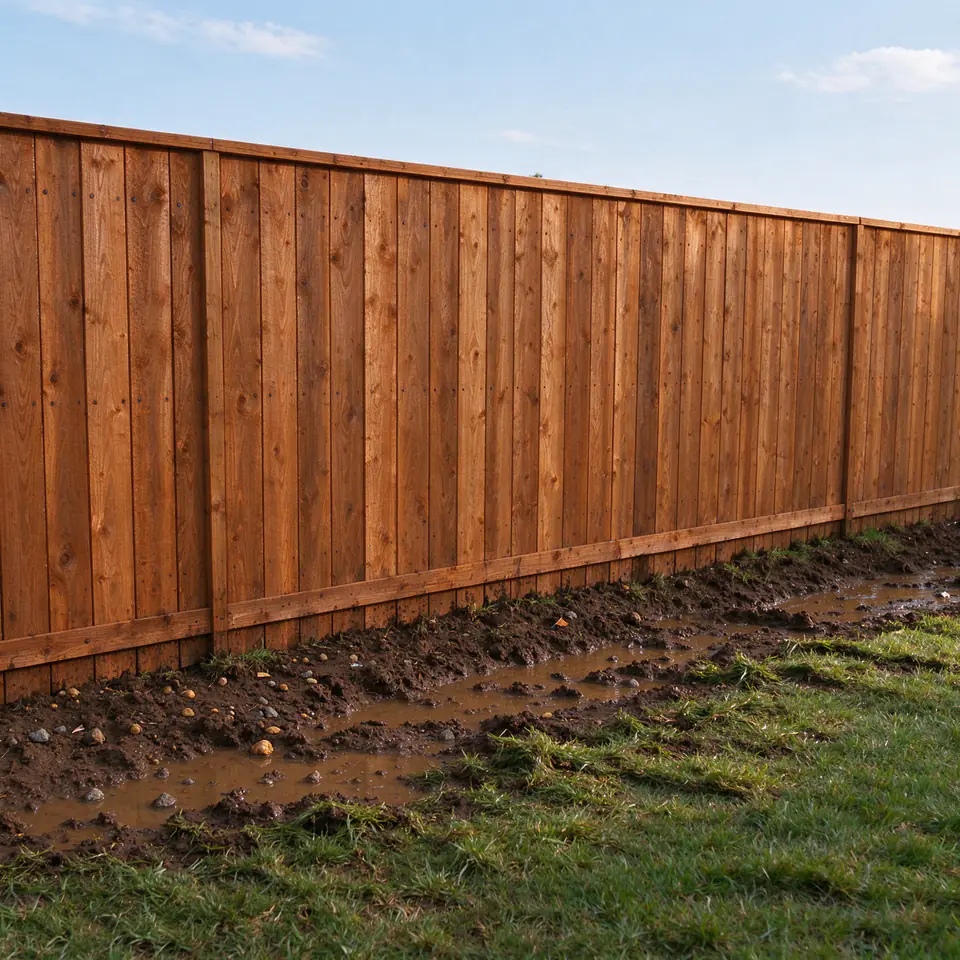
Water coming over the fence line?
Mud at the base of the fence, a trench worn under the pickets, a corner that floods every time the neighbor’s zones run. Before talking to anyone, work out what kind of water it is, because the rules treat natural runoff and redirected water differently.
Clay Plano Drainage Company regrades and drains yards in Plano and nearby cities, including lots that take water from next door. This guide covers what the law says, how to build a record, and what we can build on your side that keeps you within the rules.
The two rules that apply in Plano
Two layers of rules cover water between lots here: one state statute and the city’s design manual. They point the same way.
- Texas Water Code section 11.086. No person may divert or impound the natural flow of surface water in a manner that damages another person’s property.
- Plano’s Stormwater Design Manual. House lots are designed to drain to the street, lot-to-lot drainage is not permitted, and natural flow may not be diverted or impounded to harm adjacent or downstream property.
The statute is about changes to how water moves: a berm, a wall, a pipe, fill or a ditch that sends water where it didn’t go before, or holds it where it didn’t sit before. Whether one case crosses that line is a question for an attorney, who reads the statute against the facts.
Natural flow or redirected water?
Water runs downhill, and a lower lot has always taken some water from the one above it. That alone isn’t a violation. What matters is whether something changed.
| What you see | Usually points to |
|---|---|
| Water crossing the line only in heavy storms, in the same place for years | Natural flow from a higher lot |
| A new flood after the neighbor built a patio, pool or raised bed | Paving or fill changing how water leaves their lot |
| A pipe, pop-up or downspout line ending at the shared fence | Water redirected toward you |
| A berm, rock border or wall along their side of the line | Flow being pushed or held along the boundary |
| Water arriving in a dry week, on a schedule | Their sprinkler zones, not rain |
| A side swale that used to carry water to the street and now doesn’t | A blocked or filled swale on either lot |
A neighbor’s rock pile or border that dams the low line can leave the upper lot swampy, which is the impounding half of the rule. A swale filled on your own side can do the same to the lot above you. The guide to drainage easements in Plano covers what can sit in that shared strip.
Build a record before you talk
A clear record makes the conversation with a neighbor, an HOA or an attorney much shorter. Phone video taken while it happens beats any description.
- Film the water during a steady rain, showing where it enters your lot and where it ends up.
- Film again while their sprinklers run, if the wet spot appears in dry weather.
- Note the date and how much it rained, from a rain gauge or a weather app.
- Photograph changes next door: new paving, fill, a pipe outlet, a border along the line.
- Pull your plat from the Collin Central Appraisal District record and mark any easement along the shared line.
- Keep repair records for anything the water has damaged, such as a fence base, beds or sod.
Plano’s drainage rules are summarized in the guide to Plano’s drainage manual, which helps if the conversation turns to how the lots were meant to drain.
Talking with your neighbor
A conversation is the quickest fix. A neighbor may not know their downspout line ends at the fence, or that a new bed dammed the swale.
- Show the video rather than describing it.
- Suggest a fix that helps both lots, such as moving an outlet toward the street or reopening a shared swale.
- If you’re in an HOA, check its guidelines; some subdivisions require approval for exterior drainage work.
- If the water causes damage and nothing changes, talk to an attorney about your options under the statute.
What we can build on your side
Your side of the line can handle water that arrives from above, as long as the fix carries it to the street instead of pushing it back. Water from a higher lot is extra load on your system, so we size for it.
- A swale along the line that collects the water and carries it toward the front of the lot. Yard regrading shapes it.
- A curtain drain, a French drain set across the flow, when water seeps through the soil from the higher lot. See French drain installation.
- A catch basin at the point where surface water crosses, piped in solid line to the street side. See catch basins.
- A reopened side swale between houses, which can be the simplest fix; see side-yard drainage.
We don’t build walls or berms that dam the flow along the line. Under 11.086 that would only move the problem, and the liability with it.
How nearby cities treat water between lots
The cities around Plano say much the same thing, with a few useful details. Where your house sits outside these, we confirm the rule for the address.
| City | Rule on water between lots |
|---|---|
| Garland | Lot-to-lot surface drainage in single-family subdivisions is prohibited; a private storm line crossing another lot needs that owner’s written acceptance |
| McKinney | No lot-to-lot drainage; water that has reached the right-of-way or a drainage easement can’t be sent back onto private property |
| The Colony | No lot-to-lot drainage unless an easement exists or is dedicated through every lot the water crosses |
| Parker | Drainage is designed to avoid concentrating storm water from one lot onto the next |
| Heath | Drainage between two or fewer lots is treated as a private matter between the owners |
What it costs to fix on your side
Most neighbor-water fixes are a regrade, a swale, a basin or a short drain line. Our typical range for yard regrading is $1,000 to $4,000 per project; the site visit and written estimate set yours.
- The yard regrading cost guide explains what moves that price.
- The guide to fixing yard drainage problems helps sort the sources when water arrives from several directions.
- Where yard drain water can go covers the outlet at the street side.
If water from next door is soaking your yard, call (469) 551-8518 or send your video through the form below. We’ll walk the line with you, find where the water enters and plan a route to the street.