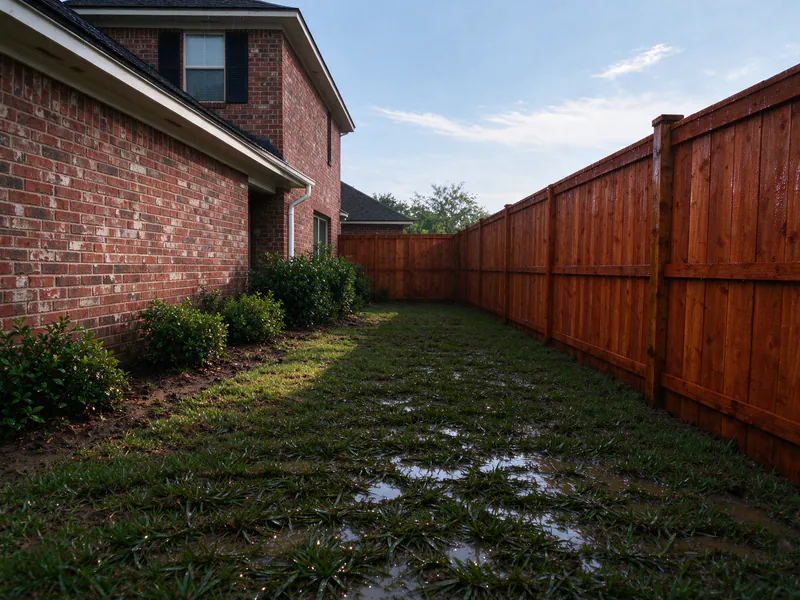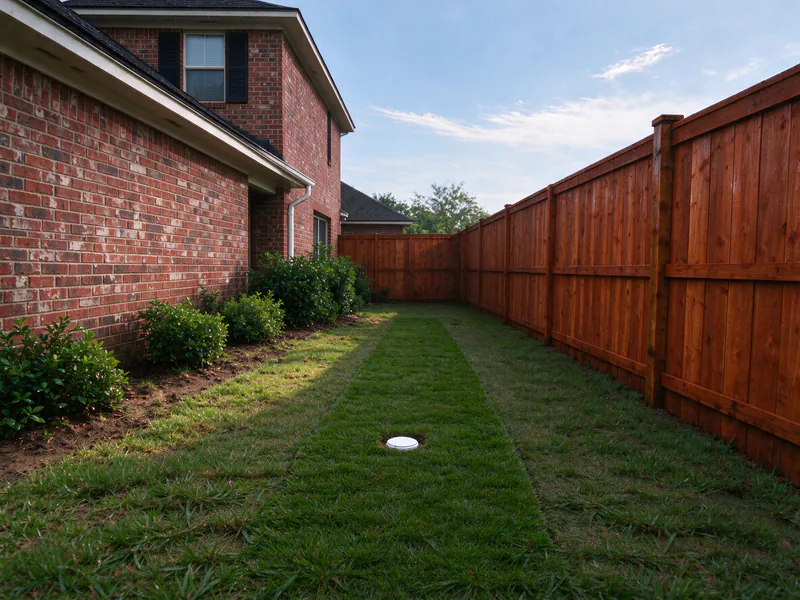
Lawn still soggy two days after the rain?
That strip along the fence that never dries, or the slope that keeps seeping after a storm, is water held in the soil with nowhere to go. A French drain gives it a way out.
Clay Plano Drainage Company plans and installs French drains in Plano and nearby cities. We start where the water starts. Before we draw a trench, we work out where the water comes from and where it can leave, because Plano lots are designed to drain to the street, never onto the lot next door.
What happens on the first visit
We walk the yard with you and look at where water sits, where it comes from and where it could leave. Photos or a short video from the last storm help a lot.
- Source. We check downspouts, the neighbor’s grade, sprinkler zones and any paving that sheds onto the lawn.
- Soil or surface. We probe the soil to see whether the water is held in the ground or sitting on top, which decides whether a French drain fits at all.
- Fall. We measure the fall from the wet area to the street side of the lot, so the pipe can run downhill the whole way.
- Outlet. We look for a legal place to let the water out: a pop-up emitter in open front lawn, an existing line, or the curb where the city permits it.
- What’s in the way. Fences, gates, AC pads, beds, sprinkler lines and the width of the side yard all shape the route.
You get a written estimate that shows the route, the run lengths, the outlet and what gets put back afterward.
Is a French drain the right fix for your yard?
A French drain is the right tool when water is in the soil: ground that stays soft after the surface has dried, or a slope that weeps for days. It is the wrong first answer for water running across the top.
Surface water moves faster than a trench can take it in. A low spot that fills during the storm usually needs a catch basin or a small change in grade, and roof water needs downspout lines in solid pipe.
| Points to a French drain | Points to something else |
|---|---|
| Soil stays wet a day or more after the surface dries | Water sheets across the lawn during the storm and is gone soon after |
| A band along a slope or fence line weeps after rain | A puddle forms in one low spot and sits on top |
| Water reaches the yard through the ground from higher land | Water pours off one roof corner |
| Grass is spongy over a defined strip | The patch is wet when it hasn’t rained at all |
A patch that stays wet through a dry week points to a sprinkler zone, not a drain. Many yards need two of these collectors on one line, and yard drainage covers systems that combine them.
Water seeping downhill toward the house
A curtain drain is a French drain laid across a slope to catch groundwater before it reaches the lower yard or the house. It sits uphill of the wet area, not in it.
It suits a lot below a higher neighbor, or a yard that steps down toward the slab, where water moves sideways through the soil after storms. We set the trench across that flow, at the depth where the wet layer runs, and carry what it collects in solid pipe to the street side of the lot.
What a curtain drain won’t fix
A curtain drain doesn’t change what a higher lot sends over the surface; grade or an inlet handles that. The guide to water from a neighbor’s yard covers what Texas law says about runoff between lots.
What goes in the trench, and why clay changes it
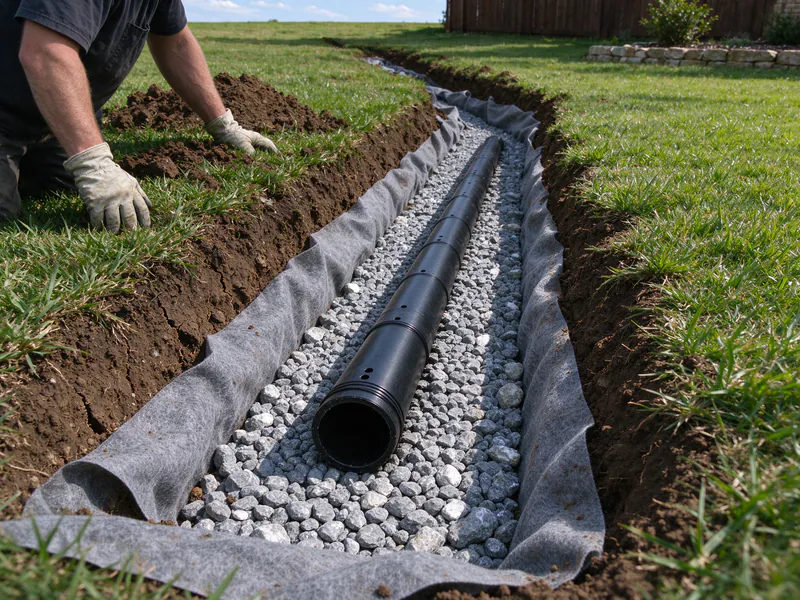
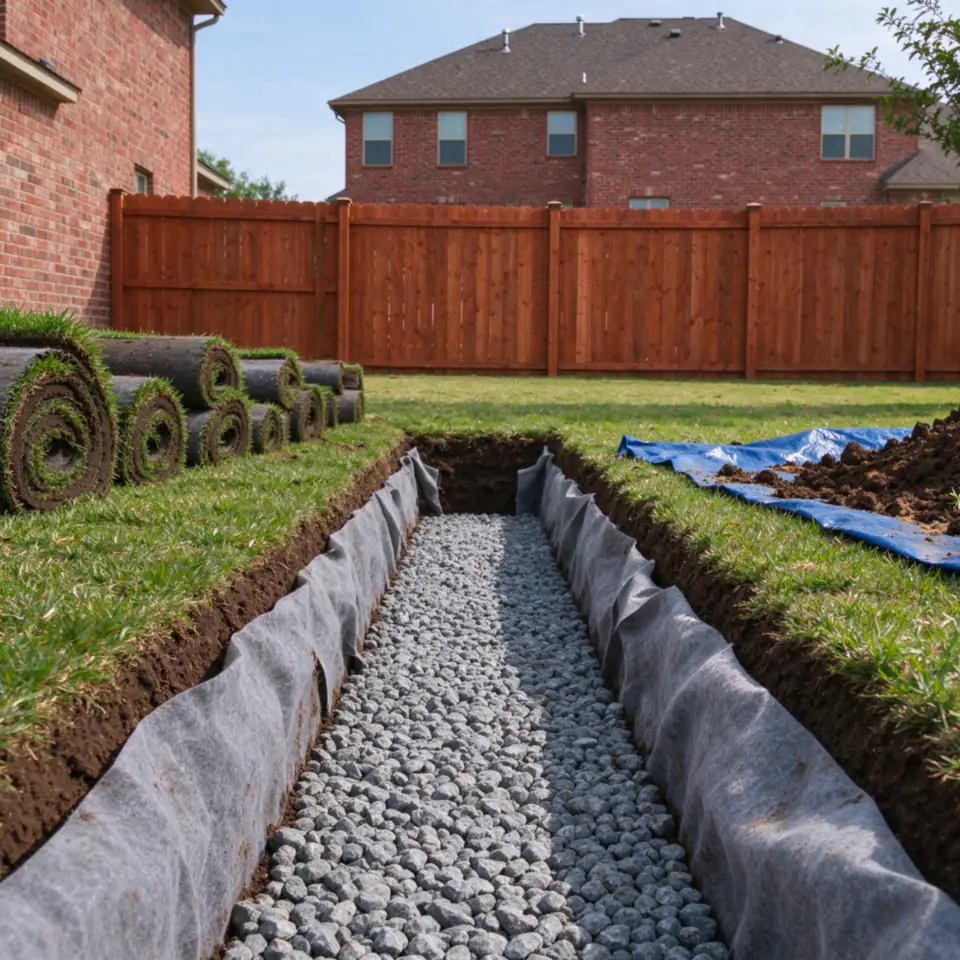
A French drain is a trench of washed stone with perforated pipe inside, wrapped in filter fabric and connected to solid pipe that carries the water away. Each part has a job, and in Plano clay the details decide how long it keeps working.
- Filter fabric lines the trench and wraps the stone. Clay fines are what clog drains here; the fabric lets water through and keeps the fine particles out of the stone.
- Washed drainage stone holds open space around the pipe. Unwashed rock brings its own fines into the trench on day one.
- Perforated pipe runs only through the wet zone, where it gathers water that seeps into the stone.
- Solid pipe takes over between the wet zone and the outlet, so collected water doesn’t soak back into the ground on the way.
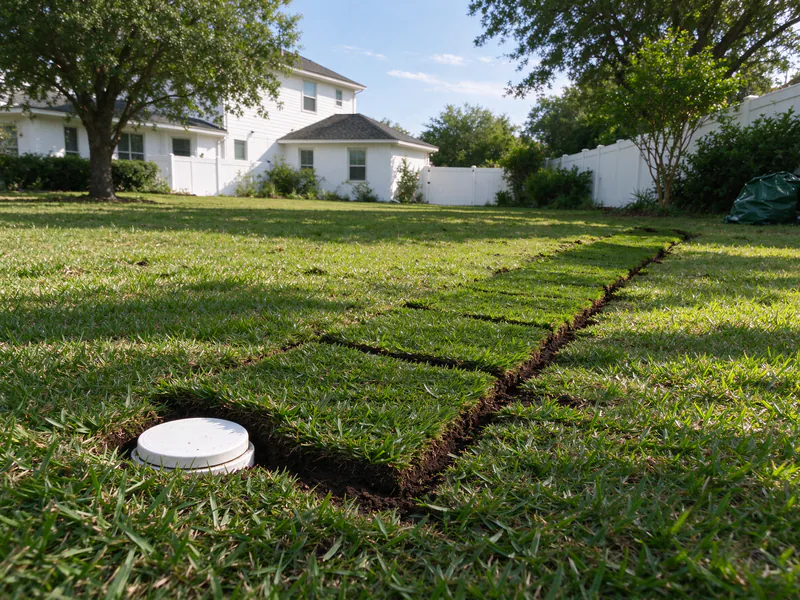
- Cleanouts sit where lines join or turn, so the line can be flushed with a hose later.
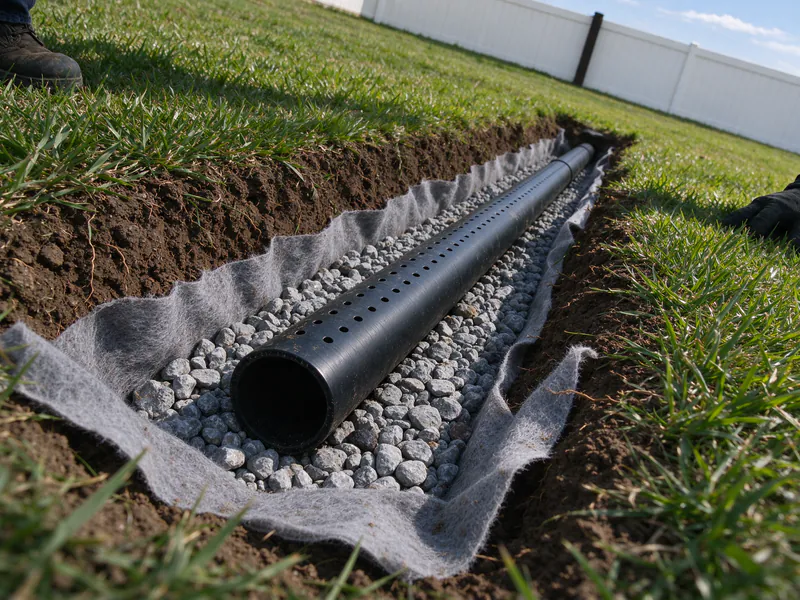
Houston Black, the clay across central, east and north Plano, takes in only about 0.03 inches of water an hour. In ground that slow the stone stores water while the clay releases it, so we size the stone zone to the wet area, not the pipe. The guide to French drains in clay soil goes deeper.
Where does the water go when it leaves?
Every French drain needs an exit, and the exit shapes the whole design. A drain with nowhere to send water just fills up and holds it.
Plano’s Stormwater Design Manual has house lots drain to the street, and lot-to-lot drainage is not permitted. So we plan the outlet toward the front of the lot:
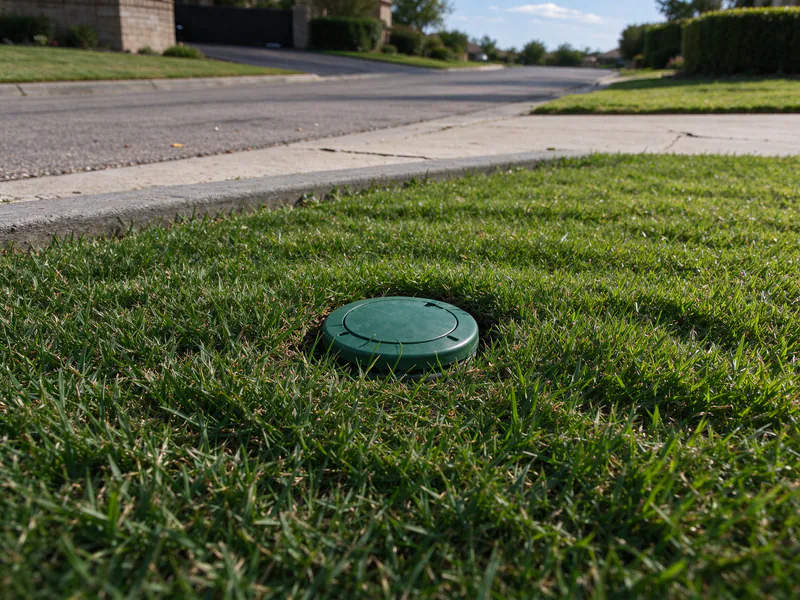
- A pop-up emitter in open lawn on the street side, which opens when water flows and closes afterward.
- An existing line that already reaches the street, after we run water through it to prove it still works.
- The curb. Work in the public right-of-way, a curb outlet included, needs the city’s Engineering Permit for public infrastructure. We confirm what applies to your address before the route is final.
If the lot has no fall toward the street at all, gravity can’t do the job and a yard sump and pump lifts the water instead. The guide to where yard drain water can go covers the outlet rules in full.
Digging in far west Plano: chalk under the lawn
Out west, around the Dallas Parkway and Arbor Hills, the soil changes. Eddy gravelly clay loam and Stephen silty clay sit shallow over chalk, and the chalk can turn up inside trench depth.
That changes the dig more than the design. The top layer drains faster than the deep clay farther east, but rock in the trench means slower digging and sometimes a shallower route that still has to keep its fall. It is one reason two drains of the same length can price differently.
How we install it
Once you approve the route, the work runs in the same order every time.
- Locates. We call Texas811 so buried gas, power, water and cable lines get marked, and we mark our own route in white.
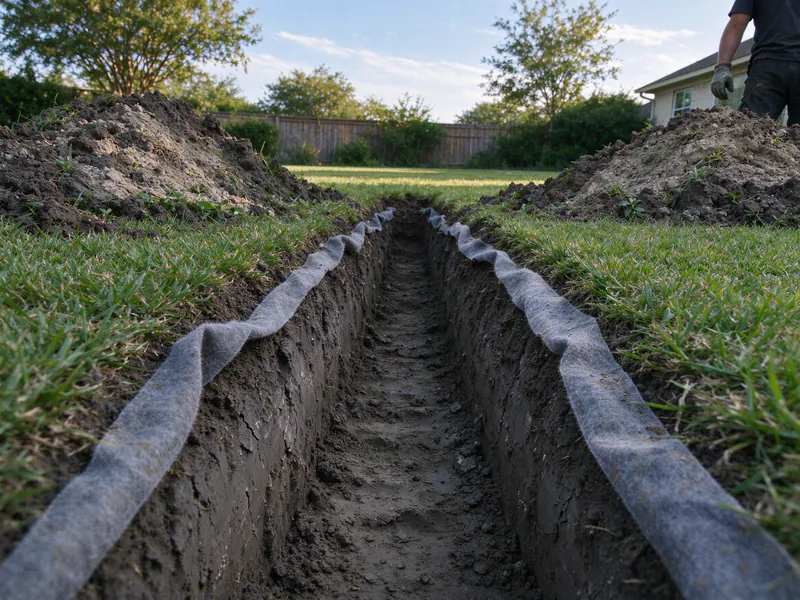
- Sod and soil. We cut the sod in strips and set it aside, keep the trench narrow and pile the soil on tarps instead of the lawn.
- Silt control. Silt controls keep loose soil out of the street and storm inlets while the trench is open.
- Build. We shape the trench bottom to the measured fall, line it with fabric, then set stone, pipe, more stone and the fabric wrap.
- Water test. Before any backfill, we run water through the whole system and watch it reach the outlet. A low spot gets fixed while the trench is still open.
- Restore. We backfill, put the sod back and repair any sprinkler lines we crossed.
- Walk-through. We show you the route, the cleanouts and the outlet, so you know what to keep clear.
The guide to what happens during drainage installation follows a day on site in more detail.
What a French drain costs
Our typical range for a French drain is $25 to $60 per foot. That covers the trench, fabric, washed stone, perforated pipe and a solid run to an existing legal outlet; the site visit and written estimate set yours.
Depth and rock, the distance to the outlet, extra basins, a tight side yard and sprinkler lines in the path move a job within that range. The French drain cost guide breaks it down, and the cost estimator lets you try your own run lengths.
Keeping it working after we leave
A French drain usually fails at its weakest point, which is the outlet. Keep the pop-up emitter or curb opening clear of clippings, mulch and leaves, and flush the line through a cleanout if water starts to slow.
Plano also expects owners to keep drainage ditches on their own property clear of debris and growth. If an older drain has quit, drain repair and cleaning starts by finding where it failed before anything is replaced, and the guide on how long a French drain lasts covers what wears one out.