
Wondering what a drain install will do to your yard?
It’s easy to picture the whole lawn torn up. A drain goes in along one narrow line, and the order of the work is what keeps the rest of the yard intact.
Clay Plano Drainage Company installs yard drainage systems in Plano and nearby cities, and every job follows the same sequence. Here is each stage, what happens in it and what we’ll ask of you.
Stage 1: The site visit
The visit is where the plan is made. We walk the yard with you, ideally with photos or a video from the last storm, and work out where the water comes from, where it can legally leave and what lies between.
On that visit we:
- Probe the soil to see whether water is held in the ground or sitting on the surface.
- Measure the fall from each wet area to the street side of the lot.
- Find the outlet: an emitter in the front lawn, an existing line that still works, or the curb.
- Note obstacles: fences, gates, AC pads, trees, beds, paving and the width of the side yards.
You get a written estimate with the route, the run lengths, each basin or cleanout, the outlet and what gets restored. The guide to fixing yard drainage problems explains how we choose the fix.
Stage 2: Permits and approvals
Two kinds of approval can apply, and they’re separate. One comes from the city, the other from your HOA.
| Approval | When it applies | Who handles it |
|---|---|---|
| Plano Engineering Permit for public infrastructure | Any work in the public right-of-way, such as a curb outlet or a line under the parkway | We arrange it as part of the job; the approved permit stays on site during the work |
| Neighboring city right-of-way or easement permit | Work in city right-of-way or easements in Frisco, Allen, Murphy and others | Confirmed for the address and arranged with the job |
| HOA approval | Where your subdivision’s guidelines cover exterior or drainage work | You request it, using the route and outlet from our estimate |
Plano’s drainage rules cover the permit and lot-grading rules in more detail.
Stage 3: Locates and the painted route
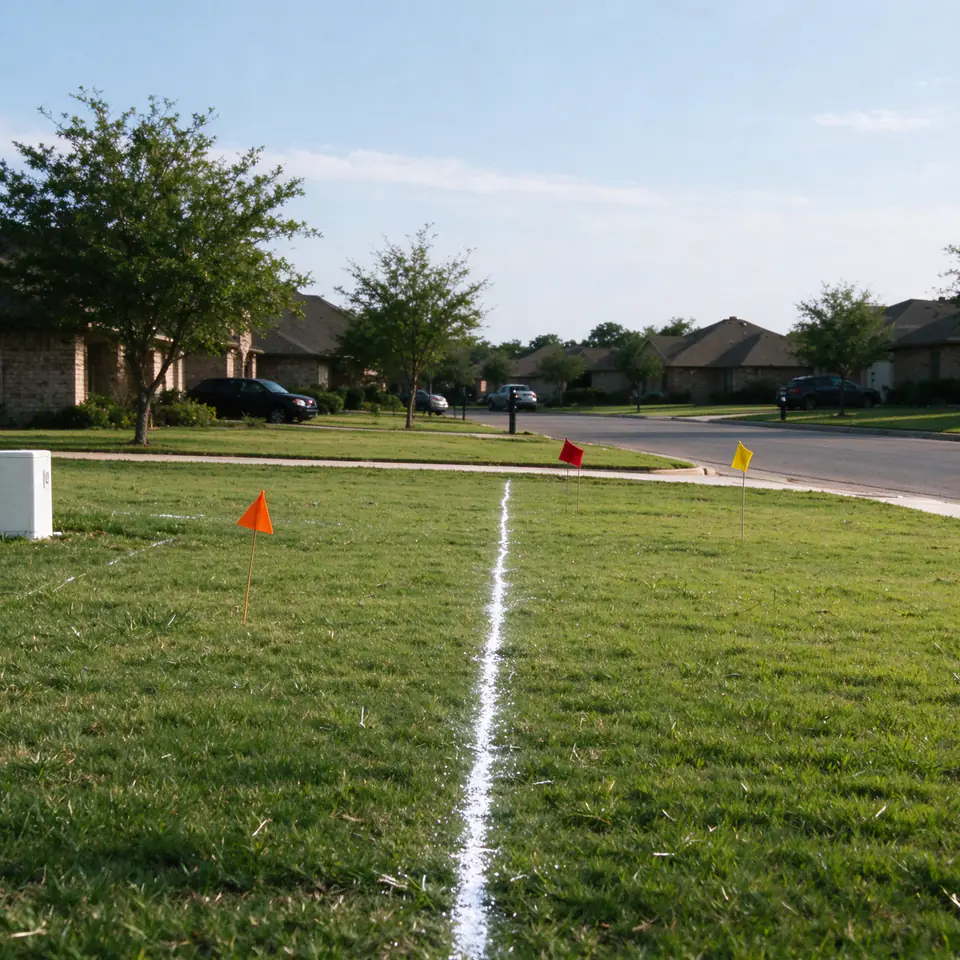
No trench opens until buried utility lines are marked. We call Texas811, the state’s call-before-you-dig center, and the utilities mark gas, power, water and communication lines with flags and paint.
Texas811 covers lines the utilities own. Your own lines aren’t part of it, so before the dig, tell us about:
- Sprinkler mains, valves and heads along the route
- Landscape lighting and low-voltage wiring
- Invisible pet fences
- Gas or power lines to a grill, pool, shed or outbuilding
We then paint the drain route in white and walk it with you. That’s the moment to raise a bed, a tree or a sprinkler head you want us to work around.
Stage 4: The dig and the build
The trench follows the painted line and stays narrow. Sod along the line comes up in strips and is kept to go back down, and the soil from the trench sits on tarps beside it.
What goes in depends on the fix:
- The trench bottom is shaped to the fall we measured, so water runs downhill the whole way.
- French drain sections get filter fabric, washed stone and perforated pipe, wrapped closed over the top.
- Solid pipe carries water from downspouts, basins and drain sections to the outlet.
- Cleanouts go in where lines join or turn.
- The outlet is set: an emitter in open lawn, a tie-in to a proven line, or a permitted curb outlet.
Silt controls keep loose soil out of the street and storm inlets while trenches are open. Plano’s storm system runs under a state stormwater permit that targets construction runoff, so sediment stays on the lot.
Stage 5: The water test
Before any backfill, we put water into the system and follow it to the outlet. This is where a low spot or a slow joint shows up, while it can still be fixed in an open trench.
If you’re home, watch it with us. Seeing water come out of the emitter at the front of the lot is the clearest proof the route works.
Stage 6: Putting the yard back
Backfill goes in over the stone and pipe, and the sod we lifted goes back along the same line. Sprinkler lines we crossed are repaired, and we run the affected zones to check them.
After we leave, the cut lines in the sod show until it roots back in. Water those strips with the rest of the lawn so the roots take.
Stage 7: The walk-through
At the end, we walk the finished system with you. You’ll see where each line runs, where the cleanouts are and where the water leaves.
That walk is also your maintenance briefing: which grates to clear after storms, which outlet to keep free of mulch and clippings, and how to run a hose test through a cleanout. The guide on how long a French drain lasts covers that upkeep.
What the install costs
Our typical range for a whole-yard drainage route is $3,000 to $8,000 per project; the site visit and written estimate set yours. Run length, depth, the outlet and restoration move it.
The drainage cost guide breaks down each kind of job, and where yard drain water can go explains the outlet choices. When you’re ready to plan the work, call (469) 551-8518 or send photos through the form below.