
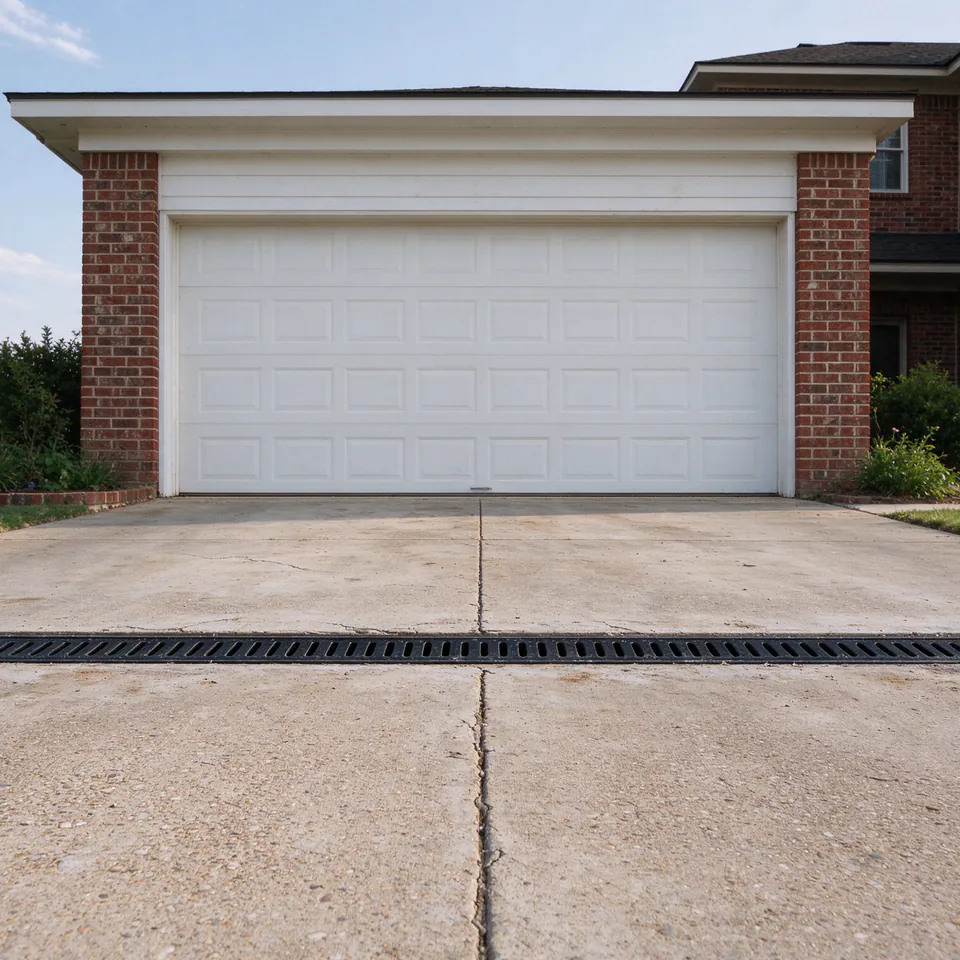
Water running across concrete, or sitting in the lawn?
A driveway that sends water under the garage door, a patio that floods at the back door, a lawn that stays soft beside the walk. They look like one problem, and they can be two.
Clay Plano Drainage Company installs channel drains in paving and French drains in soil across Plano. This guide sets the two side by side so you can see where each fits around your house.
Two drains, two jobs
They share a shape: long, narrow and ending in solid pipe to the street side of the lot. That’s where the similarity ends.
- A channel drain is a trough of polymer or PVC with a grate on top, set into concrete or pavers. Water running across the paving drops straight in.
- A French drain is a trench of washed stone and perforated pipe wrapped in filter fabric, buried in soil. Water seeps into it from the ground around it.
You’ll also hear a channel drain called a trench drain or a strip drain. All three names mean the same grated trough.
Side by side
This table compares the two where it matters for a decision at home.
| Channel drain | French drain | |
|---|---|---|
| Where it sits | In concrete or pavers | In a lawn, bed or along a slope |
| Water it handles | Surface water running across paving | Water held in or seeping through soil |
| How fast it takes water | As fast as it arrives at the grate | Slowly, through stone and fabric |
| What you see | A grate flush with the paving | A sod line, cleanouts and an outlet |
| Main install work | Saw-cutting, setting the channel at grade, patching the concrete | Trenching, fabric, stone, pipe, restoring the sod |
| What can go wrong | Wrong load rating, no fall to the outlet, grate packed with leaves | Clay in the stone, a blocked outlet, roof water in the trench |
| Our typical range | $60 to $150 per foot | $25 to $60 per foot |
The site visit and written estimate set your price. Channel drains cost more per foot because of the saw-cut and concrete work, and the channel drain cost guide breaks that down.
Where a channel drain belongs
Paving sheds rain almost as fast as it falls. A grate across the path of that water catches it in a line before it reaches somewhere it shouldn’t.
- Garage aprons, where the driveway slopes toward the door.
- Patio edges against the house or at a back door.
- Pool decks, where water runs toward a fence, a bed or the house.
- Walks and side paths that carry water into a side yard.
- Low thresholds, where a few inches of water would reach the door.
On flat paving, the grade still has to carry water to the channel. McKinney’s design manual asks paved surfaces within 10 feet of a building to slope at least 1% away from it, a useful target here too.
Load ratings
Channels come in load classes. One under a patio sees foot traffic only; one across a driveway carries the weight of a car or truck. We match the channel and grate to what will drive or roll over it.
Where a French drain belongs
A French drain belongs where water is in the soil, not on the surface. A strip of lawn that stays soft for days, or a slope that seeps after rain, is French drain territory.
A gravel strip beside a driveway can look like a cheap channel, but it isn’t one. Stone in clay takes in water only as fast as it can seep through, so sheet flow off the concrete runs past it or fills it. The guide to French drains in clay soil explains why.
When to use both
Some patios end at a lawn that’s already wet. A channel at the paving edge and a French drain in the lawn beyond can each do their own job and share one outlet.
- The channel catches surface water at the patio edge.
- Solid pipe from the channel joins the line below any perforated section, so paving water never spills into the stone.
- The French drain gathers soil water from the lawn.
- One solid line carries both to an emitter or curb outlet at the street side.
A catch basin can replace the channel when the water gathers at one low point instead of along an edge. The guide to French drains or catch basins covers that choice.
Channels next to a slab
A channel drain against the house sits on clay that swells and shrinks with water. Keeping the channel’s outlet line solid and carrying its water to the street keeps roof and paving water from soaking the slab edge.
The guide to foundation moisture in clay soil covers that boundary, and where drainage work ends and structural work begins.
Water from the street
If the water at the garage comes off the street rather than your own driveway, the curb is the city’s. A channel at the apron can catch some of it in ordinary storms, but it can’t change what the street carries in a big one.
The guide to where yard drain water can go explains how the outlet works when the street is full. To sort out the water at your paving, call (469) 551-8518 or send photos through the form below.