
Not sure where your drain’s water should go?
A drain is only as good as the place it empties. Pick the outlet first, then design the trench back from it, and most of the hard choices make themselves.
Clay Plano Drainage Company plans the outlet first on every French drain and yard drain we build in Plano. This guide compares every outlet a Plano yard can use and the ones it can’t.
The Plano rule that sets the outlet
The city’s Stormwater Design Manual has house lots drain to the street. Lot-to-lot drainage is not permitted, and water can’t be diverted so it harms a neighbor’s or a downstream property.
That narrows the choice to outlets at the street side of the lot. The details of each are in the guide to Plano’s drainage rules.
Outlet options compared
Each outlet suits a different lot. This table shows what each one needs and where it fits.
| Outlet | How it works | Suits | Watch for |
|---|---|---|---|
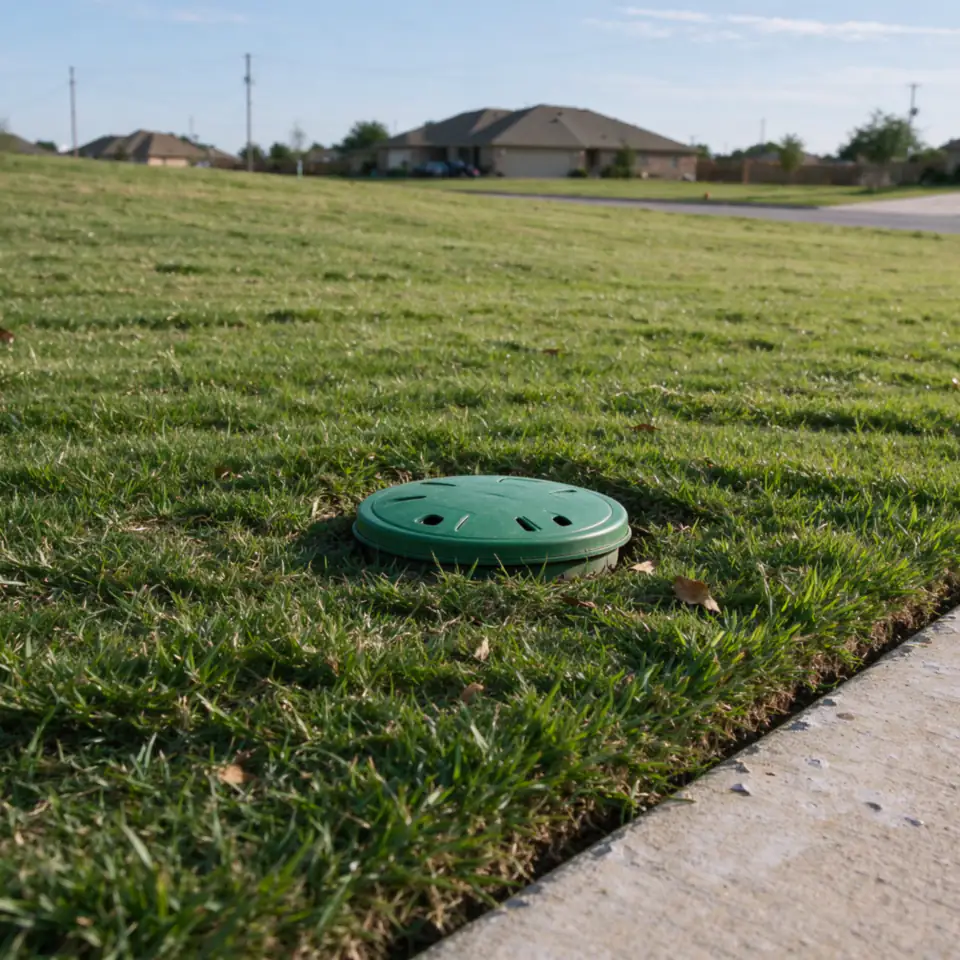
| Pop-up emitter | A buried fitting at the end of solid pipe; its lid lifts to release water onto the lawn | Lots with open front lawn and fall toward the street | Needs open grass below it, not a bed or a dip |
| Existing line to the street | A tie-in to a drain line already in the ground | Lots with a line that still flows | Prove it with water first; an old line may be crushed or full |
| Curb outlet | Pipe carried under the parkway to an opening in the curb | Lots where an emitter has no room, or water must reach the gutter directly | Public right-of-way: city permit, and limits in some cities |
| Daylight to a swale | Pipe ends at a grade that leads to the street | Sloped lots with a working side swale | The swale must keep its depth and fall |
| Pump basin | A basin and pump lift water to an emitter or the curb | Flat or low lots with no fall to the street | Needs power and occasional checks |
Downspout lines and French drains can share an outlet. What matters is that every line feeding it stays solid from the point it stops collecting water.
Outlets that don’t work here
Some outlets look handy and don’t fit a Plano lot. Here’s why each one is off the list.
- The neighbor’s yard or the shared fence line. Plano doesn’t permit lot-to-lot drainage, and Texas law bars diverting natural flow onto another property. See neighbor runoff in Texas.
- The sanitary sewer. A sewer cleanout leads to wastewater treatment, not the storm system. Yard water stays out of it.
- A soak-away pit. Houston Black clay is in the slowest-draining soil group, so a pit fills and stays full. The guide to dry wells in clay shows the numbers.
- The end of the back yard. A line that stops short of the street side puts the water back into the clay.
Getting the outlet low enough
An outlet has to sit lower than every point in the line, and the pipe has to fall steadily all the way there. A single high spot leaves water standing in the pipe behind it.
On Plano’s flat lots, a few inches decide the plan. A run of 80 feet that falls 1% end to end drops just under 10 inches, so we measure the fall from each wet area to the outlet before choosing the route. When the numbers don’t work, there are four ways out:
- Start shallower at the wet end, if the water layer allows it.
- Choose a lower outlet, such as the curb instead of a mid-lawn emitter.
- Shorten the run by moving the outlet closer.
- Lift the water with a yard sump and pump when there’s no fall at all.
Curb outlets in Plano and nearby
A curb outlet crosses the parkway and opens into the street gutter. All of that is public right-of-way, so the city has a say before anything is cut.
In Plano, the work goes through the Engineering Permit for public infrastructure, and the approved permit stays on site. We arrange it as part of the job and confirm the curb details for the address with the city. Nearby cities add their own terms:
| City | Curb and right-of-way terms |
|---|---|
| Prosper | Curb coring only when surface flow can’t be handled; one core per lot, no more than 3 inches across, crossing the right-of-way straight; 2 feet clear of meters, laterals, mailboxes and lights |
| Wylie | Any curb or street section removed for private work is restored to standard and certified with the permit |
| Murphy | Flatwork that touches the driveway approach, curbs or drainage needs a utility permit as well |
| Allen | Right-of-way permits go through the city’s online application, with an 811 ticket for locates |
When the street can’t take it
Street drains are built for ordinary storms. Next door in Richardson, the city sizes its storm drains for storms with a 10 to 20% chance each year and lets streets fill to the curb in bigger ones.
During those storms, a curb outlet can’t empty until the street drains. That’s why we plan an overflow route across the surface for any system, so water the pipe can’t carry goes somewhere harmless.
Creek-side lots
On lots along the Rowlett Creek and Oak Point corridors, soils are mapped as eroded silty clay on 3 to 5% slopes. Water leaving there needs a spread-out, protected landing so the outlet doesn’t cut a gully down the bank.
Pricing the outlet
The outlet is part of every price, and a far or permitted one moves it. Our typical range for a French drain with a solid run to an existing legal outlet is $25 to $60 per foot; the site visit and written estimate set yours.
The French drain cost guide shows what pushes a job up that range. To have the fall measured and an outlet chosen for your lot, call (469) 551-8518 or send photos through the form below.