
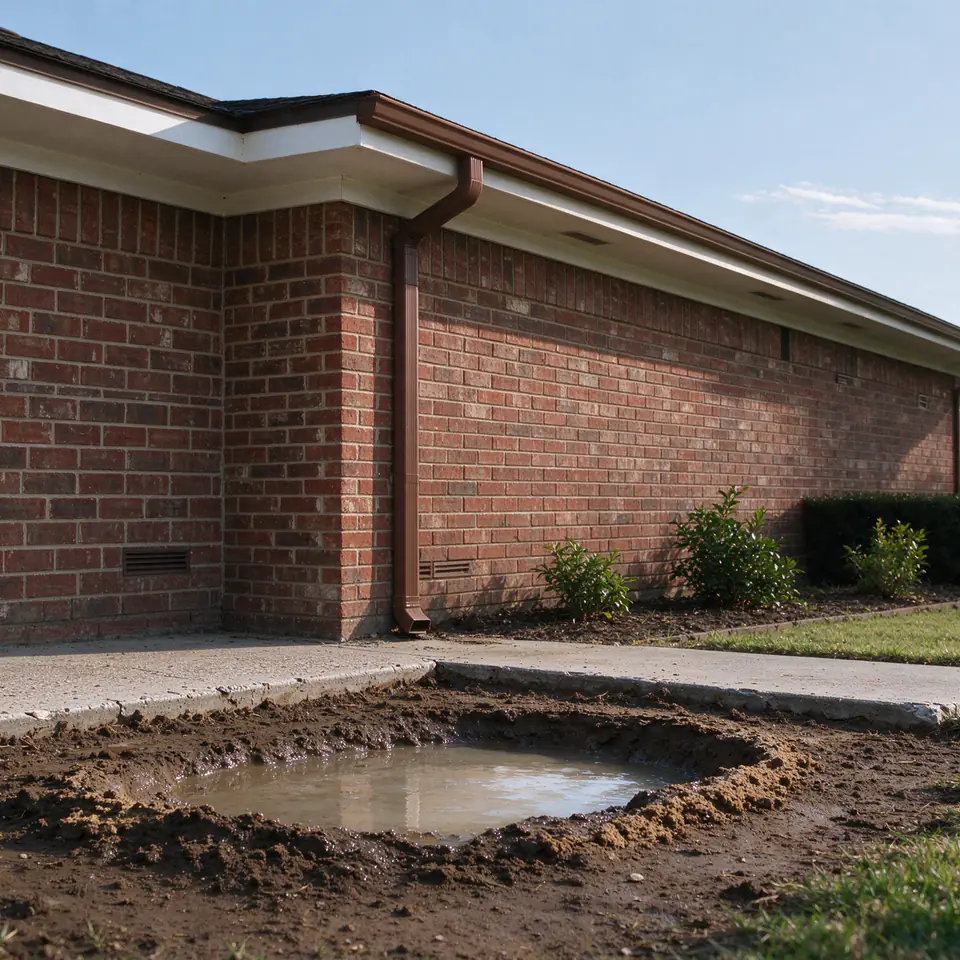
Water pooling against the slab after storms?
A downspout pouring onto the bed, mulch that slopes toward the brick, a soil gap that opens along the beam every August. Each one changes how much water the clay at the slab edge takes in.
Clay Plano Drainage Company handles the water side of that picture: downspouts, grade and drains around the house. We don’t assess, repair or level foundations. This guide explains how drainage and clay interact, and where our work ends and a foundation professional’s begins.
Why moisture matters on Plano clay
Houston Black, the clay under most of central, east and north Plano, changes volume with water. The USDA soil survey rates its plasticity index at 45 and its linear extensibility at about 12%, both in the high range.
What those numbers mean around a house:
- It swells when wet. A bed that takes roof water every storm keeps that clay swollen.
- It shrinks when dry. Through a hot summer, clay along the slab can pull back and open a gap at the beam.
- It moves unevenly when moisture is uneven. A slab sitting on wet clay on one side and dry clay on another rests on ground that behaves differently from edge to edge.
Clay near Canyon Creek in Richardson is rated even higher, at a plasticity index of 55. Far west Plano’s thinner Eddy and Stephen soils over chalk behave differently, and there the rock matters more than the swell.
Where water reaches a slab
Storm water reaches a foundation from a handful of places, and you can see each one in a heavy rain.
| Source | What you see | The drainage fix |
|---|---|---|
| Downspouts | Water gushing onto the bed at a corner | A solid downspout line to the street side |
| Grade sloping toward the house | Water running back to the brick after it leaves the roof | Yard regrading to fall away from the slab |
| Beds and borders | Edging that holds water against the beam | Reshaped beds and an opening for water to leave |
| Paving | A patio or walk tilted toward the house | A channel drain or a reset slope |
| Sprinklers | Spray hitting the slab and siding every cycle | Adjusted heads and run times |
| Water held in the soil | A side that stays soft for days after rain | A French drain set back from the beam |
Rain arrives in bursts here. In central Plano, a storm with a 10% chance in any year drops 6.04 inches in a day, by NOAA’s rainfall atlas, and a downspout concentrates the roof’s share of that at one point.
The grade a foundation needs
Ground next to a slab should drop away from it. Neighboring cities publish the target, and it’s a good one for any Plano house.
- McKinney’s Engineering Design Manual calls for finished grade to fall at least 6 inches in the first 10 feet from a building, or 5% where something prevents that, with water directed to drains or swales.
- Paving within 10 feet of the building should slope at least 1% away under the same manual.
- Garland’s Technical Standards Manual uses the same 6 inches in 10 feet in its lot grading checklist.
Six inches over 10 feet is a 5% slope, and years of mulch and soil top-ups in the beds can erase it. Richardson’s stormwater guidance says the same in plain words: keep a gentle slope away from the house, and point gutters and pipes away from it.
What drainage can’t do
Drainage work changes where water goes. It doesn’t lift, level, stabilize or repair a foundation, and it can’t promise that a slab won’t move.
These signs call for a foundation engineer or repair firm before any drainage plan:
- New or widening cracks in brick, drywall or the slab
- Doors and windows that start sticking or won’t latch
- Floors that slope or feel uneven
- Gaps opening between trim, cabinets or countertops and the wall
A foundation professional assesses the structure and its causes. When they’re done, or alongside their work, the drainage plan deals with the storm water at the slab edge.
Building drainage near a slab
How a drain is built next to a foundation matters as much as what it collects. We follow a few rules near the beam.
- Solid pipe along the house. Downspout lines and conveyance runs are solid, so collected water doesn’t leak back into the clay at the slab.
- Collection set back. A French drain that gathers soil water sits away from the beam, so the trench doesn’t dry the clay right under the edge.
- The whole house, not one wall. We look at every side, so one edge doesn’t end up much wetter or drier than the others.
- Outlets away from the slab. Water leaves at the street side of the lot, through an emitter or a permitted curb outlet.
Our typical range for drainage around the slab is $2,000 to $6,000 per project; the site visit and written estimate set yours. Foundation drainage covers that service in full.
Watering and dry spells
Clay that dries hard in summer and soaks in spring swings the most. Keeping it even is partly a watering question, and that part is shared with your foundation professional.
On the drainage side, keep irrigation even around the house, keep spray off the slab, and fix any zone that leaves one side soggy in dry weather. The guide to a soggy yard without rain helps find a leak or a zone running long.
Where to read next
Three guides go further into the parts of this problem that drainage handles.
- French drains in clay soil: how a collection drain is designed for slow ground
- How to fix yard drainage problems: finding every source before choosing a fix
- Where yard drain water can go: legal outlets in Plano
If storm water is reaching your foundation, call (469) 551-8518 or send photos through the form below. We’ll walk the house with you and plan the drainage around it.