
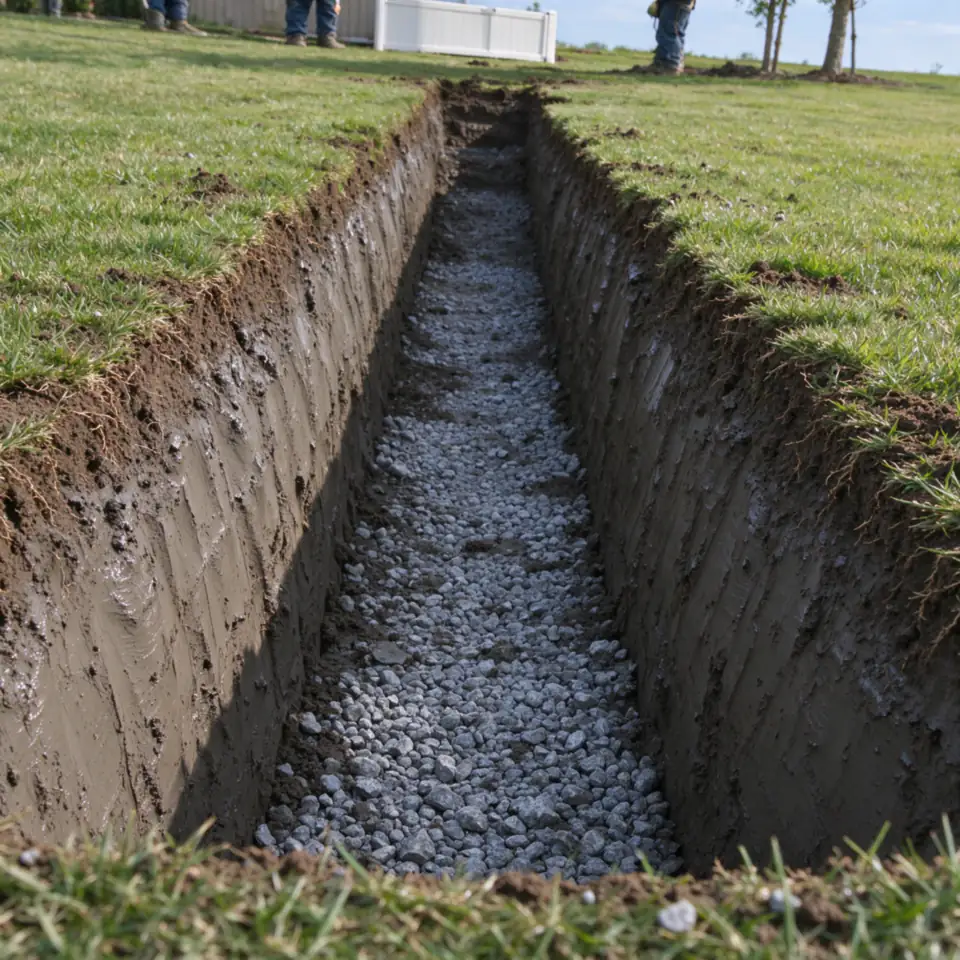
Heard that French drains don’t work in clay?
You may have heard it from a plumber, a landscaper or a neighbor, often after an old drain quit. Clay doesn’t rule a French drain out. It rules out a drain built as if the ground were sand.
Clay Plano Drainage Company plans and builds French drains in Plano’s clay. This guide explains how water behaves in that soil, what the design changes because of it, and the signs that a yard needs something else.
How water moves through Plano clay
Water moves through Houston Black, the soil under most of central, east and north Plano, at about 0.21 micrometers a second once the clay is soaked. That’s roughly three quarters of an inch a day.
That speed explains most of what a drain can and can’t do:
- A trench drains the soil near it. Water a few feet away takes a long time to reach the stone.
- Wet ground stays wet. After a storm, water held near the surface can sit for days with no high water table beneath it.
- Rain arrives far faster. A storm that drops 1.80 inches in an hour, which central Plano has a 50% chance of seeing in any year, overwhelms the clay’s intake in minutes.
The USDA soil survey puts this clay in hydrologic group D, the slowest-draining class. Murphy, Parker, Wylie, central Allen and much of McKinney sit on the same soil.
Shrink, swell and cracks
Houston Black has a plasticity index of 45 and a linear extensibility of about 12%, both high. In plain terms, it swells as it wets and shrinks hard as it dries, opening cracks through a dry summer.
Those cracks take in the first water of a storm quickly, then close as the clay swells. A drain that seems to work in a summer storm can behave differently by the second wet week in spring.
What a clay-built French drain does differently
The parts are the same as anywhere: a trench, filter fabric, washed stone, perforated pipe, then solid pipe to an outlet. In slow clay, each one is sized and placed for the soil.
| Design choice | In fast-draining soil | In Plano clay |
|---|---|---|
| Where the trench goes | Anywhere in the wet area | Exactly where water enters or collects, found by probing |
| How much stone | Enough to bed the pipe | A larger stone zone that stores water while the clay releases it |
| Fabric | Sometimes left out | Wraps the stone fully, because clay fines are what clog the drain |
| Pipe fall | Helpful | Essential, since the soil around the pipe won’t take the water back |
| Outlet | Can sometimes soak away | A real outlet at the street side of the lot, every time |
| Near the slab | Little effect | Set back, so the trench doesn’t change moisture under the beam |
We probe the soil on the first visit to see whether the water is held in the ground or sitting on top. That single check decides whether a French drain belongs in the plan at all.
Washed stone, not rock from a pile
Unwashed rock carries its own fines and brings them into the trench on day one. Washed drainage stone keeps the open space between stones, and that space is where water waits for the pipe.
Why some clay drains quit early
When a French drain stops working in clay, look first at how it was built. These are the build faults to check for.
- No fabric, or fabric that doesn’t close over the top, so clay sludge works into the stone and seals it.
- A trench in the wrong spot, through the middle of a wet area that the water actually enters from one edge.
- No real outlet, so the pipe ends in the yard and the stone stays full.
- A belly in the pipe, a low section that holds silt and water.
- Roof water piped into the stone, which fills it before soil water can get in.
The guide on how long a French drain lasts covers how to tell which one has happened and what repair involves.
When clay calls for a different fix
A French drain is for water in the soil. If the water sits on top in a low spot or runs across the lawn during the storm, clay sends it off as runoff long before a trench could take it in.
| What you see | A better first fix |
|---|---|
| A puddle that fills mid-storm in one low spot | A catch basin or a small regrade |
| A sheet of water across the lawn | Yard regrading to give it a route |
| Water at one roof corner | A solid downspout line |
| A wet patch in a dry week | A sprinkler repair; see a soggy yard without rain |
The decision guide to French drains or catch basins compares the two side by side.
Far west Plano: faster soil, shallow chalk
Around the Dallas Parkway and Arbor Hills, the soil is Eddy gravelly clay loam and Stephen silty clay. Eddy passes water at about 7.2 micrometers a second, around 34 times faster than Houston Black.
The catch is depth. Both soils sit shallow over chalk, so water moving down stops at the rock and runs along it. A trench there may hit chalk before it reaches the depth a clay design would use, and the route is set to keep its fall above the rock.
Clay drains need a sure outlet
Because the ground around the pipe won’t soak up what the drain collects, every foot of pipe has to fall to a place where water can legally leave. In Plano that means the street side of the lot.
- Our typical range for a French drain is $25 to $60 per foot; the site visit and written estimate set yours.
- The French drain cost guide covers what moves the price.
- Where yard drain water can go explains the outlet choices.
If your yard stays soft for days after rain, call (469) 551-8518 or send photos through the form below. We’ll probe the soil, find where the water enters and tell you whether a French drain is the right fix.