
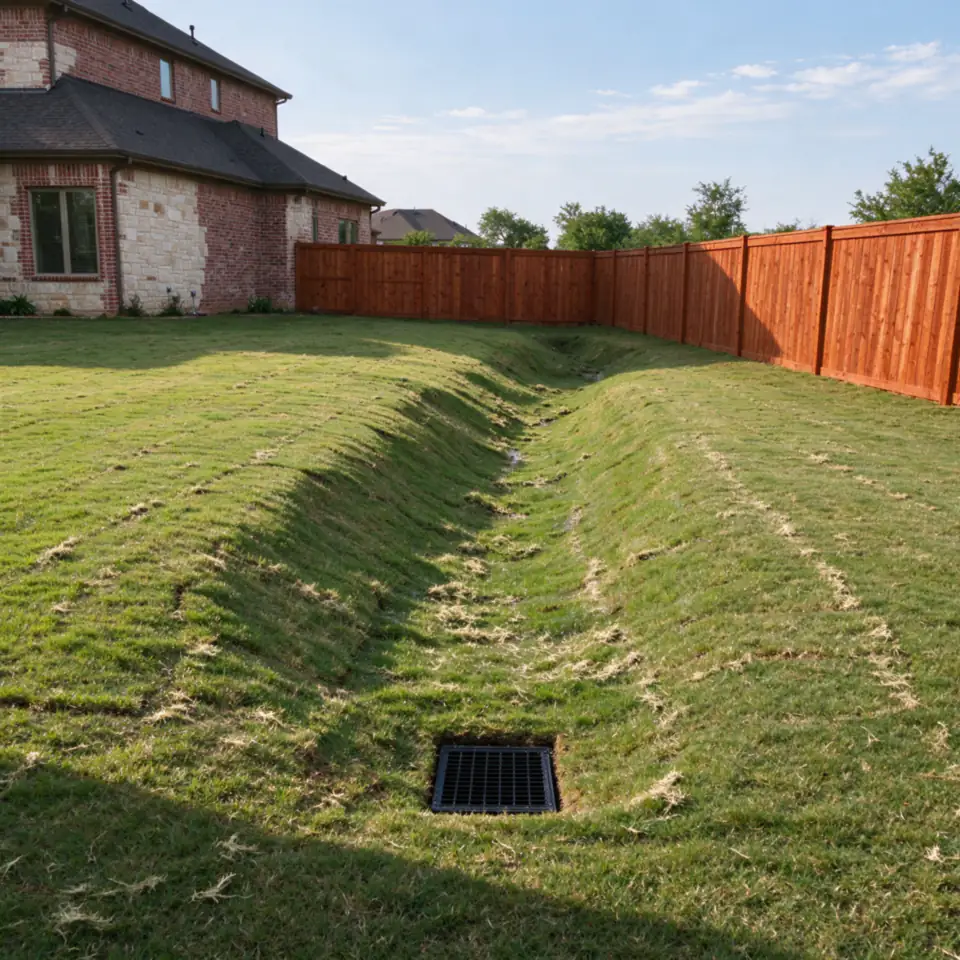
Your neighbor’s water ends up in your yard?
Every storm, water pours over from the lot next door and settles in yours. Clay Plano Drainage Company builds swales, drains and re-grading in Heath to catch that water and carry it somewhere it can go.
What makes Heath different is who handles it. Between two lots, the city treats the drainage as a matter for the owners.
Two-lot drainage is a private matter
Heath’s drainage participation process says lot-to-lot drainage between two or fewer lots is considered a private matter. In plain terms: if the water problem involves only you and one neighbor, the city generally won’t step in to fix it.
That doesn’t leave you stuck. It means the solution gets planned on the ground, between owners, and it tends to hold up when both sides understand it.
- On your side: a swale or side-yard pipe along the fence line that intercepts the water and carries it to the front.
- At the low spot: a catch basin that collects water where it pools and sends it through solid pipe.
- On both sides: a shared swale both owners keep open, which often moves the most water for the least work.
Our guide to water from a neighbor’s yard explains how Texas law treats runoff between lots and how to raise it with the people next door.
Easements you have to keep clear
Heath describes drainage easements as private land reserved for stormwater: swales, ditches, pipes and creeks. The owner is responsible for keeping them clear.
That’s a bigger deal than it sounds. A shed, a raised bed or a fence across a back-line swale can turn a channel that used to carry two lots’ runoff into a dam.
| What’s in the easement | What it means for you |
|---|---|
| A grassed swale | Keep it mowed and open, not filled or planted over |
| A ditch or pipe | Keep it free of debris and growth so it flows |
| A creek section | Keep the channel clear; your land, your upkeep |
| Fences, sheds, beds | Check the plat before building anywhere in it |
When a swale has filled in over the years, regrading it back to a steady fall is often the simplest fix. The easement guide shows how to find yours.
Re-grading with a plan on paper
Heath’s residential re-grading permit asks for two sets of contours, the ground as it is and as it will be, with flow arrows that end at an approved collection point. The city wants to see where the water goes before any soil moves.
We take the elevations on the first visit, so the drawing comes from measured ground rather than a guess from photos. The written estimate includes it, along with how much soil moves, where it comes from and how the new slope ties into the lawn beside it.
Why the collection point matters
A re-grade that only pushes water off your lot onto the next one fails the test before it starts. The arrows have to finish somewhere the water is allowed to go: a street, a public channel, or another point the city has approved. That’s also why yard regrading and a drain are often designed together.
Slopes toward lower ground
Heath sits on the east shore of Lake Ray Hubbard, and where a lot falls toward lower ground, runoff can pick up speed. When it moves fast across a slope, it takes topsoil and seed with it and starts to cut a path.
The answer is less about collecting water and more about slowing it:
- A shallow swale across the slope catches sheet flow before it gathers speed.
- Rock at the outlet absorbs the energy where a pipe lets go.
- A level spreader releases a line’s water across a wide strip instead of one point.
We probe the soil on the first visit, because how it drains decides how much water reaches the outlet at all.
Talking it through with the neighbor
Because a two-lot problem stays between owners in Heath, a little preparation goes a long way. You don’t need to prove anything; you need a shared picture of where the water goes.
- Film the next storm from your side of the fence, showing where water enters.
- Walk the line together on a dry day and look at the swale, the fence bottom and any downspouts that point your way.
- Share the plan. Our written estimate shows the route and the grade, which gives both of you something concrete to look at.
- Agree on upkeep for any swale that serves both lots, since an easement you share only works while it stays open.
Around Heath
FM 740, Ridge Road, runs through Heath north toward Rockwall. Each nearby city sets its own drainage rules:
- Rockwall reviews plats for no lot-to-lot drainage, with sheet flow at the property line or an easement on the neighbor.
- Rowlett keeps pool equipment out of drainage swales and designated drainage flows.
- Sunnyvale inspects private drainage structures outside the building footprint by the linear foot.
How we approach a Heath yard
We start by finding where the water enters your lot and where it is allowed to leave. With two-lot problems handled privately here, that answer is the foundation of the plan.
- Entry and exit mapped before any route is drawn.
- Fall measured along the whole path.
- System tested with water before backfill.
- Yard restored with sod returned in strips and sprinkler lines repaired.
- Roof water handled separately with buried downspout lines, so the yard drain only carries ground runoff.
If you’re sorting out where to begin, our step-by-step guide lays out the order. To see where the water can legally end up, read where yard drain water can go.