
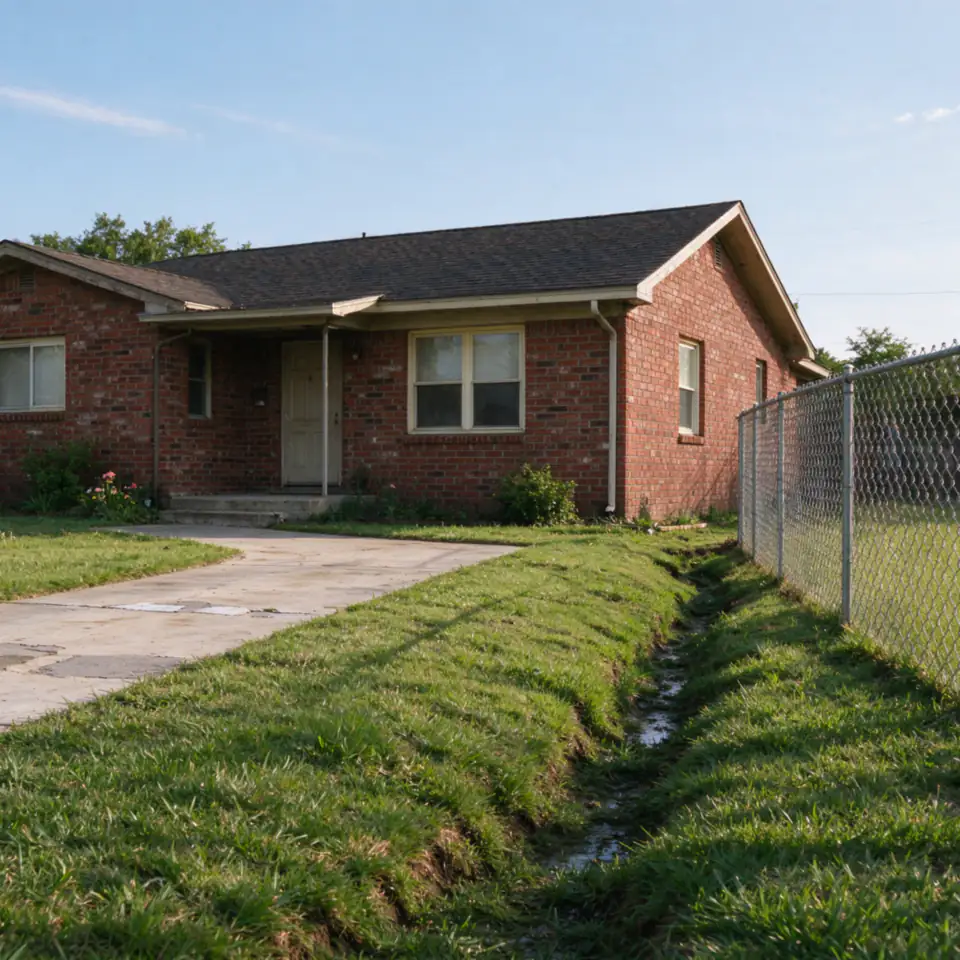
Is your yard draining into the neighbor’s?
Water crossing a property line starts small: a soggy corner by the fence, a wet stain on the neighbor’s patio. Clay Plano Drainage Company plans and builds yard drainage in Garland, including French drains, side-yard swales, catch basins and regrading.
In Garland, the direction the water takes is a rule, not just a preference. The city’s standards keep surface water from running lot to lot, so every route we draw ends at an outlet your own lot can use.
Garland’s rule on water between lots
Garland’s Technical Standards Manual, section 4.12.D, prohibits lot-to-lot surface drainage across property lines in single-family subdivisions. Water that falls on your lot has to leave by your lot’s own path.
That rule shapes the fix more than the pipe does. A drain that dumps the problem onto the next yard isn’t an option, so we start with where your water is allowed to go and work back to where it collects.
| What you want to do | What Garland asks | How we plan it |
|---|---|---|
| Let surface water run onto the next lot | Not allowed in single-family subdivisions | Turn it toward your own street-side outlet |
| Run a private pipe across a neighbor’s lot | The adjacent owner’s written acceptance | Ask early; route around their lot if they decline |
| Build in a drainage easement or the right-of-way | Right-of-Way/Easement permit, registration, engineered plan sheet | Put the permit and plan sheet on the schedule before the dig |
| Set a fence in a floodplain or drainage easement | Engineering approval | Flag it on the estimate if the route meets a fence |
The guide to water from a neighbor’s yard covers what you can ask of the lot uphill from yours.
When the only fall is through the house next door
Where a Garland lot sits lower than the street at the front, the natural fall can run out the back or across a side neighbor. A private storm line on someone else’s lot needs that owner’s written acceptance under the city’s standards.
We ask about this on the first call, because it changes the design. With the neighbor’s signature, a solid pipe across their lot can be the shortest legal route. Without it, the water has to be lifted, held or turned:
- A catch basin and solid pipe that wrap around the house to the front, if the elevations allow it.
- Regrading the back yard so surface water reaches the side swale instead of the rear fence.
- A yard pump basin when nothing on your lot falls toward the street.
The French drain vs catch basin guide explains which collector fits which kind of wet spot.
Easements, fences and the plan sheet
Garland asks for a Right-of-Way/Easement permit for work in city right-of-way or in an easement. The application wants registration and engineered plans drawn at a scale of 1 inch to 50 feet or larger.
For you, that means a drain through an easement isn’t a weekend start. What the plan sheet carries:
- The route drawn on the lot, with each basin, cleanout and bend.
- Depth and fall from the collector to the outlet.
- The outlet and how the water leaves the easement.
- Restoration, so the city can see what goes back over the line.
We arrange the permit as part of the job and show it as its own line on the estimate.
Fences are the other easement question in Garland. Engineering approval is needed before a fence goes into a floodplain or drainage easement, and a back-lot fence can sit right on the swale. Our guide to drainage easements shows how to read your plat and find where yours run.
Grade around the slab
Garland’s grading checklist asks for 6 inches of fall within the first 10 feet from the structure. Unpaved swales need at least 1% slope, paved swales 0.5%, and side slopes stay at 3 to 1 or flatter.
The standards also set the house pad at least 12 inches above the lot’s lowest primary drainage point. Over the years, the ground next to the slab can creep up until that fall is gone:
- Mulch and bed soil topped up every spring.
- Edging and borders that hold water in a strip against the wall.
- New sod laid over the old grass without cutting the old layer out.
When that is the cause, a pipe isn’t the first answer. Yard regrading takes the soil back down and reshapes the swale, and downspout lines move roof water past the beds so it no longer lands at the slab edge.
From the lake side to the turnpike
Garland covers a lot of ground, from the I-635 and I-30 corridors in the south to the President George Bush Turnpike across the north, with SH 78 and SH 66 running through it. Its eastern edge reaches Lake Ray Hubbard.
We don’t assume a soil type for your street. On the first visit a soil probe shows what the trench will meet and how slowly the ground takes water, and that decides how much stone and fabric a French drain needs and whether a basin does the job better.
Neighbors with their own rules
Cross a city line and the drainage rules change. The cities next door draw theirs differently:
- Richardson designs its streets and alleys to hold water up to the top of the curb in large storms.
- Rowlett requires a grading permit for adding, removing or moving dirt on a lot.
- Sachse asks for a permit with a plot plan for residential grading and flatwork.
Why we start at the outlet
In a city that won’t let water cross into the next yard, the outlet decides everything else. We pick it first, then shape the route to reach it with steady fall.
- Outlet before route. A street-side emitter, a curb line through the permit, or a pump basin when gravity won’t reach.
- Neighbors asked early. If a route needs another lot, the conversation happens before the price, not after.
- Cleanouts where lines join or turn, so a section can be flushed later instead of dug up.
- Water run before backfill. We find any low spot while the trench is still open.
- A walk-through at the end so you know where every line and grate sits.
The guide to where yard drain water can go lays out the outlet choices side by side, and whole-yard drainage covers yards where water comes from more than one direction.