
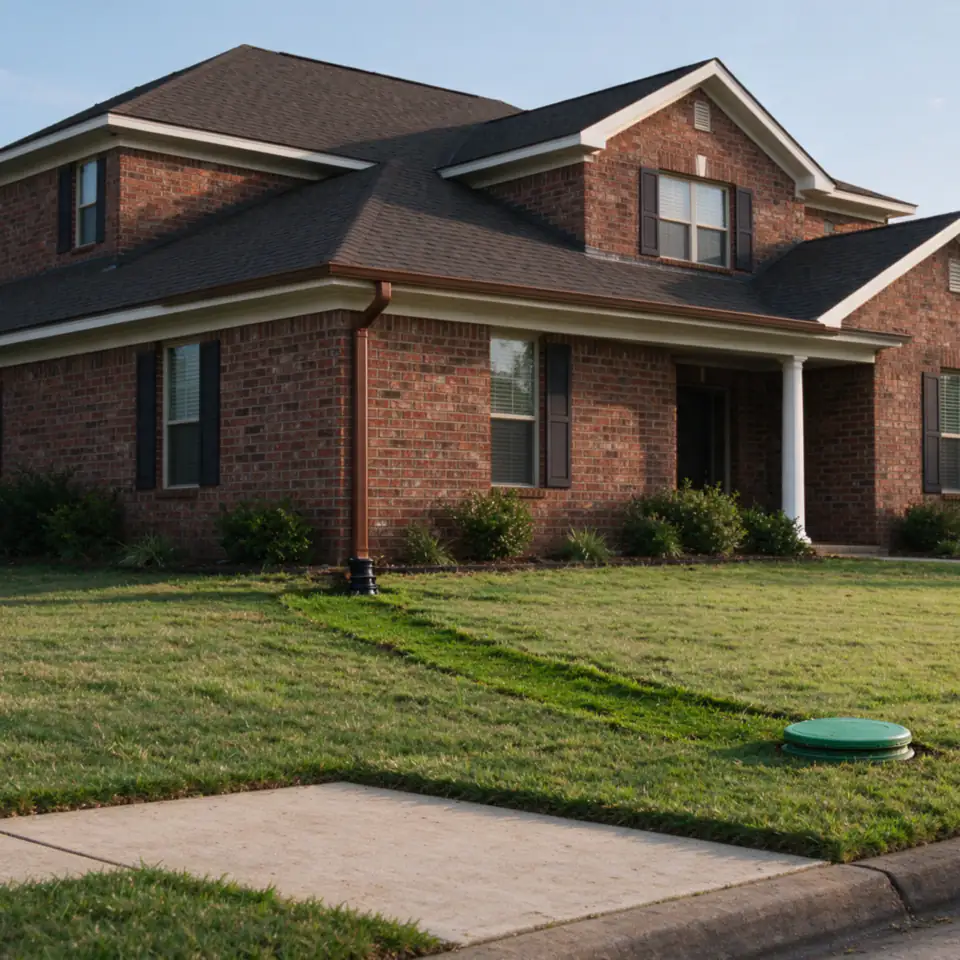
Soft lawn long after the rain stops?
A Murphy yard that stays spongy for days, or a bed that floods beside the slab, usually has nowhere for water to go. Clay Plano Drainage Company builds French drains, downspout lines and slab drainage in Murphy.
Two things shape every job here: the clay under the lawn and the order of the permits. The heavy clay decides how we build the drain. The permits decide when we can start digging.
Easement and curb work needs its own permit
Murphy’s right-of-way/easement permit covers public street right-of-way and the drainage and utility easements recorded on your plat. It is pulled by whoever does the digging, and on our jobs we arrange it with everything else.
The timing matters more than the paperwork:
- Locate. The city won’t issue the permit until the first utility line locate is complete.
- Permit. Processing runs about 48 hours once the application is in.
- Dig. Only then does the trench open inside the easement or right-of-way.
| Where the route runs | What Murphy asks |
|---|---|
| Entirely on your own ground, no easement crossed | We check this with Murphy for your address |
| Through a drainage or utility easement | Right-of-way/easement permit |
| To the curb or driveway approach | Utility permit, plus the easement permit where it applies |
If you’re not sure what’s recorded behind your fence, our easement explainer shows where to look on a plat.
When the drain comes with new concrete
Sometimes a drainage problem comes to light just as you’re planning a patio or a wider drive. Murphy treats that combination carefully: residential flatwork needs a building permit with the easements shown, and drainage, curb or approach work brings a utility permit as well.
That’s a good reason to design them together. A slab poured first can sit right on the natural drain route, and a drain dug first can end up under the forms.
- Plan the outlet before the slab, so pipe can run under or around it.
- Add a catch basin where the new slab will create a low corner.
- Leave cleanouts outside the concrete, so the line can be flushed later without breaking anything.
Houston Black clay under Murphy
Murphy is mapped on Houston Black clay, the same soil mapped across central Plano. It is about half clay, drains at roughly 0.03 inches an hour and swells by a large margin when it gets wet.
For you, that shows up two ways. First, rain that soaks in can’t get deeper, so the lawn stays soft and low spots hold puddles. Second, the slab rests on soil that swells where it’s soaked and shrinks where it’s dry, so a wet corner and a dry corner pull it in different directions.
What that means for the drain
A French drain here gets a deeper bed of washed stone, a fabric wrap that keeps clay fines out of the pipe, and an outlet we’ve confirmed before trenching, since the trench walls give almost nothing back to the ground. Our page on drain design for heavy clay goes through each layer.
Along the house, foundation drainage starts with the roof: we pipe downspouts away first, then deal with the beds.
The outlet comes first
Whatever the drain gathers ends up somewhere, and it can’t be next door. Under Texas Water Code section 11.086 nobody may redirect or pond natural runoff so that it harms someone else’s land, which is why a Murphy route usually ends on the street side.
The end point might be an emitter that lifts open in the front lawn, or pipe carried out to the curb, and the curb option is where the utility and easement permits come in. Our outlet options guide compares them.
Across the city line
Murphy runs along FM 544 with Murphy Road heading north toward Parker, and each neighbor has its own rule.
- Parker lays lots out so drainage doesn’t concentrate one lot’s stormwater onto the next.
- Wylie issues construction permits for right-of-way work through an online portal with a registration good for one year.
- Sachse requires a permit for any residential grading or flatwork, with a plot plan.
How we run a Murphy job
We pick the outlet, then the route, then the method. In a city that ties the permit to a completed locate, the locate is the first call we make.
- Source first. Gutters, a neighbor’s higher grade, an overspraying sprinkler head and saturated clay call for different collectors.
- Fall measured from the wet spot to the outlet, so the line keeps draining.
- Water tested through the system before backfill.
- Yard restored, with sod back in its strips and crossed sprinkler lines repaired.
If the lawn holds water but nothing seems to feed it, our page on standing water in the yard covers how we find the cause.
Getting ready for the visit
The wettest months on the Plano record are May and October, so spring and fall storms are when Murphy yards give themselves away. A phone video during one is the most useful thing you can send us.
Add your address and any survey you have. If you’re planning flatwork, tell us early so both permits can be arranged at once.
- Where the water stands and how long it stays after the rain ends.
- Which downspouts run into the beds and which already have extensions.
- Any cracks you’ve noticed in interior walls or along the slab edge, so we can look at the drainage near them. That’s a moisture question for us, not a structural verdict.
- Gates and access. Tell us how wide the side gate is, since that decides how we bring stone and pipe in.