
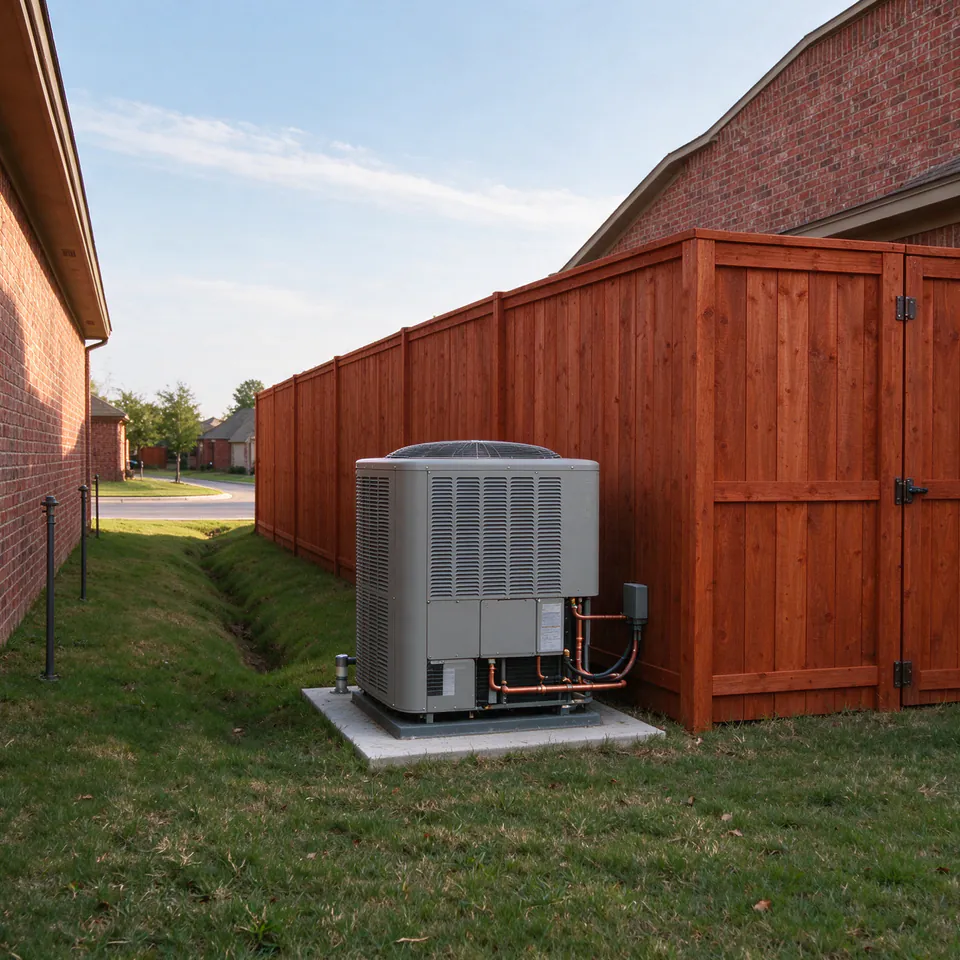
Side yard holding water after every storm?
The strip between two houses has to carry water from both back yards to the street, and anything built in it slows the flow.
Clay Plano Drainage Company fixes side-yard swales and builds French drains, basins and channel drains in Allen. Allen spells out what may sit in a side swale. That detail is our starting point for deciding whether to reshape the swale, move water past an obstruction, or both.
What Allen allows in a side swale
Allen’s standard construction details for residential lot drainage, sheets SD-RL01 to SD-RL04, show how a lot sheds water and how close improvements may come to the swale. The current set dates from a May 2017 revision.
The details group lots into three grading types, A, B and C, by how the water leaves. They also cover side-swale encroachment, the part that matters most in a side yard:
| What sits in the side yard | What Allen’s detail allows | What it means for drainage |
|---|---|---|
| A concrete slab (patio, walk, AC pad) | No more than 1 foot into the side swale | A wider slab pinches the channel and backs water up |
| A screening fence | Cantilevered over the drainage easement | Posts stay out of the water’s path |
| The fence’s reach | Not past the slab footprint | The swale stays open beyond the slab |
When a slab or fence already crowds the swale, there are two ways forward. One is to bring it back within the detail. The other is to let the water pass underneath with a basin upstream and solid pipe past the pinch point. We lay out both on the estimate.
Fixing a crowded side yard
The fix depends on how much room is left. A swale that only lost its fall gets reshaped. A swale with a slab across it needs a way past.
- Reshape the swale. Where the strip is open, we re-cut the channel to a steady fall from the back corner to the street.
- Pipe past the pinch. A catch basin collects water above the slab or pad, and solid pipe carries it under to open ground.
- A channel drain across a walk. Where a side walk runs the full length, a channel drain can catch sheet flow and hand it to a buried line.
- Both neighbors in mind. The swale serves two lots, so the work keeps it draining for the house next door too.
The side-yard drainage page covers the method, and the guide to drainage easements explains how to find the easement on your plat.
Flat ground near Rowlett Creek
Soil maps put Tinn clay along the Bethany and Rowlett Creek areas of west Allen. It sits on 0 to 1 percent slopes, it is listed as occasionally flooded, and it drains very slowly.
That combination is hard on a gravity drain. With almost no fall across the lot, a pipe has nowhere to drop to, and the soil around it won’t take the water either. On a flat west-side lot, the realistic options are:
- Regrade toward the street, if the front of the lot sits low enough to receive it.
- A yard pump basin that collects water at the low point and lifts it to a street-side outlet.
- Check the floodplain first. Ground that floods from the creek is a different problem from a yard that won’t drain, and work there is confirmed with the city for the address.
The floodplain or drainage problem guide helps sort one from the other.
Central Allen’s heavy clay
Most of central Allen sits on Houston Black clay, the same heavy clay found under much of Plano. It takes in water very slowly and swells when wet, so rain sits on top of the lawn instead of soaking in.
A French drain in that soil is built for it:
- More stone around the pipe, so the trench holds water while the pipe carries it away.
- Filter fabric against the clay, to keep fines from silting the stone.
- An outlet that works every time, because the soil around the trench won’t take the water.
The guide to French drains in clay soil shows the build. If a patch of lawn stays wet even in dry weather, the cause may be a sprinkler leak or seepage instead; the soggy yard guide explains how to tell.
Planning a patio or fence in the side yard?
The easiest swale to fix is the one that never gets blocked. If you’re about to pour a slab, set an AC pad or put up a fence beside the house, a few checks first can save a drainage job later:
- Find the easement on your plat before you mark the fence line.
- Keep slabs within a foot of the swale edge, as Allen’s detail allows.
- Ask how the fence spans the swale, so the posts land outside the channel.
- Leave the low line open from the back corner to the street, with no edging or beds across it.
- Think about downspouts on that side, which may need a buried line before the slab goes down.
If the slab has to go where water runs today, a solid pipe under it, laid before the pour, is far simpler than cutting concrete later. We can plan that line with you ahead of the work.
Work in the right-of-way
When the outlet crosses the parkway, Allen’s right-of-way process applies. The city has taken applications online since March 3, 2026, and asks applicants to check its GIS utility map before they apply.
Locates for right-of-way work need three things: the permit number, a Texas811 ticket and a location map of the work. We handle that sequence as part of the job and show the permit as its own line on the written estimate.
Allen and the cities around it
Allen spans US 75 and SH 121, with SH 5 along its east side. Cross a city line and the drainage rules change:
- McKinney leaves private swales and natural creeks on a lot to the owner to maintain, even inside an easement.
- Lucas asks for a permit before work in or near a street, right-of-way, easement or public way.
- Frisco requires a Public Works permit for any work in city right-of-way or easements.
How we approach an Allen side yard
The swale comes first, the pipe second. A side-yard fix is usually about giving the water back its path.
- Measure the encroachment. How far each slab, pad and fence reaches into the swale.
- Read the fall from the back corner to the street, not just where it is wet.
- Choose the outlet before the route, at the street side of the lot.
- Run water through the swale or pipe before backfill.
- Restore and walk through. Sod back in strips, sprinkler lines repaired, and the route shown to you.
Where the whole lot tilts the wrong way, yard regrading resets the slope before any pipe goes in.