
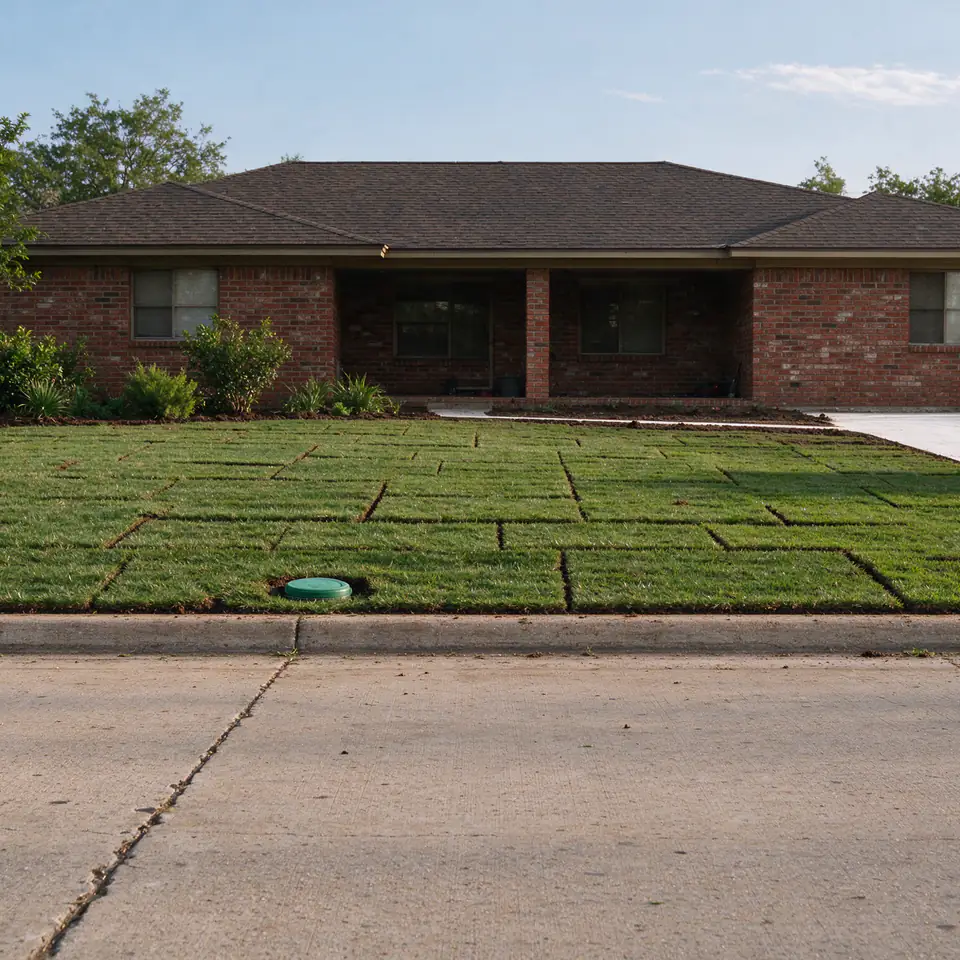
Low spot in the lawn that never dries?
A puddle that sits in the same spot after every rain shows you where the ground has settled. Fill it the quick way and it often sinks right back.
Clay Plano Drainage Company regrades yards and builds French drains and catch basins in Mesquite. Mesquite’s grading rules work in your favor on most existing homes. The bigger question is how the soil goes back in, because the city sets a compaction standard for fill.
Do you need a grading permit in Mesquite?
For an existing home on a lot under an acre, no. Mesquite’s grading and floodplain development permit package requires a grading permit from the City Engineer to fill, grade or excavate, with one exemption that covers many established homes.
Existing single-family lots with an existing residence and under one acre are exempt from the permit, the deposit and the fee. That makes a typical back-yard regrade on an established street a matter of doing the work right, not of waiting on paperwork.
| Your lot | Mesquite grading permit | What we plan for |
|---|---|---|
| Existing house, under one acre | Exempt from permit, deposit and fee | Schedule as soon as locates are in |
| One acre or more | Grading permit from the City Engineer | Permit on the schedule before the first cut |
| No house on the lot yet | Grading permit from the City Engineer | Permit and the lot’s grading plan first |
| Fill in right-of-way or easements | Compacted to 95% standard proctor | Thin compacted lifts and an outlet confirmed for the address |
The exemption covers the permit, not the result. Regrading still has to send water toward your own outlet and away from the house next door.
Why fill has to be compacted
Mesquite asks for fill on residential lots and pads, and within city right-of-way or easements, to be compacted to 95% standard proctor. That figure is a lab benchmark for how dense the soil should be once it is packed.
It matters for drainage because loose fill doesn’t stay where you put it. Dumped soil is full of air, and rain and time press it down:
- The low spot returns, sometimes deeper than before, because the fill settled unevenly.
- Grade by the slab drops, and water that used to run away starts running back.
- A trench over a pipe sinks into a long dip that collects water right above the line.
We place fill in thin layers and compact each one before the next goes on. Over a drain line, the backfill is compacted the same way so the lawn above stays level.
Regrade, drain, or both?
Not every wet Mesquite yard needs a pipe. Where the yard still has somewhere to send water, yard regrading alone can bring the fall back. Where water arrives faster than the grade can move it, a collector has to pick it up.
How we decide on the first visit:
- One local dip, good fall around it. Compacted fill and new sod.
- Whole yard tipping toward the house. Regrade the back yard so the slope leaves the slab.
- Low corner with no fall to the street. A catch basin and solid pipe to an outlet.
- Soggy strip fed by roof water. Downspout lines first, then see what’s left.
- Wet ground with no obvious source. We look for sprinklers and seepage before calling it a drain job; the standing water page explains why.
The guide to fixing yard drainage problems walks through the same order in more depth.
Where the water leaves your lot
Regrading moves water; it still needs somewhere to go. Texas Water Code section 11.086 makes it unlawful to divert or impound natural surface flow in a way that damages another person’s property, so a new slope can’t simply aim at the fence.
The usual answer is the street side of the lot. The choices we weigh:
- Sheet flow to the front yard, where the new grade carries water around the house to the street.
- A pop-up emitter in open lawn near the curb, fed by solid pipe from a basin or downspout.
- A line to the curb, which crosses the parkway; the city’s steps for it are confirmed for your address.
- A yard pump basin when a back yard sits lower than the street and nothing else can reach.
The guide to where yard drain water can go compares these outlets in more detail.
Patios, drives and channel drains
Hard surfaces change how fast water reaches the lawn. A wide patio or a driveway that slopes toward the garage can deliver a whole storm’s worth of water to one edge at once.
Where that is the problem, a channel drain set across the slab catches the sheet of water and hands it to a buried pipe. On a regrade job, we check that the new lawn grade meets the slab edge without creating a lip that holds water against the concrete.
Around I-635 and I-30
Mesquite sits where I-635 and I-30 cross, with US 80 running east and SH 352 through the middle. The cities around it each handle grading a little differently:
- Sunnyvale uses a grading or floodplain development permit and inspects private drainage structures by the foot.
- Garland bars surface water running from lot to lot in single-family subdivisions.
- Rowlett needs a grading permit any time dirt is added, removed or moved on a lot.
We don’t assume your soil from the city name. A probe on the first visit shows what the trench and the fill will be working with.
What a Mesquite regrade looks like
We keep the work tidy because the lawn is the finished product. Most of the job is ground you’ll see every day afterward.
- Sod cut in strips and set aside, so it can go back instead of being replaced.
- Soil on tarps, not on the grass or the drive.
- Silt controls so loose soil stays out of the gutter and the inlets.
- Fill compacted in lifts to hold the new grade.
- Water run across the finished slope, and through any pipe before backfill.
- A walk-through at the end, with sprinkler heads and lines put back.
Before the visit, it helps to know roughly how big the lot is, when the house was built, and whether anything new went in recently: a pool, a patio, an addition, a fence. Each one can change where water runs.
For a full picture of the day, see what happens during drainage installation. The yard regrading cost guide explains what moves the price.