
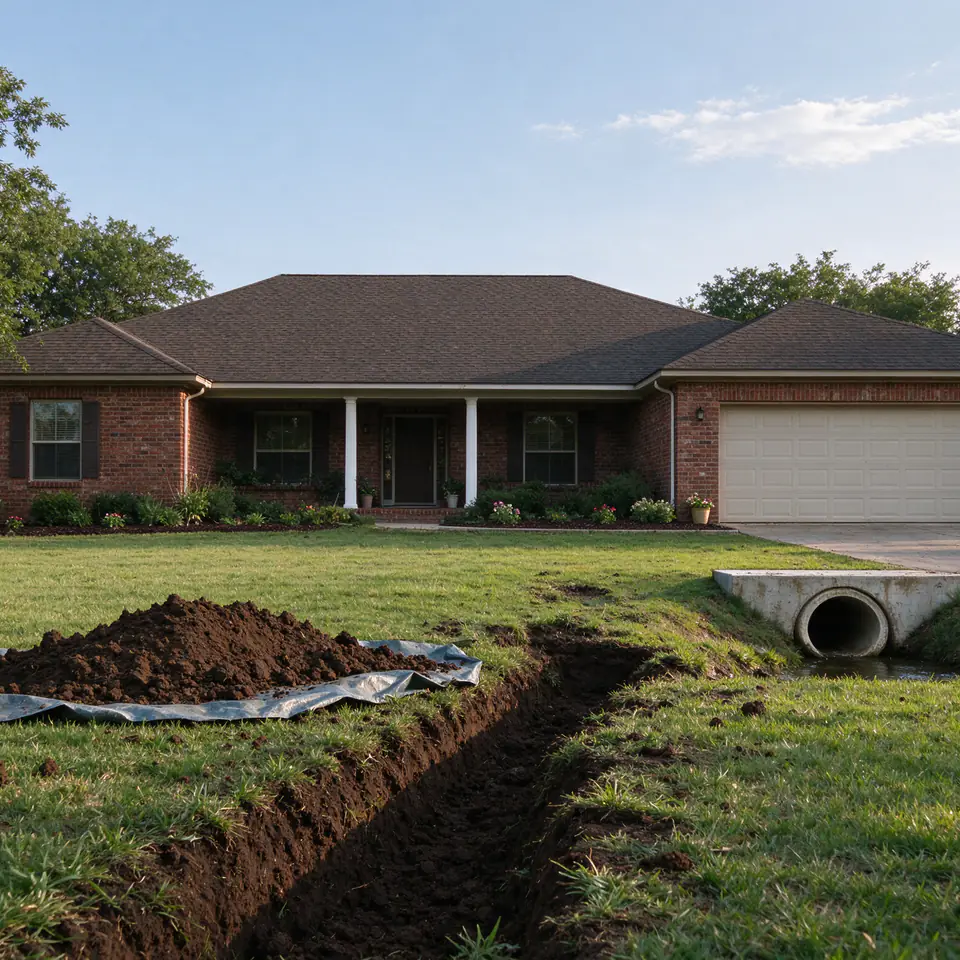
Water pooling on a big lot?
A low corner that stays wet, a slope that sends water back at the house, a ditch that won’t clear: on a wide lot each one starts with where the water is trying to go, and how far it has to travel.
Clay Plano Drainage Company installs French drains, catch basins and yard regrading in Sunnyvale.
Private drains, public inspection
One Sunnyvale detail is easy to miss. The town’s engineering fee schedule lists inspection of drainage structures outside the building footprint, private systems included, and it charges that inspection per linear foot.
So a drain that never leaves your lot can still be one the town looks at. We confirm what applies to your address and plan the job around it:
| Part of the job | What Sunnyvale’s schedule lists | How it shows in our estimate |
|---|---|---|
| Drainage structures outside the footprint | Inspection per linear foot | Route length and inspection on their own lines |
| Grading or work near floodplain | Grading or Floodplain Development Permit, base fee per acre | Permit line sized to the area we regrade |
| Culvert, headwall or drive approach | Permit at $300, inspection included | Separate line when the outlet touches it |
Because the inspection is by the foot, a shorter, smarter route saves you money twice: fewer feet of drain and fewer feet to inspect.
Keeping the route short
On a wide Sunnyvale lot, the first instinct is often a long French drain from the back fence to the street. Sometimes that’s right. Often a closer outlet or a different tool does the job with less pipe.
- A catch basin at a single low spot, piped a short way to open ground.
- Regrading to move surface water across the lawn without any pipe at all.
- A French drain only where water soaks in along a strip and has to be collected underground.
The guide to French drain vs catch basin explains how we choose between the two.
Low ground near a creek
If part of your lot runs down toward a creek or a mapped floodplain and the back of the yard floods, the cause may be the creek rising, not rain that has no path out.
Those are different problems. Yard drainage moves rain off your lot; it can’t hold back a creek. And grading in floodplain falls under the town’s floodplain development permit. We check the maps for your address first, and our guide to floodplain or a drainage problem shows how to tell them apart.
Culverts and drive approaches
Where a yard drains toward the road past a driveway culvert and headwall, the culvert becomes part of the job.
When the yard drain ends at it, or the culvert needs work for the water to pass, Sunnyvale’s culvert and headwalls/drive approach permit applies. Its listed fee is $300, inspection included. On the visit we check both ends of the culvert:
- A blocked or buried inlet holds water upstream, and no yard drain fixes that until the culvert flows.
- A sagging or crushed pipe slows the flow even when both ends look clear.
Soil and weather
We probe the soil on the first visit. Heavy clay that sheds water slowly calls for a wider stone zone and fabric to keep fines out of the pipe; a looser soil drains through the trench walls and can take a lighter build.
Rain here peaks in spring and fall. On the nearest long records, at Plano and Richardson, May and October are the wettest months. A storm in either is a good time to film the yard.
When an old drain stopped working
A buried line that used to work and now doesn’t is often clogged or crushed in one section. Drain repair starts with a flush or camera to find the spot, and we price the repair once we’ve seen it.
Next door to Sunnyvale
Sunnyvale lies along US 80, with Belt Line Road and Town East Boulevard crossing it. The towns around it write their own drainage rules:
- Mesquite exempts existing single-family lots under one acre from its grading permit.
- Rowlett requires a grading permit for adding, removing or moving dirt on a lot.
- Garland needs engineering approval for fences in a floodplain or drainage easement.
How the job runs
We find the source, then the outlet, then the shortest route that keeps its fall. On a Sunnyvale job the inspection is part of that schedule.
- Trench and lay the drain with the sod set aside and the soil on tarps.
- Water test the whole system and fix any low spot.
- Inspection by the town where it applies, with the trench still open.
- Backfill and restore, then a walk along the finished route with you.
The guide to what happens during a drainage installation explains each step in more detail.
What the inspection means for your yard
An inspection step changes the rhythm of the job a little. The trench, pipe and stone stay visible until the town has looked, so part of the lawn may stay open longer than on a job with no inspection.
We stage the work so the open section is as short as the schedule allows, and the sod stays rolled and watered nearby.
Before the visit
The more we know about the lot, the better the first visit goes. Along with photos or a storm video, tell us:
- Roughly how large the lot is, since the town’s grading fee is figured per acre.
- Whether a creek or low field borders the property.
- Where the driveway culvert is and whether water stands at either end of it.
- Any older buried drain that has stopped working, so we can flush or camera it before suggesting a new one.