
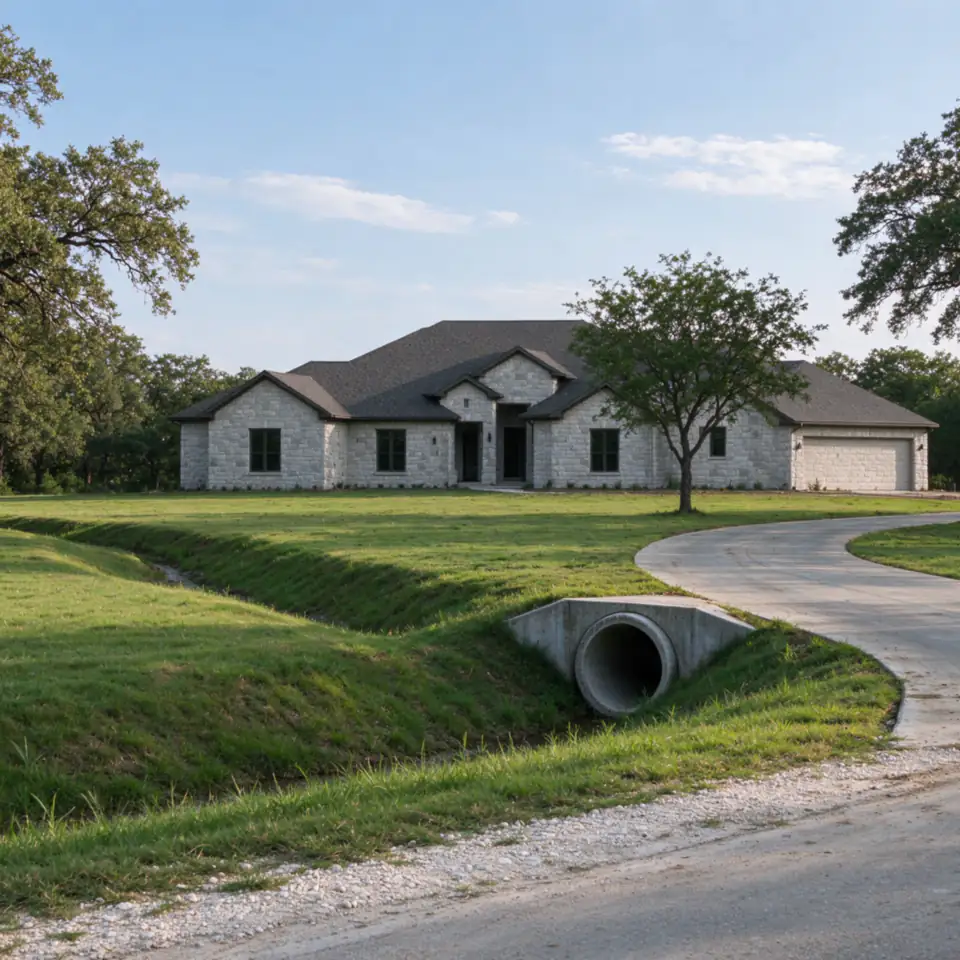
Acreage that stays wet long after the storm?
A low pasture, a back lawn that squelches for a week or a ditch that overflows at the drive can each trace back to a path broken somewhere along hundreds of feet. Clay Plano Drainage Company plans drainage for larger lots in Lucas.
The work is familiar. The distance and the permit trigger are what change here.
The permit trigger is “near”
Lucas requires a permit before any work in or near a street, right-of-way, easement or public way. That word, near, is what sets the city apart. A drain doesn’t have to cross the ditch to need a permit; ending close to it can be enough.
Here’s how it sorts out by where the route runs:
| Where the route runs | What Lucas asks | What we do |
|---|---|---|
| Well inside the lot, away from roads and easements | Confirmed for the address with the city | Check before the work is scheduled |
| Close to the road or ditch | Permit for work near a street or right-of-way | Arrange it as part of the job |
| Through a recorded easement | Permit for work in or near an easement | Read the plat and add it to the schedule |
| At a driveway culvert or approach | City culvert and approach inspection | Plan the tie-in with the city |
The written estimate shows any permit as its own line, so it’s priced before the work starts, not added after.
Easements you keep open
Lucas expects owners to keep right-of-way and easements clear. On acreage, a recorded drainage easement may carry water from several properties across yours, often as a broad grass swale.
A swale like that stops carrying water, and the low ground behind it floods, when it:
- fills in with silt and thatch over the years,
- gets fenced across with a solid bottom rail, or
- turns into a planting bed or a spot for stored materials.
Clearing and regrading the swale is often the first fix, before any pipe. That work sits inside a recorded easement, so it goes through the city permit too. We aim to regrade in dry weather, so the reshaped channel can grow grass before the next heavy rain. Our easement guide explains how to find what’s recorded on your plat.
Long runs on big lots
A wet spot far from the road is a distance problem first. The water has a long way to go, and a buried line has to keep falling the whole distance.
- Elevations first. We take levels along the route before we price it, so we know the run will drain.
- Whole-yard drainage links several wet spots into one planned system.
- Regrading moves surface water across broad slopes without hundreds of feet of pipe.
- A yard pump basin handles a low spot with no gravity outlet at all.
Cleanouts go in at every junction and bend, so a long line can be flushed end to end later.
Why not just a dry well?
On a big lot a dry well looks tempting: no long pipe, no outlet to permit. It only works if the soil takes water fast enough. We probe the soil on the first visit, and in heavy clay a dry well fills up and stays full. The guide do dry wells work in clay explains why.
Culverts and ditches at the road
Where an acreage lot releases water to a roadside ditch, that ditch usually passes under the drive through a culvert. Lucas includes culvert and approach installation in its required inspections, so the city sees that work.
A culvert silted half full or crushed by traffic holds water back up the ditch and into the yard. On the visit we look at both ends. If the culvert is the bottleneck, it needs fixing before any yard drain can help.
- Stone and spoil stay out of the ditch while we work.
- The outlet is set flush into the ditch bank, with rock where the flow is strong.
Older lines that quit
Got a buried drain that no longer works? A clog or a crushed section is often the cause.
Drain repair starts with a flush or a camera to find it, and we price the repair once we’ve seen it. The guide on how long a French drain lasts covers what wears them out.
Lucas and its neighbors
Lucas lies between Allen and the west shore of Lavon Lake, with Angel Parkway on its west side and FM 1378 running through town. The cities next door have their own rules:
- Allen lets a concrete slab reach no more than 1 foot into a side swale.
- Parker keeps one lot’s stormwater from being concentrated onto adjacent lots.
- McKinney leaves private drainage and creek banks to the owner, even inside an easement.
How we approach a Lucas property
We find where the water starts and where it’s allowed to leave, then design the shortest route that keeps its fall.
- Map the flow across the whole property, not just the wet spot.
- Pick the outlet: ditch, swale, emitters or a pump basin.
- Check the permit trigger: in or near a road, right-of-way or easement.
- Build and test: water through the system before backfill, then the ground put back and a walk along the route.
For the outlet choices in detail, read where yard drain water can go.
What helps us plan the visit
On acreage, a little context saves a lot of walking. Along with your address, send:
- The plat or survey, so we can see recorded easements and how close the road sits.
- A storm video showing where water gathers and which way it runs.
- The driveway culvert, photographed from both ends.
- Septic, pool or pond locations, so the route stays clear of them.
- Any old drain you know about, even if you’re not sure where it ends.