
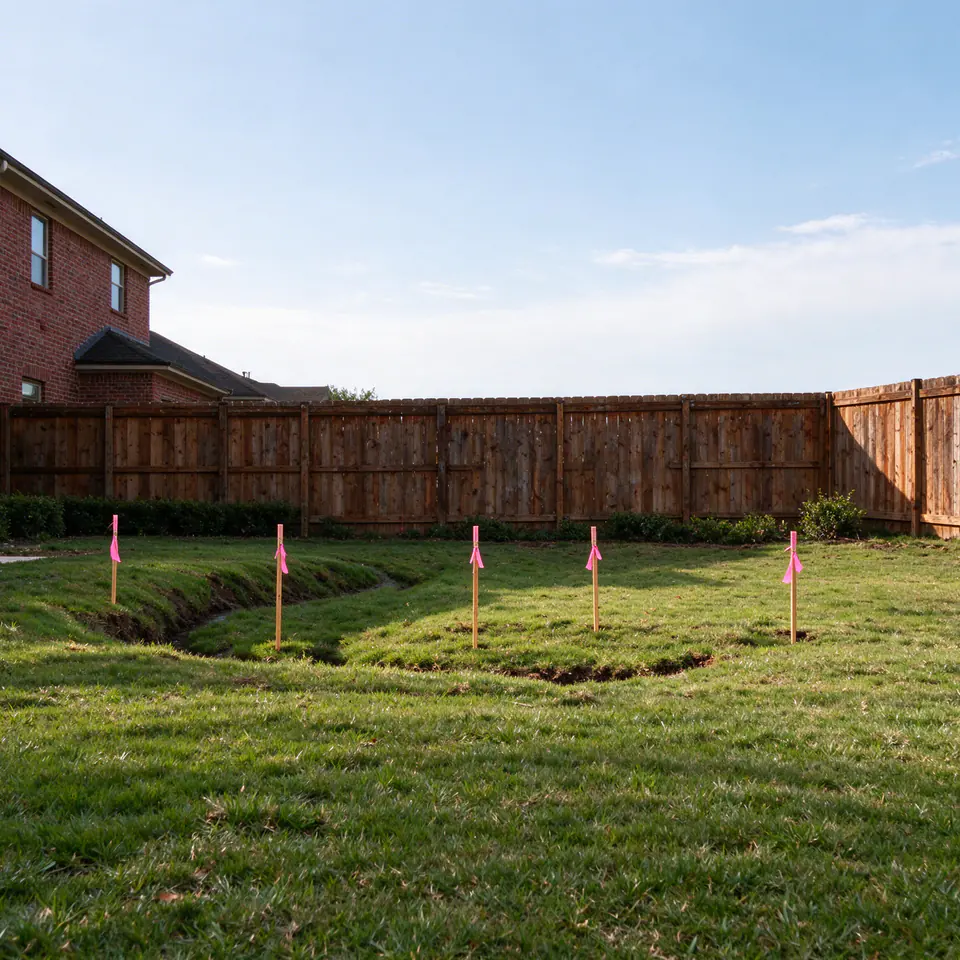
Swale behind the fence holding water?
A back-yard swale should carry water past the house and out to the street or the creek. When one stripe of grass stays soft for days, the slope has flattened somewhere.
Clay Plano Drainage Company regrades yards and builds swales, French drains and downspout lines in McKinney. Before we change anything, we measure. McKinney’s design manual sets slope minimums for yards and swales, and those numbers tell us how much fall the fix has to recover.
The slopes McKinney asks for
McKinney’s Engineering Design Manual, adopted May 5, 2026, sets out how a residential lot is graded. It reads like a checklist for a healthy yard, and it is the yardstick we use when we take levels on your lot.
| Where | McKinney’s minimum | What it means in your yard |
|---|---|---|
| First 10 feet from the house | 6 inches of fall (5% toward drains or swales where barriers are in the way) | Water leaves the slab edge before it soaks in |
| Paved surfaces within 10 feet | 1% slope away from the house | Patios and walks don’t send water back to the wall |
| Earthen swales | 2% | A grass swale keeps moving water instead of holding it |
| Side and back yards | 1% | Gentle, but enough that a puddle can’t settle |
| Paved swales | 0.6% | Concrete flumes can run flatter than grass |
| Earthen side slopes | 3 to 1 at most | Banks you can mow and that hold their shape |
The same section bars lot-to-lot drainage. Once runoff reaches the right-of-way or a drainage or floodplain easement, it may not be turned back onto private property.
Your swale, your repair
This McKinney rule is easy to miss. Section 4.1.G of the manual says private drainage facilities are maintained by the owner of the lot they sit on, or by an HOA where the plat says so.
A drainage easement doesn’t change that. The easement gives the water a right to pass; it doesn’t hand the swale to the city. If the swale behind your fence has silted in or been flattened by a new fence line, the repair falls to the lot owner. A swale repair usually involves:
- Reading the fall along the full length, not just at the wet spot.
- Reshaping the channel to the 2% the manual asks for on earthen swales, where the lot allows it.
- A side-yard drain in solid pipe where a slab or AC pad leaves no room for a swale.
- Cleanouts on any piped section, so it can be flushed later.
Our guide to drainage easements shows how to find yours on the plat.
A creek at the bottom of the yard
Lots that back onto a natural creek have a second duty. McKinney’s manual says creeks and floodplain areas are owned and maintained by the property owner, not the city.
For a drain, that changes the outlet. Water piped to a creek bank arrives fast and in one spot, and on a soft bank that can cut a gully. Where a yard line has to end near a creek, we plan:
- Where the outlet meets the bank, set back from the edge rather than poking out over it.
- How the water slows down before it leaves the pipe, with rock at the outlet where the bank needs it.
- What the overflow does in a storm bigger than the line can carry.
Work inside a floodplain is confirmed with the city for your address before any of it is planned.
The floodplain or drainage problem guide helps you tell a creek-flood issue from a yard-drainage one.
Heavy clay in McKinney yards
Soil maps show Houston Black clay in McKinney, the same heavy clay found under much of Plano. About half of it is clay, it takes in water at roughly three hundredths of an inch an hour, and it swells as it gets wet.
That has two effects in a McKinney yard. Water that reaches the lawn sits on top instead of soaking away, and clay that stays wet along one side of a slab moves differently from the dry side. The fixes follow from that:
- Downspout lines that carry roof water well clear of the slab, since the clay won’t take it quickly.
- Foundation-edge drainage where water keeps pooling against the beam.
- French drains with a larger stone zone and fabric to keep clay fines out of the pipe, explained in the guide to French drains in clay soil.
The guide to foundation moisture in clay soil goes further into why even moisture matters.
Signs the grade has slipped
A yard that drained well when the house was new can lose its fall over time. Clay settles, beds get topped up, and a fence or shed ends up across the swale. Look for these after a rain:
- A stripe of wet grass along the back or side fence that is still soft two days later.
- Mulch washed onto the walk from a bed next to the house.
- Water standing on a patio that tilts toward the back door.
- Downspouts that empty onto a bed right at the slab edge.
- A fence bottom that dams the swale, with silt piled on the uphill side.
Take a short video during the next storm. It shows us more than a dry-day photo, and with the address it is enough to plan the visit. The cost estimator gives you a first range before we come out.
From the square to the tollway
McKinney stretches across US 75 and SH 5 in the middle, with US 380 crossing east to west and SH 121 along the south. Grade, swales and creek frontage vary a lot across that spread.
Next to McKinney, the rules shift:
- Allen lets a concrete slab reach no more than 1 foot into the side swale.
- Prosper allows one curb core per lot, no wider than 3 inches, through a right-of-way permit.
- Lucas asks for a permit before work in or near a street, right-of-way or easement.
How we fix a McKinney yard
We work from the slope back to the pipe. On gentle clay slopes, a wet yard is usually a grading problem before it is a pipe problem.
- Measure before we price. Grade stakes and a level along every swale and away from the slab.
- Fix the slope where it’s broken. Yard regrading brings the fall back to the manual’s minimums.
- Pipe only what grading can’t carry. Roof water, a boxed-in side yard, a low corner with nowhere to go.
- Test with water before backfill, so a low spot shows while the trench is open.
- Put the yard back. Sod in its strips, sprinkler lines repaired, and a walk-through at the end.
A failing older line is a different job: drainage repair is priced once a camera or flush test finds the problem section.