
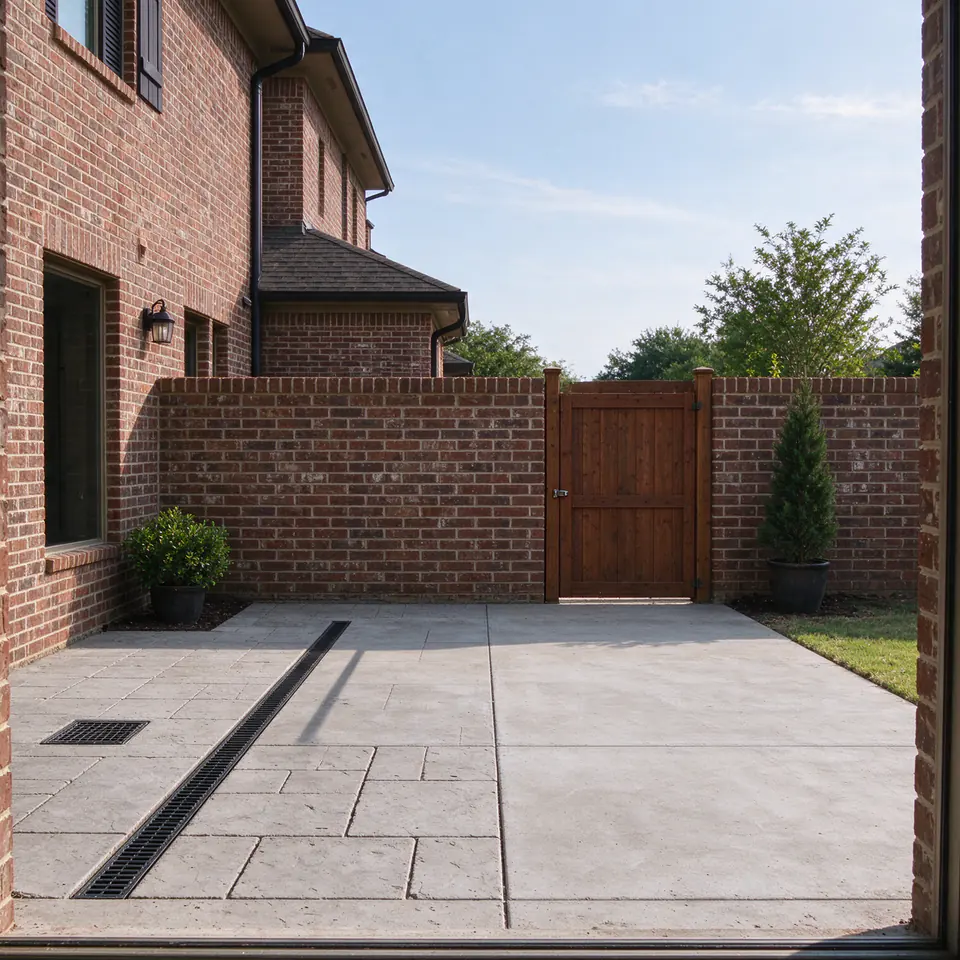
Patio or courtyard holding water?
On a lot with more paving than lawn, rain has little ground to soak into. It runs across the patio, collects at the back door or sits in a courtyard corner. Clay Plano Drainage Company installs channel drains, catch basins and downspout lines in Addison.
The job here is mostly about hard surfaces and short distances.
How much water a patio sheds
Pavement sends almost all of its rain straight to the low point. Each inch that falls on 1,000 square feet of patio or drive is roughly 620 gallons, and none of it soaks in on the way.
Storms here can deliver that quickly. At central Plano, the nearest point we size against, a storm with a 50 percent chance in any year drops about 1.8 inches in an hour. That’s why we size grates and pipe for a real downpour, not a drizzle.
Drains for paved ground
When most of the space is concrete or pavers, a French drain in a lawn isn’t usually the answer. The water is on the surface, moving fast, and it needs to be caught where it runs.
- Channel drains sit flush in the paving along a patio edge, a garage apron or a door threshold, and catch sheet flow along their whole length.
- Catch basins collect water at a single low corner and send it through solid pipe.
- Downspout lines carry roof water under the paving instead of across it.
Our guides to channel drain vs French drain and French drain vs catch basin help you see which fits your space.
Getting the pavement’s fall right
A channel drain only works if the paving slopes toward it. We measure the fall across the patio first. Where the slab tilts toward the house, the drain goes at the house edge with a sloped run to the outlet, and the estimate says so.
The Town’s right-of-way permit
Addison requires a right-of-way permit for all construction in, under or over public right-of-way. That wording is broad. A line that runs beneath a sidewalk is “under” the right-of-way and needs the permit as surely as a cut curb.
| Part of the job | What Addison asks |
|---|---|
| Drains inside your lot | Confirmed for the address with the Town |
| A line under the sidewalk or parkway | Right-of-way permit |
| A connection at the curb or a public inlet | Right-of-way permit |
| The drainage design itself | Meets Town standards in the Drainage Criteria Manual |
We arrange the permit as part of the job, and the written estimate shows the fee as its own line.
Townhomes and tight lots
Where an Addison home shares walls or sits on a narrow lot, the space between buildings can be only a few feet wide. Equipment, stone and pipe all have to come in by hand or on small machines.
That changes how we work, not what we install:
- Narrow cuts through paving, saw-cut clean so the patch lines up.
- Spoil on tarps, never on a neighbor’s side.
- Cleanouts placed where you can reach them, even in a small courtyard.
- Shared walls considered, so water from one unit isn’t sent toward the next.
No fall to any outlet?
A sunken courtyard sometimes sits lower than the street. Gravity can’t carry the water out, so a small pump basin collects it and pushes it to a legal outlet.
Water near the foundation
On a paved lot, water that pools at the house has nowhere to soak away. It sits against the slab edge, and the soil underneath stays wet while the rest dries.
We start with the roof, because downspouts often deliver the most water to one spot. Then we catch surface water before it reaches the wall. Foundation drainage and the guide to foundation moisture in clay soil explain the approach. Soil varies across the area, so we probe it on the first visit rather than assume what’s underneath.
Businesses in Addison
Addison mixes homes with offices, shops and restaurants along Belt Line Road and around Addison Airport. Commercial properties bring their own drainage problems: parking lot edges, loading areas, patios for diners.
Commercial drainage is scoped and bid per job after a site visit, because every property and its Town review are different.
Around Addison
The Dallas North Tollway, Midway Road and Belt Line Road all run through Addison. Next door, the rules differ:
- Carrollton permits French drains and their curb cuts through its Engineering Department.
- Richardson designs streets and alleys to carry and pond water up to the top of the curb in big storms.
- The Colony requires a grading permit for any grading-only project.
How an Addison job runs
We find where the water lands, where it gathers and where it may legally leave. On a small paved lot, that path is short but precise.
- Measure the fall across paving and lawn.
- Choose the collector: channel, basin or buried downspout line.
- Confirm the outlet and any right-of-way permit.
- Build, test and restore, with water run through the system before backfill and surfaces put back.
The guide to where yard drain water can go compares the outlet choices.
Before the visit
A few details make the first visit faster on a compact Addison lot:
- Photos during rain showing where water enters the patio and where it stops.
- Access: gate widths, shared walls and whether a small machine can reach the back.
- Any HOA or property manager who needs to approve exterior work, since that’s separate from the Town permit.
- Old drains or grates already in the paving, which we can test before adding new ones.