
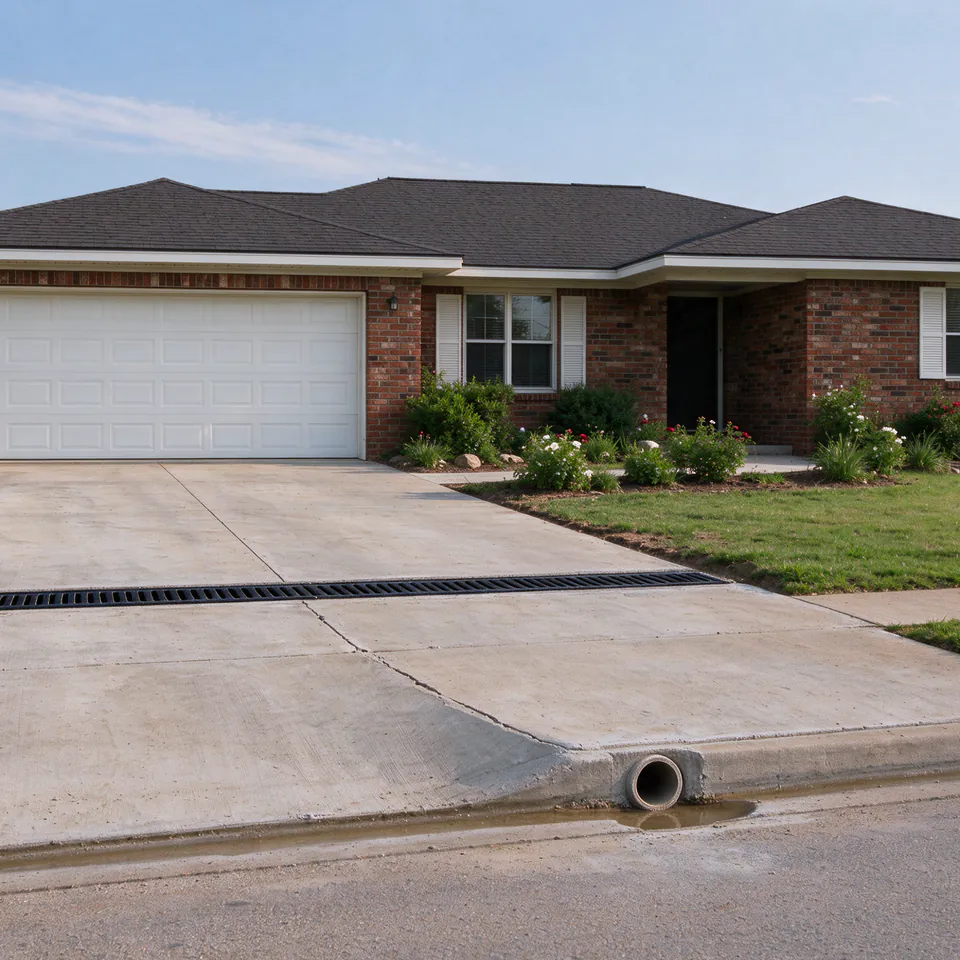
Does your drain end in a puddle?
A French drain should move water out of the yard, not relocate the puddle to the end of the pipe. If the lawn at the outlet is always soft, the drain is doing half its job.
Clay Plano Drainage Company installs and repairs French drains, channel drains and curb outlets in Carrollton. The fix nearly always starts at the outlet. In Carrollton, a drain that ends at the street, and the curb cut it needs, go through the city’s Engineering Department.
Inside the fence or out to the curb?
Should the drain end inside the fence line, or run past it so there’s no puddle where it stops? That depends on two things, the water and the soil.
A pipe that collects a downspout or two carries a modest amount of water. A line that drains a whole side yard in a big storm carries far more, all at once, to one spot.
| Outlet | Where it works | What to watch |
|---|---|---|
| Pop-up emitter inside the lot | Open lawn with fall beyond it, modest flow | Slow soil can leave a wet patch around it |
| Line to the curb | The yard falls to the street; larger flows | Carrollton Engineering permits the drain and the curb cut |
| Yard pump basin | Back yard lower than the street | A pump and its discharge line to maintain |
| Spreading outlet in a bed or gravel strip | Light roof water only | Too much water and it ponds |
We look at both on the first visit. A soil probe shows how quickly the ground takes water, and the elevations show whether the curb is reachable with steady fall. The guide to where yard drain water can go compares the outlets in more depth.
Curb cuts through Engineering
Carrollton permits French drains, and the curb cuts that let them reach the street, through its Engineering Department. That is the step that sets the schedule when your line ends at the gutter.
For you, it means the curb option has a little lead time, and the outlet has to be planned before the trench rather than added at the end. We arrange the permit as part of the job and show it as its own line on the written estimate. What we settle before applying:
- Where the line crosses the parkway, clear of meters, mailboxes and utility markings.
- The outlet elevation at the curb, so water leaves the pipe instead of standing in it.
- How the curb is restored once the outlet is in.
For a line that stays inside your lot, what applies is confirmed with the city for your address before the dig.
A curb outlet also has a limit worth knowing. When the gutter runs full in a heavy storm, water at the curb can’t leave the pipe as fast, so we keep the yard end of the line higher than the outlet and plan where any overflow goes.
Keep it out of the plumbing
Carrollton doesn’t count a French drain that isn’t connected to plumbing as plumbing work. That fits what the drain does: a yard drain carries rainwater and groundwater, and it has no business tying into the house drain or the sewer.
We keep the two systems separate. On the visit we note where the house cleanouts and sewer line run, so the drain route doesn’t cross them carelessly, and so nothing in the design connects them. If a past owner tied a yard line into plumbing, we’ll point it out and plan the drainage to stand on its own.
Driveways and roof water
On a house with gutters, much of the yard’s water starts on the roof. Gutters empty onto a driveway, a patio or a bed beside the slab, and that one spot takes the whole roof’s runoff in every storm.
Two fixes suit that kind of lot:
- Underground downspout lines that carry roof water in solid pipe to the outlet, instead of dumping it at the wall.
- A channel drain across a driveway or patio that slopes the wrong way, catching sheet flow before it reaches the garage or the door.
Which one fits is a matter of where the water lands. The channel drain vs French drain guide explains the difference: one catches water running across a hard surface, the other collects water from the ground.
When an older drain stops working
A French drain that worked for years and now holds water has usually silted up, lost its outlet or been crushed somewhere along the run. We find out before anyone digs.
- Flush test. Water run from the top shows whether it reaches the outlet and how fast.
- Camera. A camera through a cleanout shows silt, roots or a broken section.
- Then a price. Cleaning is priced per visit; a section repair is priced once the camera finds it.
The guide to how long a French drain lasts covers what wears a line out, and drainage repair explains the section fix.
Between the turnpike and I-35E
Carrollton spreads along the President George Bush Turnpike, with I-35E running north through it and SH 121 at its northern edge. The cities on its borders write their drainage rules separately:
- Addison needs a right-of-way permit for all construction in, under or over the public right-of-way.
- The Colony allows no lot-to-lot drainage unless a drainage easement exists or is dedicated through every lot the water crosses.
- Richardson designs its streets to hold water up to the top of the curb in big storms.
How we build a Carrollton drain
Every route starts at its outlet and works uphill. That order keeps the permit, the fall and the end of the pipe settled before the price.
- Outlet chosen first, inside the lot or at the curb, based on flow and soil.
- Fall measured from the wet spot to the outlet, so the pipe never holds water.
- Stone, fabric and pipe sized to the soil the probe finds; the French drain cost guide shows what moves the price.
- Cleanouts where lines join or turn.
- Water through the system before backfill, then sod and sprinkler lines put back.
Where water collects in a low corner rather than a strip, a catch basin may be the better collector, and whole-yard drainage ties several sources into one route.