
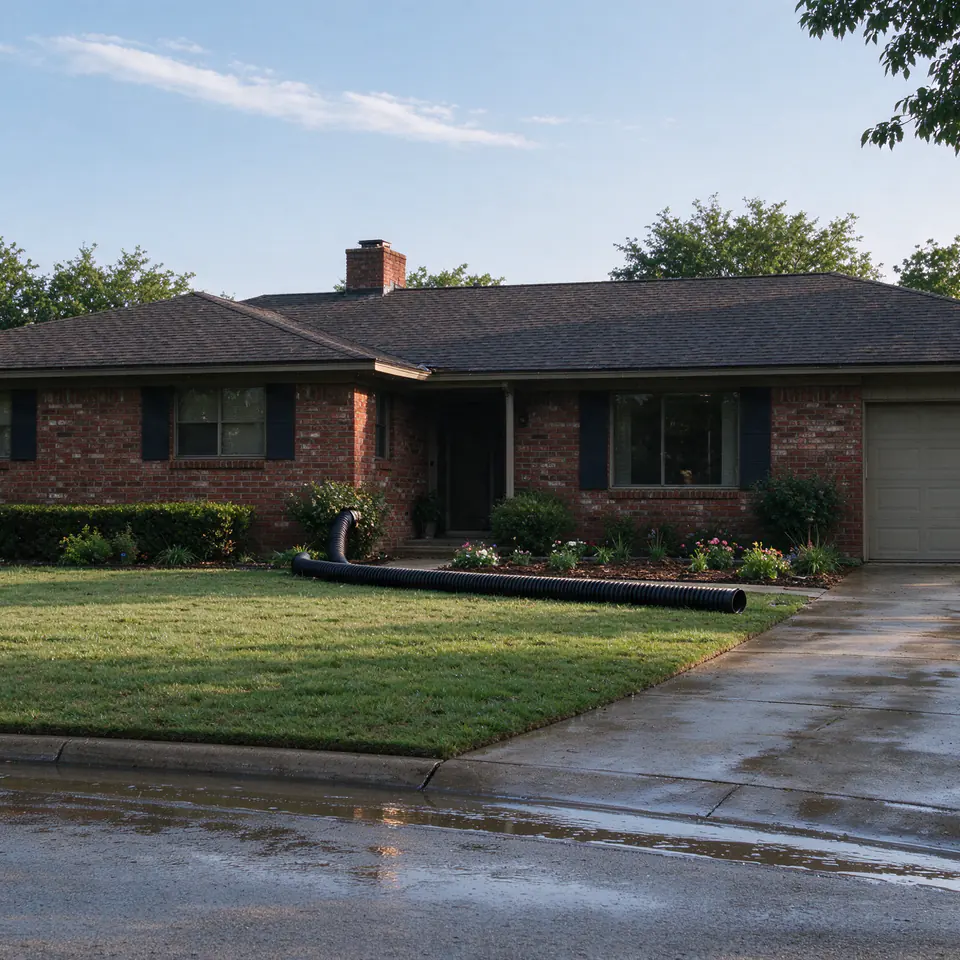
Yard drain backing up when it really pours?
You put in a drain, it handles an ordinary rain, and then a big storm comes and the yard floods anyway. In Richardson, that isn’t always the drain’s fault. Clay Plano Drainage Company builds yard drains, downspout lines and catch basins in Richardson.
The city designs its streets and alleys to fill with water in large storms. A yard drain here has to be planned around a street that sometimes can’t take any more.
How Richardson’s streets handle a big storm
Yards in Richardson drain to the street gutters, then to curb inlets, and from there through the city’s storm drains to the creeks. The city describes 362 miles of storm drain feeding 12 creek basins, Cottonwood Creek among them.
Those storm drains are sized for storms with a 10% to 20% chance of happening in a given year. When a bigger one arrives, the streets and alleys take over: they are designed to carry and pond water up to the top of the curb. That has a direct effect on your yard:
- A curb outlet can be under water while the street is full, so the yard line stops moving until the gutter drains.
- The storm system can back up while a creek flood surge passes, and the city notes yards can flood for a while.
- An alley-side yard can see the same thing from the back, since alleys carry water too.
The floodplain or drainage problem guide helps you tell a creek or street issue from one your yard can solve.
Planning a yard drain around a full gutter
A drain can’t beat a street that’s full to the curb. What it can do is keep the yard from holding water once the street drains down, and keep storm water away from the house while the gutter is busy.
On the first visit we measure your yard against the top of the curb and, where there is one, the alley. Those heights decide the plan:
| What the levels show | What it means | How we plan it |
|---|---|---|
| Yard well above the top of curb | The line drains even with a full gutter | A curb outlet or emitter near the street |
| Yard close to curb height | The outlet goes under while the street is full | Raise the collector end, add an overflow path across the lawn |
| Low back yard against an alley | Water may stand until the alley drains | Grade water to the front, or a pump basin |
| Slab close to yard grade | Storm water can reach the foundation | Basins and solid pipe to move it away from the slab first |
Where a line ends at the curb, the permit for that work is confirmed with the city for your address and arranged as part of the job.
Getting roof water away from the slab
Roof water landing at the slab is the easiest Richardson drainage problem to fix, and the city’s advice points the same way we do.
Richardson’s own stormwater guidance reads a lot like a drainage plan:
- Keep a gentle slope away from the house.
- Send gutters and pipes away from it.
- Let water cross grass or gravel before it leaves the property.
- Keep inlets and streets clear of leaves.
That last idea, slowing water across grass before it reaches the street, works on any lot with open lawn between the house and the street. Our downspout lines carry roof water in solid pipe past beds and walks to open lawn, where it spreads out and soaks in a little before it moves on.
Where a downspout sits in a corner with no lawn to reach, a catch basin collects it with the surface water around it. The French drain vs catch basin guide explains which collector suits which spot.
Heavy clay around Canyon Creek
Soil maps put Houston Black clay under the Canyon Creek area, with a higher swell potential than central Plano’s clay. In east Richardson, around Breckinridge, the maps show Austin silty clay on 2% to 5% slopes, some of it eroded.
For a house on that kind of clay, uneven moisture is the risk. Clay that stays wet along one side of the slab and dries out along another moves by different amounts:
- Move roof water first. Each downspout drops a share of the whole roof’s water at the slab edge.
- Even out the grade. Low spots beside the foundation get filled and reshaped so water leaves.
- Collect what still sits there with drainage around the slab.
The foundation moisture guide covers why consistency matters more than keeping the ground bone dry. On the sloped, eroded ground near Breckinridge, the outlet is the other concern, since fast water cuts a channel where it leaves the pipe.
When Richardson rain comes
Richardson’s weather station averages about 42 inches of rain a year, and the wettest months are May and October, at a little over 5 inches each. Spring and fall storms are when yards show their problems.
The most useful thing you can send us is a video from one of those storms: the street, the curb, the downspouts and where water stands in the yard. Then a second look a day later, once the street has drained, shows what the yard is doing on its own.
- Gone within hours: the street system, more than the yard.
- Still standing next day: a yard drainage problem we can plan a fix for, explained on the standing water page.
Next to Richardson
Richardson sits on US 75, with the President George Bush Turnpike across its north side. Its neighbors write their rules differently:
- Garland bars lot-to-lot surface drainage in single-family subdivisions.
- Addison requires a right-of-way permit for all construction in, under or over the public right-of-way.
- Carrollton permits French drains and their curb cuts through its Engineering Department.
Why we measure the curb first
In a city whose streets fill by design, the curb height is the number that matters most. We take it before we draw a route.
- Curb, alley and slab heights before anything else.
- An overflow path for the storm bigger than the pipe can carry.
- Roof water handled first, since it is the easiest source to move.
- Water run through the system before backfill.
- Sod and sprinklers put back, and a walk-through at the end.
For yards with water from several sides, whole-yard drainage ties the sources into one route, and a French drain handles a long wet strip. The guide to where yard drain water can go compares outlet options.