
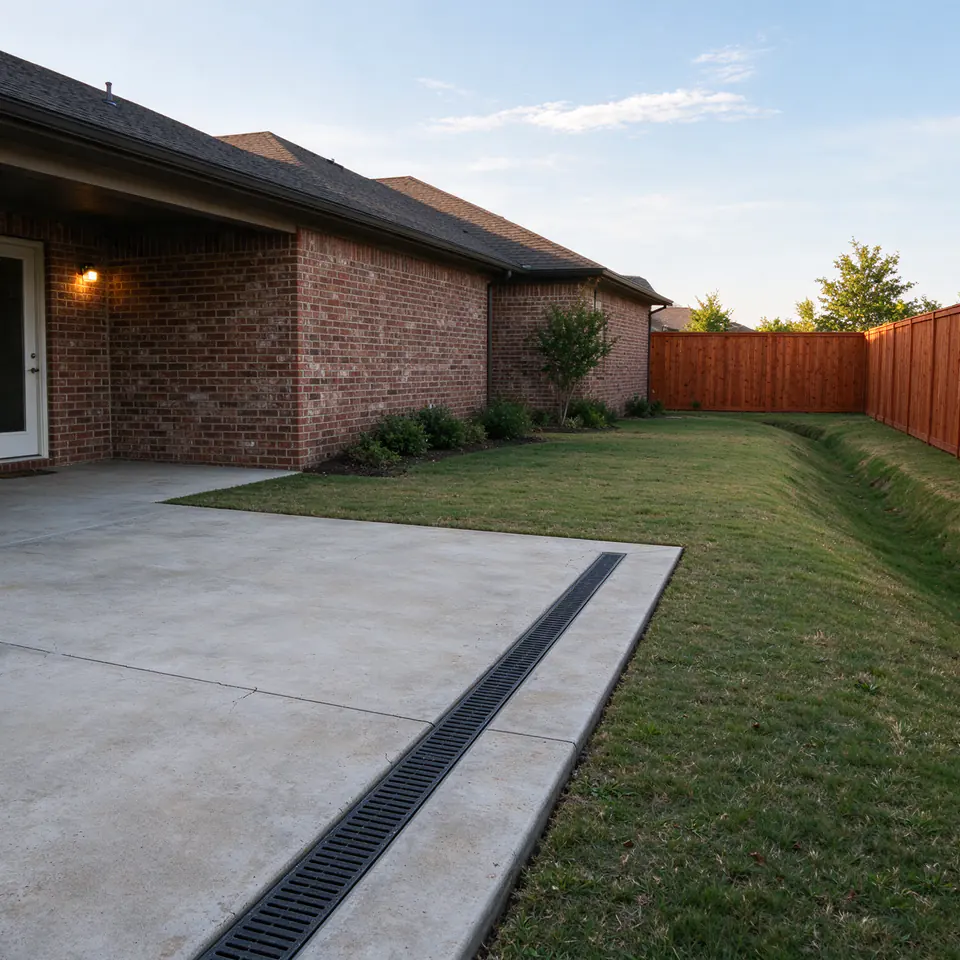
Water crossing the fence line?
It can go either way: your back yard sends water under the fence into the neighbor’s, or theirs sends it into yours. In The Colony, the city has a clear rule on that crossing.
Clay Plano Drainage Company regrades yards and builds swales, basins and channel drains in The Colony. We plan each fix around the city’s ban on lot-to-lot drainage, which only an easement can lift.
The Colony’s rule on lot-to-lot drainage
The Colony’s building inspections plan submittal checklist allows no lot-to-lot drainage unless a drainage easement already exists, or one is dedicated through every property the water would cross.
That second part is the hard one. An easement through every lot means every owner along the path agrees and records it, which rarely makes sense for one yard’s problem. In practice, the fix keeps your water on your lot until it reaches your own outlet.
| Situation | What The Colony allows | What we plan |
|---|---|---|
| Existing drainage easement across the lots | Water may follow the easement | Read the plat and keep the route inside it |
| No easement, water crossing to the next lot | Not allowed | Turn the water to your own street-side outlet |
| Easement dedicated through every lot crossed | Allowed once it’s in place | Rarely practical; we’ll say if it is |
| Grading-only project | Grading permit | Plan with flow arrows, swale or flume |
The guide to drainage easements shows how to find easements on your plat.
What a grading plan has to show
Grading on its own still needs a permit here. The Colony requires a grading permit for any grading-only project, and the plans it asks for set out how the water will move.
Three things matter on the drawing:
- Flow arrows showing the direction water runs across the lot after the work.
- The swale or flume that carries it, with its location on the lot.
- Matching grade at the property lines, so the proposed grade meets the existing grade where your lot touches the neighbors’.
That last point protects both sides. Your new slope can change a lot inside the lot, but at the fence it has to meet what is already there, so nobody’s yard gets a new wave of water or a new dam.
Fixing a yard without pushing water next door
With the edges held at existing grade, the work happens between them. The usual tools:
- A swale along the property line, shaped inside your lot to carry water to the street side. Side-yard drainage covers the method.
- Yard regrading that lifts low spots and turns the slope away from the slab and toward the swale.
- A catch basin where water gathers in a corner, piped in solid line to the outlet.
- A French drain where a long strip stays wet and the soil allows it.
Soil varies from lot to lot here. We probe on the first visit to see how fast the ground takes water, and that tells us how much the collector has to carry.
When the water is coming from next door
If runoff from the lot above lands in your yard, the same rule applies to that lot: it isn’t allowed to drain onto yours without an easement. Start with a conversation, and with the plat, before anything else.
On your side, you can still protect the house. A swale along the shared line catches what arrives and sends it to your outlet; a basin handles a low corner. Our guide to water from a neighbor’s yard covers what Texas law says about runoff between lots.
Before you talk to the neighbor
A cross-lot water problem goes better with facts on the table than with opinions over the fence. A little groundwork helps either way, whether the water is leaving your yard or arriving in it.
- The plat, to see whether a drainage easement runs along the shared line.
- A video during rain, showing where the water starts, where it crosses and where it stops.
- What changed, such as a new patio, fence, pool or bed on either lot since the houses were built.
- Where the downspouts on both houses empty, since roof water can be a large share of the flow.
If the conversation stalls, the fix on your own lot still works. A swale or basin inside your line handles what arrives without depending on anyone else.
Patios and channel drains
Hard surfaces bring water faster than lawn does. A patio or walk that slopes toward the house can deliver a full sheet of storm water at the back door.
A channel drain set across the slab catches that sheet and hands it to a buried pipe. The channel drain vs French drain guide explains which fits a hard surface and which fits wet ground.
Along SH 121
The Colony sits along SH 121, between its neighbors to the east and south. Each writes its own drainage rules:
- Frisco requires a Public Works permit for any work in city right-of-way or easements.
- Carrollton permits French drains and their curb cuts through its Engineering Department.
- Addison needs a right-of-way permit for construction in, under or over the public right-of-way.
How we work a cross-lot problem
The property line is fixed, so we plan inward from it.
- Elevations along each line before any design.
- Flow arrows drawn first, then the swale, basin or pipe that serves them.
- Grading permit arranged as part of a grading-only job.
- Water run across the new grade before the sod goes back.
The guide to fixing yard drainage problems walks through the same order.