
Lots of yard, and the water won’t leave it?
If the back acre turns to mud, or a sheet of water heads straight for your neighbor’s fence, the ground isn’t carrying rain where it should. Clay Plano Drainage Company designs and installs drainage for larger lots in Parker.
The distance is what makes Parker different. A long run has to keep falling every foot of the way, and its outlet can’t simply aim at the lot next door.
Spread the water, don’t aim it
Parker’s subdivision regulations lay lots out for positive drainage away from buildings. They also design drainage to avoid concentrating stormwater from one lot onto the lots beside it.
That second idea shapes how we finish a route on a wide property. A single pipe that dumps everything at one point near a fence line can turn a gentle sheet of water into a gully on your neighbor’s side.
- Front ditch first. Where the lot drains to a roadside ditch, that’s where the line ends.
- Spread discharge. Where the ditch is too far, a level spreader or several emitters release the water across your own lawn instead of at one spot.
- Swales kept shallow. A broad grassed swale moves water slowly and keeps it on your side of the line.
When the runoff starts on the other side of the line, our page on runoff between neighbors explains where Texas law stands.
Ditches and culverts at the road
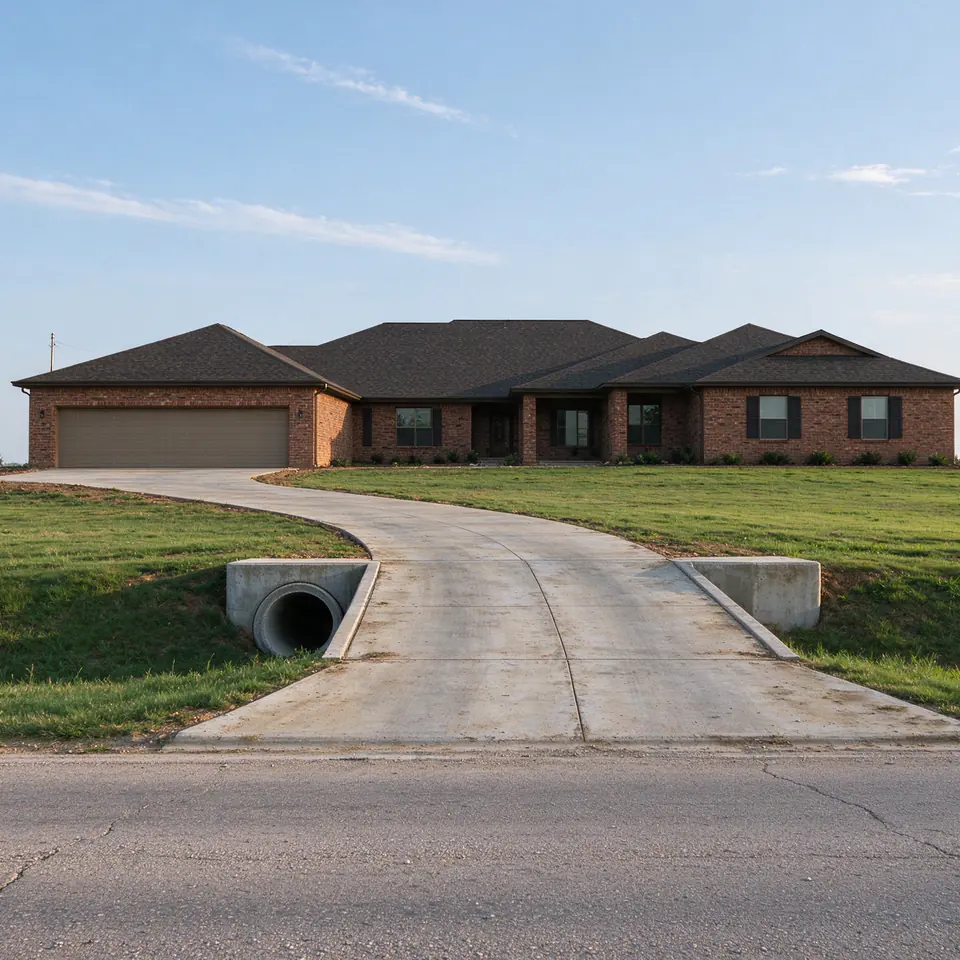
Parker’s rural ditch lots drain to open roadside ditches, with a culvert under the driveway. The city’s new-home permit spells out how those are built.
| Item | What Parker’s new-home rules say |
|---|---|
| Driveway culvert | Reinforced concrete pipe, sized by the City |
| Culvert bedding | Set on 3/4-inch rock |
| Culvert grade | Checked against the ditch monuments |
| Ditch flow | The builder is responsible for keeping it correct |
| Materials | Nothing placed in the ditches |
| Big changes | A site grading plan when major fill or drainage work is planned |
Those rules are written for new construction. For a drain on an existing yard, we confirm with the city what applies to your address. Either way, a ditch blocked by spoil or a culvert half full of silt can push water back up your drive, so we check both on the visit.
Long runs need steady fall
A French drain behind a Parker house might run a few hundred feet to reach the ditch. Over that distance, a small dip in the trench becomes a spot where water sits and clay fines settle.
We take elevations along the whole route before we price it. In the trench, the pipe is set to a measured grade, and every junction and bend gets a cleanout, which lets us flush all the way to the far end in years to come.
- Whole-yard drainage ties several wet areas into one planned route.
- Regrading reshapes broad slopes where a pipe alone would be overkill.
- A yard pump basin is the answer where the wet spot sits lower than any outlet.
Heavy clay under a wide lawn
Parker is mapped on Houston Black clay. It drains at about 0.03 inches an hour, so a storm that soaks in stays in the top layer. A large lawn doesn’t help much when the soil can’t take the water.
In this ground a drain does nearly all the work. We build the trench with a generous washed-stone zone, fabric that keeps fines out and a confirmed outlet, the layered build covered in our clay-soil drain design page.
Around the house itself
Parker’s rule about positive drainage away from buildings matches what the clay needs. A wall whose soil never dries out swells more than the rest, so we pipe downspouts out to open ground and keep the beds sloping outward.
How a Parker route comes together
We trace the water first. On a big lot it can come from the roof, a higher pasture next door, a pond overflow or the clay itself, and each one needs a different collector.
Then we design the run back from the outlet: ditch, emitters or a spreader. Before any backfill goes in, a hose test proves the whole run drains; then the turf strips return and we walk the line with you.
Neighbors with different rules
Parker sits between Murphy and Lucas, with Parker Road and FM 2551 running through it, and Southfork Ranch inside its limits.
- Murphy won’t issue its easement permit until the utility locate is complete.
- Lucas requires a permit for work in or near a street, right-of-way or easement.
- Wylie asks for curb sections removed for private work to be restored to standard and certified.
When to look, and what to send
Watch the yard during a long, steady rain, when the clay is already full. That’s when the real paths show up: the low corner, the stream toward the fence, the ditch that backs up.
Send a video of that, your address and the survey. A few other details help on a lot this size:
- Fences and gates along the route, and how wide the widest gate opens.
- Pond, pool or tank on the property, since an overflow can feed the wet area.
- Septic field location, if the home has one, so the route stays clear of it.
- Recent work by the road, such as a new drive or culvert, that changed how the ditch flows.
If you’re weighing a long run against regrading, our guide to how long a French drain lasts explains what keeps a long buried line draining and what tends to clog one early, and the outlet guide compares where the water can end up.