
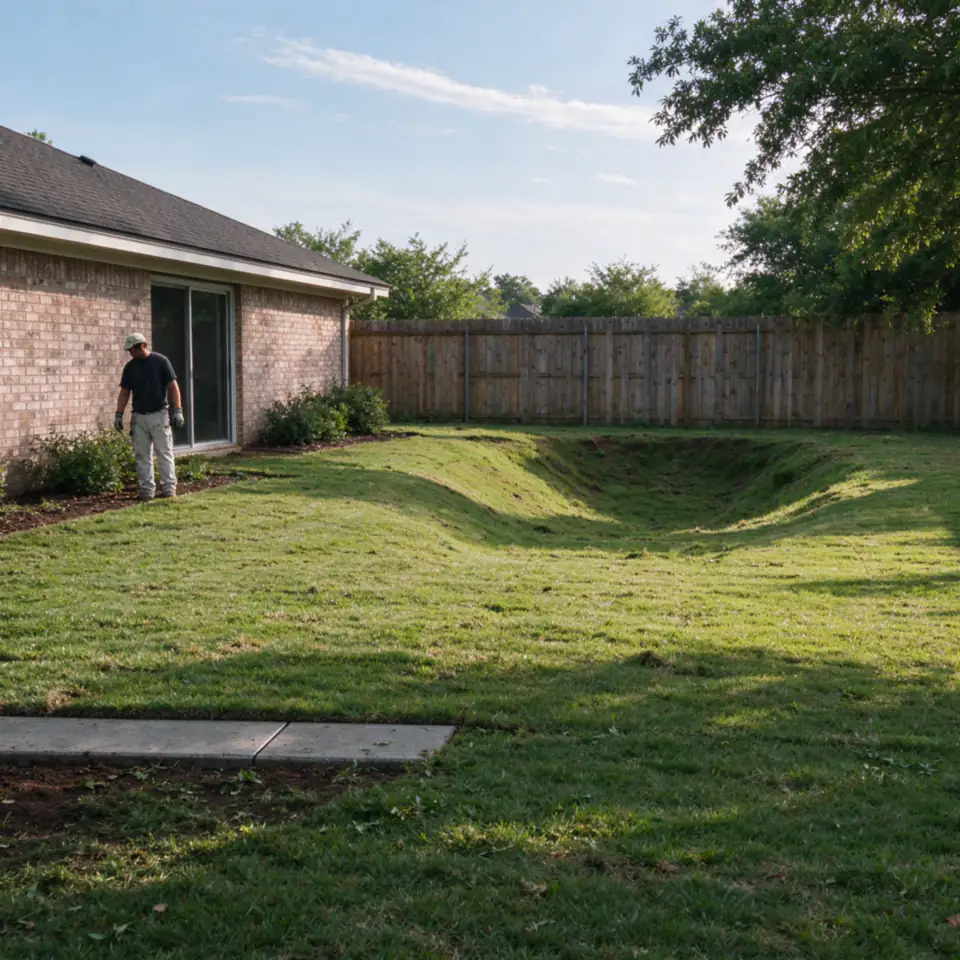
Is the yard sloping the wrong way?
Water that runs back toward the slab or sits in the lawn for days means the ground has lost its fall. Clay Plano Drainage Company regrades yards and installs drains in Sachse, from swales between houses to buried downspout lines.
In Sachse the fix often means moving soil, and the city treats that as permitted work. We plan the grading and the paperwork together, so the permit doesn’t surprise you after the price.
Grading and flatwork both go through the city
Sachse requires a permit for all flatwork and grading in residential districts, with a plot plan. The same procedure says no work may create a drainage hazard, which is the reason the city wants to see the plan first.
For a drainage job, that reaches two kinds of work you might not think of as permitted:
| Part of the job | What Sachse asks | How we handle it |
|---|---|---|
| Regrading a lawn or side yard | Grading permit with a plot plan | Draw the new slopes and flow on the plan we submit |
| A patio, walk or pad poured with the drain | Flatwork permit | Show how water passes the slab so it isn’t trapped |
| A drain that stays inside the lot | Checked with Sachse for your address | Settle it before a start date is set |
| An outlet out to the street | Right-of-way authorization | Have it approved ahead of digging in the right-of-way |
Permits are our job to arrange, not yours. The written estimate names each one and shows the city’s fee on its own line.
A slab or walk that blocks the water
Sometimes the problem starts with something solid: a patio extension, a widened walk, a pad for a shed. Water that used to sheet across the lawn now meets an edge and stops.
You have three ways out, and the yard decides which one fits:
- Reshape the ground so water flows around the slab, which is grading under the city permit.
- Add a channel drain along the slab edge where the water reaches it.
- Set a catch basin at the low point and carry the water away in solid pipe.
The plot plan has to show that the new layout doesn’t push water somewhere worse. That’s why we draw the whole flow path, not just the piece in front of the slab.
Regrading that holds its slope
Yard regrading sounds simple: add soil, rake it smooth. Done that way, it settles back flat within a season or two and water returns to the slab.
We cut and fill to a measured fall away from the house, compact in layers and tie the new grade to a swale or drain that carries the water off. On the first visit we probe the soil, because a slow-draining clay and a sandier loam need a different finish and a different amount of fall.
When grading alone won’t do
Some Sachse lots don’t have the room. A narrow side yard, an AC pad or a neighbor’s fence can leave too little ground to slope. Then a French drain or a basin picks up what the grade can’t move.
Where the water is allowed to go
Every route needs an exit, and in Sachse that usually means the front of the lot. Texas sets the outer limit: under Water Code section 11.086 you can’t reroute or hold back natural runoff so that it harms the property next to you.
We plan outlets toward the front:
- An emitter in the front lawn that lifts open under flow, where there’s room for water to spread.
- Pipe carried out to the street, which puts us in city right-of-way and needs the city’s authorization first.
We compare the exits in our outlet guide, and if the trouble begins over the fence, read runoff between neighbors.
Next door, the rules shift
Sachse lies along State Highway 78 with the President George Bush Turnpike crossing its south side, and its neighbors write their own rules.
- Murphy adds a utility permit when drainage work touches a curb or driveway approach.
- Wylie asks for a curb cut certification when a curb section is removed for private work.
- Garland prohibits lot-to-lot surface drainage across property lines in single-family subdivisions.
What we do on a Sachse yard
We work out the slope before we pick a product. When the job moves soil or pours concrete, the permit and the plot plan come from that same plan.
- Fall first. We measure from the wet spot to the outlet and set the grade that carries it.
- Roof water separated. Downspout lines handle the roof so the yard drain only sees ground water.
- Cleanouts go in where lines join or turn, so a flush can reach the whole run later.
- Tested open. Water runs through the system before backfill, and low spots get fixed while we can still see them.
At the end the sod strips go back down, any sprinkler line we cut is fixed and you get a walk along the finished route.
Before you call
A short video during a storm shows us more than a description can: which downspouts overflow, which way the sheet of water travels and the spot where it pools. Send that with your address.
- Your survey or plot plan, if you have one from the purchase, saves time on the city’s plot plan.
- Any planned patio or walk. Tell us now, so the drain and the slab are designed and permitted as one job.
- Wet spots that never dry. Water that shows up without rain can be a leak or a sprinkler zone, which we look for before we price a drain.
Want a ballpark first? Our cost estimator gives a range in a minute or two. The site visit and written estimate set the actual price.