
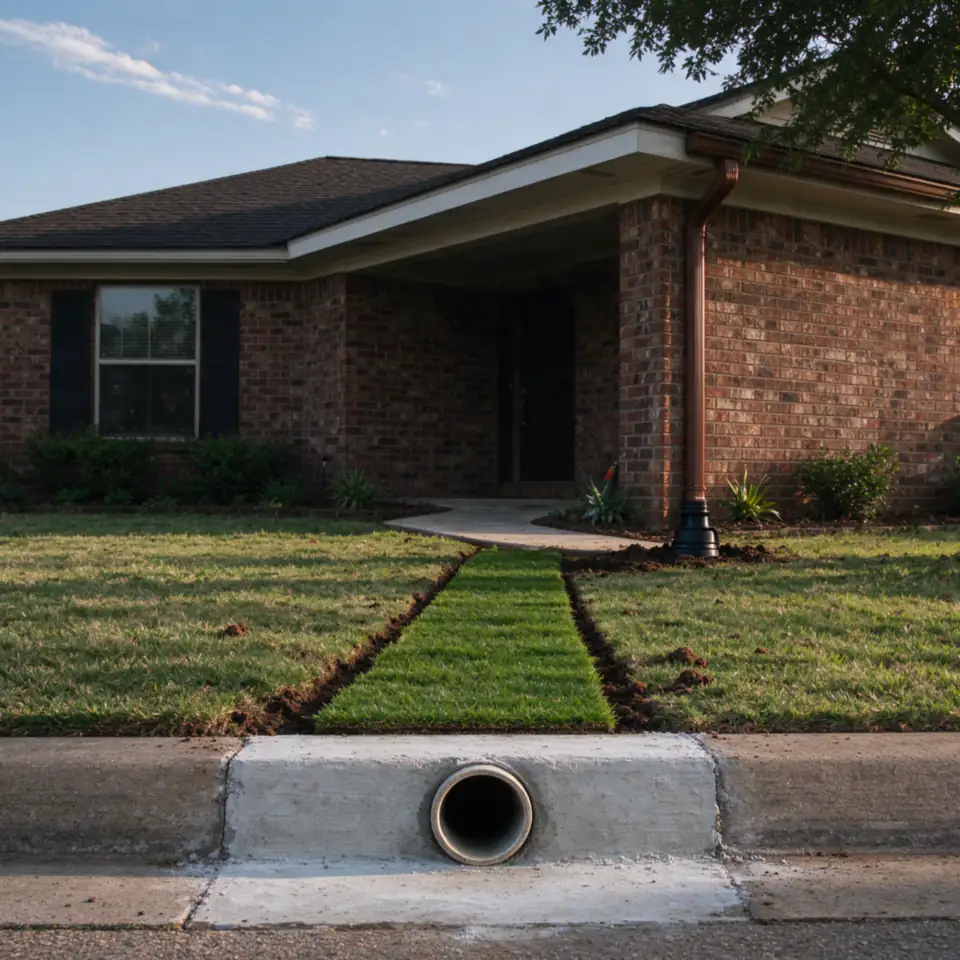
Want the water to leave at the curb?
When a Wylie yard falls toward the street, the cleanest place for drain water to go is the gutter. The pipe runs under the lawn, through the parkway and out a small opening in the curb.
Clay Plano Drainage Company builds French drains, downspout lines and curb outlets in Wylie. That last step is city work: Wylie handles it through a right-of-way permit and a curb cut certification.
What Wylie asks for at the curb
The parkway and curb belong to the city’s right-of-way, so a pipe that ends at the gutter is right-of-way construction. Wylie takes those permits through an online portal, and the registration that comes with it is good for one year.
The curb itself has its own step:
| Step | What Wylie asks | What it means for your job |
|---|---|---|
| Before work in the parkway | Right-of-way construction permit through the portal | Applied for once the route and outlet are set |
| Removing a curb or street section | Restored to the city’s standard | The curb goes back to match, not patched |
| After the restoration | Recorded with the permit (curb cut certification) | The record stays with the permit |
| At the end | Final right-of-way inspection by Public Works | The job closes when the city has looked |
We arrange the permit as part of the job and plan the curb restoration from the start, so it isn’t an afterthought once the pipe is in.
Curb outlet or lawn emitter?
Not every Wylie drain needs the curb. A pop-up emitter in open lawn on the street side of the lot can release water without touching the right-of-way, and for a single downspout it can be enough.
The trade-off comes down to flow and soil. On heavy clay, an emitter handling a whole side yard or several downspouts can leave a soggy patch around it, because the ground won’t take the water as fast as it arrives. In that case the curb is the surer exit.
- One or two downspouts, open lawn: an emitter usually works.
- A side yard or a low corner: a curb outlet through the permit.
- No fall to the street: a basin and a pump, or regrading.
The guide to where yard drain water can go sets these out side by side.
Wylie’s heavy clay
Soil maps show Houston Black clay in Wylie. It is about half clay, it takes in water at only a few hundredths of an inch an hour, and it swells as it wets.
That shapes a drain in two ways. Water collects on the surface rather than soaking in, so the collector has to be generous. And the clay’s fines will work into stone and fabric over time if the trench isn’t built for it. A French drain here gets:
- A wider stone envelope around the pipe, so the trench can hold a storm’s water while the pipe empties it.
- Fabric between the stone and the clay, to slow the fines.
- Cleanouts where lines join or turn, so the line can be flushed instead of dug up.
The guide to French drains in clay soil covers the build, and how long a French drain lasts explains what wears one out.
Roof water first
On clay, roof water landing at the slab is the first thing to move. Gutters concentrate a whole roof’s rain into a few spots, and clay at the foundation edge that stays wet while the rest dries moves unevenly.
Underground downspout lines carry that water in solid pipe to the emitter or the curb. Where water still stands by the beam after that, foundation drainage collects it, and a catch basin handles a low corner. The downspout drainage cost guide shows what moves the price.
What we check in the parkway
Before a Wylie curb outlet goes on the permit application, we walk the strip between the sidewalk and the street. The outlet has to satisfy the city and still sit well in the lawn for years.
- Meters, boxes and markers for water, gas and communications, kept clear of the pipe.
- Mailboxes, driveways and trees, so the trench avoids roots and concrete.
- The gutter’s fall, so water leaving the outlet runs downstream rather than standing at the curb face.
- Sprinkler heads and lines in the parkway, noted so they go back where they were.
Texas811 locates come before any digging, and we paint the route in white so you can see exactly where it runs.
Along SH 78 and the lake
Wylie spreads along SH 78, with Lavon Lake to its north and east. Living near the lake doesn’t change the outlet plan for a yard drain: water still leaves toward the street side of the lot, the way the lots were graded.
The towns around Wylie each run their own permits:
- Sachse requires a permit with a plot plan for residential flatwork and grading.
- Murphy adds a utility permit when flatwork touches the driveway approach, curbs or drainage.
- Lavon sets 18-inch Class III concrete pipe as the minimum for driveway culverts.
How we build a Wylie drain
The order matters on a curb job, because the permit and the curb are fixed points the rest of the route has to reach.
- Outlet settled first, emitter or curb, before the route is drawn.
- Fall measured from each wet spot to that outlet.
- Sod cut in strips, soil on tarps and silt controls in place.
- Water run through before backfill, so a low spot shows while the trench is open.
- Curb restored to standard and recorded with the permit, then Public Works’ final inspection.
For a yard with water coming from several directions, whole-yard drainage ties every source into one route.