
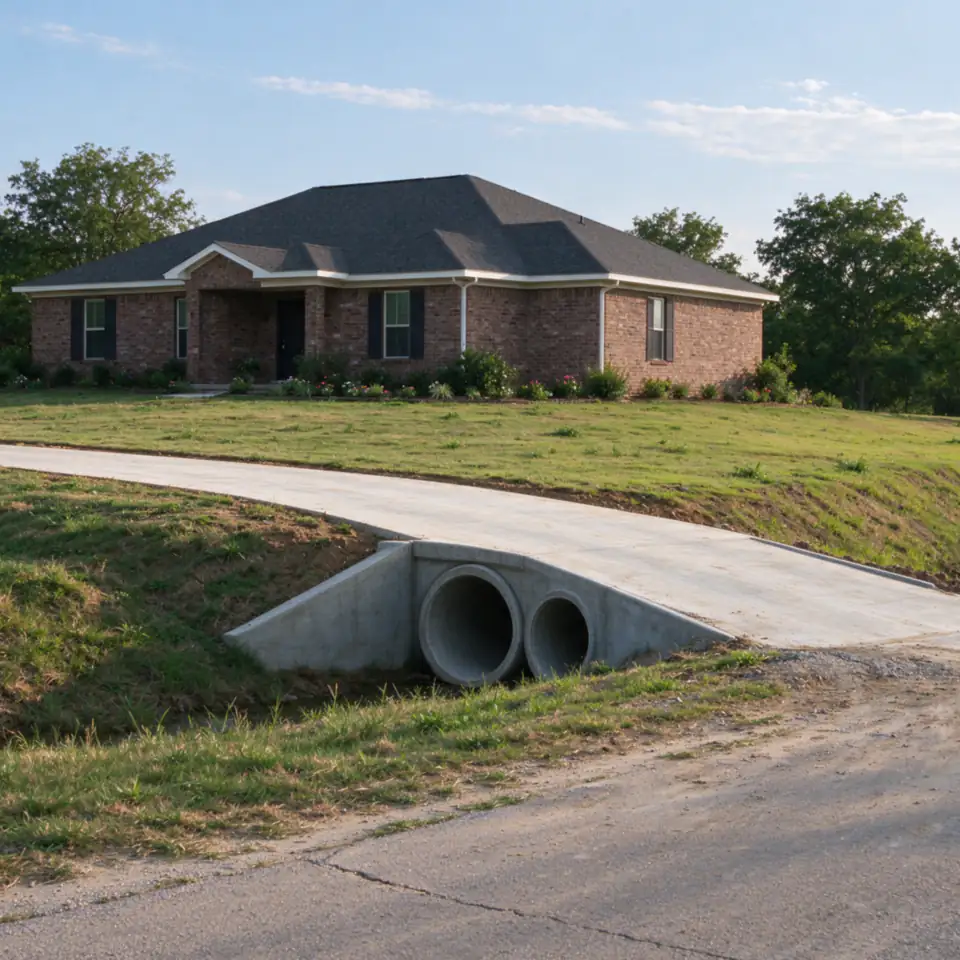
Front yard draining to a ditch, but not fast enough?
If your Lavon home has an open ditch out front instead of a curb, the yard is meant to drain into it. When water sits in the lawn first, or the ditch stays full, the path to the road has broken somewhere.
Clay Plano Drainage Company installs French drains, downspout lines and regrading in Lavon, built to finish at the ditch without damaging it.
The ditch belongs to the right-of-way
A roadside ditch looks like part of your lawn, but it usually lies in city right-of-way. A drain outlet into it is work Lavon covers with a Right of Way Activity Permit: $100, or $50 under a superseding agreement.
We arrange that permit as part of the job. Here’s how the pieces of a typical Lavon job line up:
| Part of the job | Where it sits | What it needs |
|---|---|---|
| French drain or swale in the yard | Your lot | Confirmed for the address with the city |
| Outlet into the roadside ditch | City right-of-way | Right of Way Activity Permit |
| Reshaping the ditch bank at the outlet | City right-of-way | Kept within the 3:1 side slope limit |
| Driveway culvert | City right-of-way | At least 18-inch Class III RCP with safety ends |
The permit fee shows on the written estimate as its own line, apart from our price.
A bank that keeps its shape
Lavon’s standard details limit open ditch side slopes to 3:1, three feet across for every foot down. A gentle bank like that holds grass, resists washing out and lets a mower cross it.
A drain outlet can spoil that if it’s done carelessly. Pipe that sticks out of the bank sprays water at the far side and cuts a notch; a trench backfilled loose settles into a groove.
- Flush outlet. We set the pipe end into the bank so water drops gently into the flow line.
- Rock or turf at the outlet, depending on how much water the line carries, so the bank doesn’t scour.
- Grade restored to the existing slope, never steeper than the 3:1 the city allows.
- Nothing left in the ditch. Spoil goes on tarps and washed stone stays out of the flow line.
When the culvert is the bottleneck
Sometimes the yard is fine and the ditch is the problem. A driveway culvert that’s crushed, silted half full or set too high holds water upstream, and that water backs into the low side of your lot.
Lavon’s standard details set a minimum of 18-inch Class III reinforced concrete pipe for driveway culverts, with safety end treatments. On the visit we look at both ends of yours. If it’s the cause, a yard drain won’t fix it, and the culvert becomes a conversation with the city before anything else is designed.
Building the yard side
Once the outlet is settled, the yard work is familiar. A French drain picks up a wet strip; downspout lines carry roof water past the lawn instead of across it; regrading restores a slope that has settled flat.
Soil we test before we trust
We probe the soil on the first visit rather than assume it. Heavy clay that drains slowly needs a bigger stone zone around the pipe and a sure outlet; looser soil can take a simpler trench. The estimate is written to what the probe finds.
Water with no rain
A yard that’s wet on dry days may have a leak or a sprinkler zone behind it. Our guide to a soggy yard with no rain covers what to check first.
Rules on Lavon’s borders
Lavon sits where State Highway 78 meets State Highway 205, a short drive from the south end of Lavon Lake. Its neighbors treat drainage their own way:
- Wylie asks for a curb cut certification when a curb section is removed for private work.
- Parker sizes the culverts on new-home ditch lots itself and keeps materials out of its ditches.
- Rockwall requires a grading plan by a Texas engineer for new homes.
How we work a ditch-front yard
We start at the ditch and work back toward the house. If the outlet can’t take water, nothing upstream matters.
- Outlet checked: ditch flow line, culvert ends and the bank where the line will exit.
- Source found: roof, a higher lot, soggy soil or something else.
- Fall measured from the wettest spot to the ditch.
- System tested with water before backfill, then the lawn and any sprinklers are put back.
For the full sequence, read what happens during a drainage installation. If you’d like a first figure, try the cost estimator.
What to send us
Photos of the ditch during or right after rain are the most helpful thing a Lavon homeowner can share: is it flowing, holding or overflowing? Add a shot of each end of the driveway culvert and your address.
If you’re not sure where to start, the step-by-step guide to fixing yard drainage walks through the order we use.
Timing a look at the yard
Spring and fall bring the heaviest rain to this part of North Texas; on the Plano record, May and October each average about 5 inches. A steady soaking in one of those months fills the soil and the ditch at once, which is when a weak spot shows.
- During the storm: note where water leaves the downspouts and which way it crosses the lawn.
- The next morning: check whether the ditch has drained down and whether the lawn still squelches.
- Two days later: a patch that’s still wet is the one we want to see on the visit.