
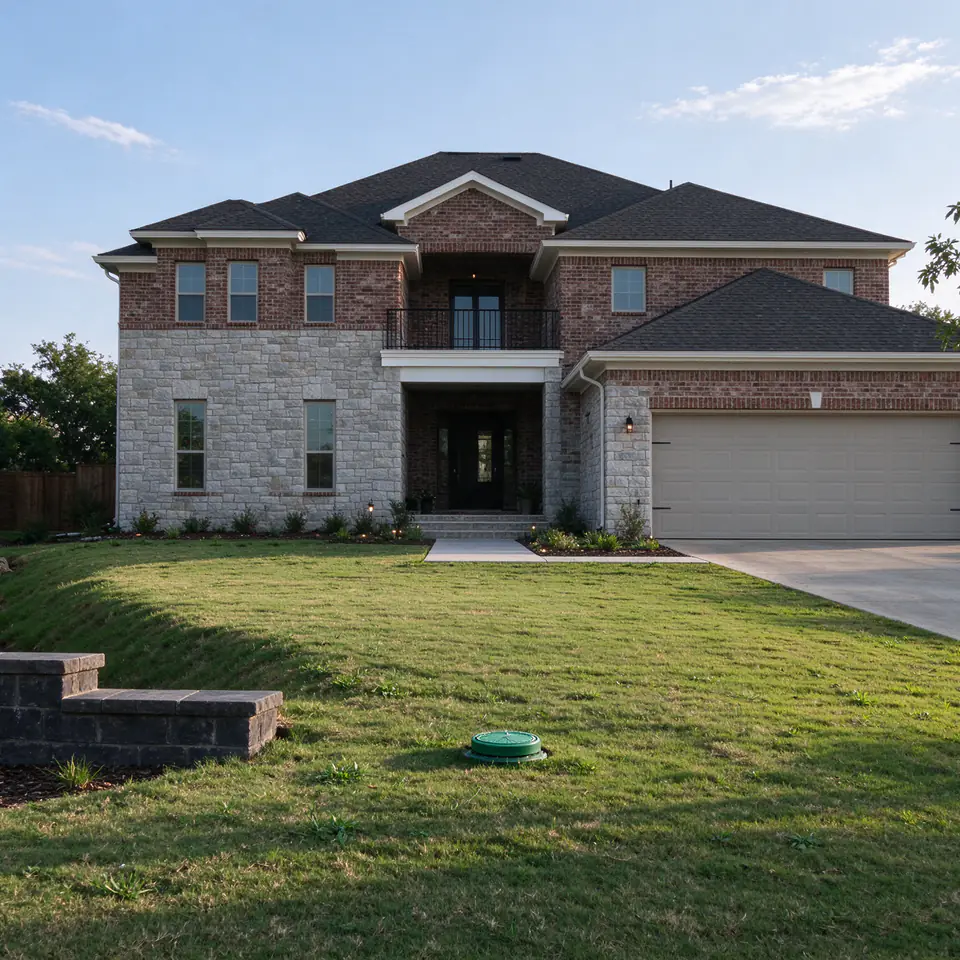
Newer Rockwall yard that’s stopped draining?
A new house usually drains well at first. A few years on, the back yard holds water, the beds by the slab stay wet, and nobody is sure what changed.
Clay Plano Drainage Company regrades yards and builds French drains, catch basins and downspout lines in Rockwall. On a newer house, we start with the plan the lot was built to, because Rockwall asks for one.
The grading plan your lot was built to
Rockwall asks for residential new construction to come with a grading plan prepared by a Texas professional engineer. That drawing shows how the lot was meant to shed water: the high points, the swales and where water leaves.
For a drainage fix, it is the most useful document you can find. It tells us the slope the yard was designed to have, so we can measure how far it has drifted rather than guessing. Where to look for it:
- Your closing papers or the builder’s handover package.
- The builder, who may have kept the lot’s plan.
- The city’s records for the address.
If it can’t be found, we work from elevations taken on the visit.
Older lots without a plan
Houses built before the grading plan rule, or lots whose plan has been lost, still drained to some design. We find it on the ground: the high point of the lot, the swales along the sides, and the spot where water was meant to reach the street.
Elevations from the slab to each of those points show where the fall has gone missing, and that becomes the plan we build back to.
How a designed grade drifts
A lot graded to plan doesn’t stay that way on its own. Over a few seasons, small changes add up until water no longer follows the design:
- Settling where soil was filled during construction, leaving low spots near the slab or along utility trenches.
- Beds and borders that raise the ground against the house.
- A fence, shed or patio placed across the swale the plan relied on.
- Downspouts that empty where the plan never expected so much water.
The fix is usually to restore the designed slope with yard regrading, then move roof water with downspout lines so it doesn’t undo the work.
No lot-to-lot drainage, sheet flow at the line
Rockwall’s plat reviews state the rule plainly: no lot-to-lot drainage. Water leaves a lot as sheet flow at the property line, or through an easement on the neighbor’s lot.
Sheet flow is water spread thin across the ground, the way rain leaves a gently sloped lawn. A pipe or a deep swale aimed at the fence does the opposite, gathering water into one stream and dropping it on one spot of the next yard. For your drain, that means:
- No pipe ending at the back fence, however short the run would be.
- Collected water goes to your street side, through an emitter, a curb line or a basin.
- The ground at the line stays as designed, so the neighbor sees the same thin flow the plan intended.
The guide to water from a neighbor’s yard covers runoff between lots under Texas law.
Roof water comes first
The roof gathers rain from a wide area and drops it at a handful of downspouts. Where those downspouts empty into beds against the foundation, the slab edge takes the whole roof’s runoff.
Moving that water is the cheapest step and the one that protects the rest of the work:
- Solid pipe from each downspout, buried under the lawn, to an emitter or outlet on the street side.
- Cleanouts where lines join or turn, so leaves can be flushed out later.
- Splash areas closed off, so beds by the slab stop taking the full roof’s runoff.
With roof water handled, a regrade or basin only has to carry what falls on the yard itself.
Basins, French drains and wet corners
Where water gathers in one corner, a catch basin collects it and solid pipe carries it away. Where a long strip stays wet, a French drain can collect water along its length. The French drain vs catch basin guide explains which suits which spot.
We probe the soil on the first visit rather than assume it, since the ground’s speed at taking water decides how much stone and pipe the collector needs. A patch that stays wet in dry weather may be a leak, not runoff; the soggy yard guide shows how to tell.
Around the lake and I-30
Rockwall sits on the east shore of Lake Ray Hubbard, with I-30 crossing it and SH 205, SH 66 and SH 276 running through. Its neighbors write their own rules:
- Heath treats lot-to-lot drainage between two or fewer lots as a private matter.
- Rowlett requires a grading permit when dirt is added, removed or moved on a lot.
- Lavon charges for a right-of-way activity permit and sets a minimum size for driveway culverts.
How we work a Rockwall yard
We build back toward the design the lot was given, not around it.
- Plan first. The lot’s grading plan, or our elevations where there isn’t one.
- Source before collector. Roof water, sprinklers and the lot above each need a different fix.
- Outlet on your side, never a pipe at the fence.
- Water run through before backfill and across the new grade.
- Sod and sprinklers back, and a walk around the finished yard with you.
The guide to fixing yard drainage problems sets out the same order, and whole-yard drainage covers lots with water arriving from several directions.